Wi Sunglac: "Considering Expanding the Cheonghae Unit in Hormuz" ... "Proposed Military Talks With North Korea Several Times"
Protecting South Korean Merchant Ships in the Strait of Hormuz
Strengthening Capabilities to Secure Oil Transport Routes
Firm Response to North Korean Troops’ Incursions Across the MDL
First Upgrade in South Korea-Germany Ties Since Diplomatic Relations Were Established
Cheong Wa Dae said it is considering ways to strengthen the capabilities of the Cheonghae Unit and expand its area of operations to protect South Korean merchant ships in the Strait of Hormuz and secure oil transport routes. Regarding the North Korean land mine explosion last month in the Demilitarized Zone (DMZ), it said it had destroyed and removed the North Korean minefield at the site of the incident and pursued diplomatic measures, including sending a letter to the United Nations Security Council. It also said it had proposed several military talks to resolve differences between the two Koreas over the location of the Military Demarcation Line (MDL).

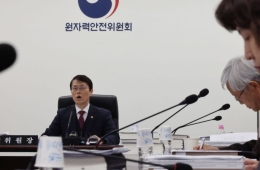
Wi Sung-lac, director of the National Security Office, answers questions from committee members during a parliamentary audit of the Presidential Secretariat, National Security Office and Presidential Security Service at the National Assembly Steering Committee on Oct. 29, 2026. Yonhap News.
View original imageNational Security Adviser Wi Sunglac said at a press briefing at Cheong Wa Dae's Chunchugwan press center on the 30th that, regarding the restoration of freedom of navigation in the Strait of Hormuz, "We are carefully considering measures such as strengthening and expanding the Cheonghae Unit, but our review has not yet been finalized." Wi emphasized the principle that "under no circumstances will we become involved or participate in a war," adding, "We will maintain our policy of carrying out the minimum activities and making international contributions necessary to protect our merchant ships, secure oil transport, and safeguard the lives and safety of our people."
He also noted that major countries, including the United Kingdom, France and Japan, have deployed warships and patrol aircraft to the Middle East and the Horn of Africa, and have sent additional forces since the Strait of Hormuz crisis began. Wi said, "Once specific measures have been drawn up, we will explain them to the public and the National Assembly transparently and clearly." His remarks were understood to mean that South Korea would seek a limited role that takes energy security and international responsibilities into account while keeping its distance from military clashes.
Wi emphasized the principle of a firm response to the incident last month in which South Korean troops were seriously injured by a North Korean land mine south of the Military Demarcation Line (MDL) on the western front.
Wi explained, "A joint investigation with the United Nations Command confirmed that North Korea's installation of the mines violated the Armistice Agreement, and we demanded an apology and responsible action from North Korea. We destroyed and removed the North Korean minefield at the site of the incident."
Wi also said South Korea was responding firmly to North Korean troops' incursions across the MDL in accordance with operational guidelines. However, he said South Korea had proposed military talks several times to resolve differences between the two Koreas over the MDL, which he identified as a fundamental cause of tensions in the border region. He reaffirmed the policy toward North Korea of building "peace in which there is no need to fight."
He said follow-up discussions between South Korea and the United States on the transfer of wartime operational control were gaining momentum. Wi said, "We completed the capability assessment to verify Full Operational Capability (FOC) during this year's South Korea-U.S. combined exercise," adding that U.S. Secretary of Defense Pete Hegseth reaffirmed the United States' commitment to the transfer of wartime operational control at a meeting of the South Korean and U.S. defense chiefs on October 28. The two defense chiefs are scheduled to meet again in Washington this December and hold the South Korea-U.S. Security Consultative Meeting (SCM) early next year. Wi said he expects these meetings to produce tangible progress toward the transfer.
On the diplomatic dispute with Ukraine, Wi acknowledged that trust between the two countries had been damaged over the violation of a confidential agreement concerning the repatriation of North Korean prisoners of war, while saying that South Korea would maintain its existing policy of supporting Ukraine. Wi said the decisions to recall the South Korean ambassador to Ukraine and withdraw some embassy staff had been made with local safety concerns and other factors in mind. He stressed that, although trust between South Korea and Ukraine had been damaged, South Korea would maintain its principled position in its bilateral relations while addressing it separately from the international community's support for Ukraine. South Korea will also continue to implement sanctions against Russia and export controls without change.
Earlier, on the 29th, President Lee Jae-myung held a summit with German Chancellor Friedrich Merz at Cheong Wa Dae and elevated bilateral ties to an "Enhanced Strategic Partnership" for the first time since the two countries established diplomatic relations in 1883. The two countries also adopted a joint statement outlining expanded cooperation in areas ranging from politics and security to advanced industries, culture and people-to-people exchanges.
The summit shifted the focus of economic cooperation. The two countries agreed to expand cooperation beyond existing trade and investment to future industries such as semiconductors, batteries and artificial intelligence (AI), as well as critical mineral supply chains. The two leaders agreed to expand cooperation in renewable energy and power grids and also signed a protocol amending the convention for the avoidance of double taxation. At a joint press announcement, President Lee said, "Bilateral cooperation, which has centered on trade and investment, will expand to include industry and advanced technology." He also asked Germany to help ensure that South Korean companies receive treatment equal to that of companies within the European Union (EU) as the EU advances its Industrial Acceleration Act.
Hot Picks Today
 "Two Spend 500,000 Won in a Flash, Yet Wait Two Hours?" ... 'Dreamland' Shunned by Kids and Foreign Tourists
- The Era of Getting 200 Million Won After 30 Years Is Over... A Japanese Bank's "Perpetual Department Head" Who Just Clocked In Cries Out
- Spain Hit by Its Worst Tragedy... Lee Kangin, Moreno and Real Madrid Join Soccer World in Mourning
- They Said, “Make It Your Home for Life” - Then Suddenly Kicked 200 Passengers Off... What Happened to the Around-the-World Cruise?
- "130 Rice Bowls Sold Out in a Day"... 'Unfiltered Face' Adds 8 Million Won to Night Market Sales: China's Bungeunwoo
In security, the two countries agreed to pursue the prompt conclusion of a military intelligence protection agreement, as well as joint development and joint investment between defense companies. Germany's support for establishing a peace regime on the Korean Peninsula was also reaffirmed. At an official dinner held at Cheong Wa Dae's State Guest House, President Lee said, "If German precision and Korean dynamism join forces, we can create boundless synergies through our cooperation." Chancellor Merz said, "Our two countries share the painful experience of division," adding, "I hope that one day we will also be able to share the history of reunification."
© The Asia Business Daily. All rights reserved. Unauthorized AI training and use prohibited.