Earnings Swing with Assumptions: 'Rubber-Band Accounting'... "Insurers Need Dual Actuarial Assumptions"
Korea Insurance Research Institute Seminar on IFRS Disclosures and Actuarial Assumptions
Proposal by Kim Ho Gyun, Samjong KPMG Executive Director and Former Financial Supervisory Service Official
General-Purpose Accounting Follows Supervisory Accounting, Distorting Corporate Values
A proposal has been made to separate the actuarial assumption bases used in general-purpose accounting (K-IFRS) and supervisory accounting (SAP) to improve the reliability of insurers' accounting. Critics say that applying prudentially oriented supervisory accounting uniformly prevents financial statements from properly reflecting the differing corporate values of individual insurers, resulting in distorted information.

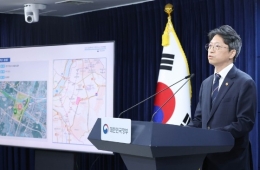
Kim Hogyun, executive vice president at Samjong KPMG, presents at the industry-academia seminar “Enhancing the Reliability of Disclosures and the Qualitative Characteristics of Actuarial Assumptions under New International Financial Reporting Standards (IFRS)” held at the Korea Insurance Research Institute in Yeouido, Seoul, on the 29th. Photo by Moon Chaeseok
View original imageKim Ho Gyun, executive director at Samjong KPMG, made the proposal during a presentation at an industry-academia seminar titled “Enhancing the Reliability of Disclosures under International Financial Reporting Standards (IFRS) and the Qualitative Characteristics of Actuarial Assumptions,” held at the Korea Insurance Research Institute in Yeouido, Seoul, on the 29th. Kim is a veteran who worked for more than 20 years as a chief specialist at the Financial Supervisory Service.
Kim said that since the adoption of the new international accounting standard IFRS 17 in 2023, the fluctuations in the experience-to-expected gap—the difference between insurers' estimates and actual figures for insurance claims and business expenses—have become excessively large.
Citing media reports on the trends in the experience-to-expected gap at major insurers in the first half of 2025 and the first half of 2026, he said, “We can see that the fluctuations in the gap are excessively large. Can we accept accounting that is this volatile, changing like a rubber band?”
Kim explained that this “rubber-band accounting” problem worsened when insurers uniformly applied to general-purpose accounting the actuarial assumptions (supervisory accounting) that financial regulators primarily use for supervisory purposes when IFRS 17 was first introduced. He said that if insurers use conservative supervisory accounting assumptions as they prepare their financial statements, then regulators' changes to actuarial assumption standards for supervisory purposes can cause net income for the period reported in those statements to fluctuate sharply.
He cited the confusion in the insurance industry after regulators introduced guidelines on lapse rates for short-term-premium whole life insurance policies, such as policies with 5- or 7-year premium payment periods. After marketing competition over refund rates for these policies became overheated, regulators set a conservative standard floor for lapse-rate assumptions around the time premium payments are completed. As a result, each insurer's own “experience data,” including the distribution of actual policyholder behavior, was not properly reflected in financial statements.
Kim said, “Some insurers have experience data related to short-term-premium whole life insurance products, while others do not. Regulators need to establish supervisory accounting standards, so they issue guidelines on lapse rates at renewal. This makes it difficult for insurers that are still one to two years away from their products reaching maturity to follow the guidance.”
He added, “If the practice of general-purpose accounting continuing to follow supervisory accounting persists, insurers' own experience data will be undermined, and their actuarial capabilities could even be rendered obsolete. In that case, contrary to the purpose of introducing IFRS 17—to improve the reliability of insurance accounting information—distrust in accounting could drive capital-market investors away, weakening the entire insurance industry.”
Kim proposed introducing a dual system in which general-purpose accounting uses neutral best estimates based on insurers' experience data, while supervisory accounting applies regulatory assumptions to ensure solvency. He also called for stronger disclosure. He stressed the need to break down disclosures of the experience-to-expected gap in greater detail and disclose the differences between assumptions used in general-purpose accounting and supervisory guidelines, as well as their financial impacts.
Hot Picks Today
 "Two Spend 500,000 Won in a Flash, Yet Wait Two Hours?" ... 'Dreamland' Shunned by Kids and Foreign Tourists
- The Era of Getting 200 Million Won After 30 Years Is Over... A Japanese Bank's "Perpetual Department Head" Who Just Clocked In Cries Out
- Spain Hit by Its Worst Tragedy... Lee Kangin, Moreno and Real Madrid Join Soccer World in Mourning
- They Said, “Make It Your Home for Life” - Then Suddenly Kicked 200 Passengers Off... What Happened to the Around-the-World Cruise?
- "130 Rice Bowls Sold Out in a Day"... 'Unfiltered Face' Adds 8 Million Won to Night Market Sales: China's Bungeunwoo
Kim said, “If insurers had practiced dynamic yet transparent accounting with highly predictable earnings since the introduction of IFRS 17, a culture of management accountability for results might have taken root. Instead, insurers can now easily make excuses by blaming guidelines set by the Financial Supervisory Service.” He urged insurers, regulators, the Korea Actuarial Society, and external accounting firms to work together to help insurers establish independent actuarial assumption-setting systems.
© The Asia Business Daily. All rights reserved. Unauthorized AI training and use prohibited.