Land Vice Minister After Parking Robot Demo: "We Will Lay the Groundwork for Commercializing Mobile Robots"
Visits Parking Robot Pilot Site Under Regulatory Sandbox in Siheung
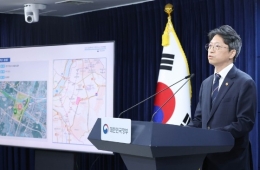
Jeong Eui-gyeong, Second Vice Minister of Land, Infrastructure and Transport, observed a demonstration of a parking robot pilot project at an apartment in Siheung, Gyeonggi Province, on the 29th. The pilot project, being conducted by a consortium of Hyundai Motor, Hyundai Wia and Hyundai Engineering & Construction, is being carried out through the Ministry of Land, Infrastructure and Transport's Smart City Regulatory Sandbox. The demonstration simulated various situations that could arise in an actual apartment parking environment.
“Parking robots are a prime example of how mobile robot technology can change our daily lives,” Jeong said. “As competition in the robotics industry expands beyond technology development to securing a foothold in actual services and markets, we must accelerate preparations for commercialization alongside technology development.”

Jung Uigyeong, Second Vice Minister of Land, Infrastructure and Transport (second from right), listens to an explanation at a parking robot demonstration at an apartment complex in Siheung, Gyeonggi Province, on the 29th. Provided by the Ministry of Land, Infrastructure and Transport.
View original imageUntil now, robots have primarily been used in manufacturing plants. They are expected to become widely used in everyday settings that many people encounter. In response, the Ministry of Land, Infrastructure and Transport is pursuing legislation for a special act on mobile robots that would set out specific rules covering parking, delivery, logistics and other areas. The act would provide for flexible application of relevant regulations, which vary across urban spaces, while fostering robot-friendly buildings and urban environments. The ministry believes that related systems need to be updated to move from the demonstration stage to commercialization.
Hot Picks Today
 "Two Spend 500,000 Won in a Flash, Yet Wait Two Hours?" ... 'Dreamland' Shunned by Kids and Foreign Tourists
- The Era of Getting 200 Million Won After 30 Years Is Over... A Japanese Bank's "Perpetual Department Head" Who Just Clocked In Cries Out
- Spain Hit by Its Worst Tragedy... Lee Kangin, Moreno and Real Madrid Join Soccer World in Mourning
- They Said, “Make It Your Home for Life” - Then Suddenly Kicked 200 Passengers Off... What Happened to the Around-the-World Cruise?
- "130 Rice Bowls Sold Out in a Day"... 'Unfiltered Face' Adds 8 Million Won to Night Market Sales: China's Bungeunwoo
“For robots to be used in real-world settings, we must consider not only their technological capabilities but also the characteristics of the spaces where they operate and the conditions on site,” Jeong said. “We need to lower regulatory barriers and create an institutional environment where companies can pursue new initiatives.” He added, “We will continue to identify what companies and on-the-ground operators need and provide support to help our mobile robot industry strengthen its competitiveness both in Korea and in global markets.”
© The Asia Business Daily. All rights reserved. Unauthorized AI training and use prohibited.