Samsung Electronics: "HBM4 Revenue More Than Triples, Next Year's Supply Sold Out... Record 84.4 Trillion Won in CAPEX" (Comprehensive)
HBM4 Reached 60% of Total HBM Revenue in Q3
"LTAs Signed with 10 Customers; Further Negotiations Underway"
76.8 Trillion Won in Capital Spending for Semiconductor Division Alone
Plans to Buy Back and Cancel Treasury Shares with Remaining Funds
Samsung Electronics said on October 29 that it had effectively sold out its HBM supply for next year, as revenue from HBM4, its next-generation high-bandwidth memory, more than tripled from the previous quarter, signaling a full-fledged rebound in the semiconductor industry. The company forecast that strong demand for AI infrastructure would help its performance next year surpass this year's.

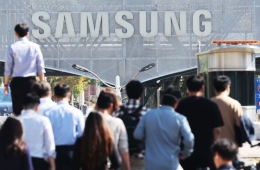
Samsung Electronics posted record-high results for the second quarter on the 7th. According to the company’s preliminary results for the second quarter of this year, consolidated revenue totaled 171 trillion won and operating profit came to 89.4 trillion won. These figures were up 129.31% and 1,810.26%, respectively, from a year earlier. The photo shows Samsung Electronics’ Seocho office building in Seocho-dong, Seocho-gu, Seoul. 2026.07.07 Photo by Yoon Dongju
View original imageAt its third-quarter earnings conference call held that day, Samsung Electronics highlighted its progress in securing a leading position in the HBM market. The company said, "Based on our differentiated product performance, our HBM4 revenue in the third quarter increased more than threefold from the previous quarter, and HBM4's share of our total HBM revenue expanded to around 60%. We achieved in the third quarter our goal of securing an HBM market share on par with our overall DRAM market share in the second half of the year."
The company also expressed strong confidence in the competitiveness of its next-generation products and in future supply negotiations. Samsung Electronics said, "Since shipping samples of HBM4E, the next-generation product, for the first time in the world in May, we have received positive feedback in initial customer evaluations. Negotiations for 2027 supply volumes have been completed at prices in line with our target, taking into account our product competitiveness, and the supply has already been sold out. However, major customers continue to request additional increases in HBM supply."
Long-term agreements (LTAs) aimed at securing visibility into medium- to long-term demand have also gained momentum. Samsung Electronics said, "We have signed memory LTAs with 10 large customers and are negotiating with another 10 key customers, with negotiations with some customers nearing completion. The likelihood of achieving our target of securing LTA volumes equivalent to 60-70% of production capacity by 2030 is becoming increasingly clear. The full-scale expansion of LTAs will greatly help establish a stable business model."
The company also offered an optimistic outlook for the semiconductor industry over the medium to long term. It said, "We expect the semiconductor industry to remain strong in 2027, supported by continued AI investment and supply constraints. Strong growth momentum in the Device Solutions (DS) division is expected to help us achieve results that surpass this year’s, while the Device eXperience (DX) division will continue to face profitability pressures, including rising costs."
By business division, the company said, "In the DS division, robust AI investment is driving memory demand well above supply, while the foundry business will accelerate its growth with the start of operations at our Taylor fab in the United States and the ramp-up of mass production of 2-nanometer AI and high-performance computing (HPC) chips. The DX division will focus on improving its business structure by expanding agentic AI experiences and high-margin service platforms."
Capital expenditure (CAPEX) this year is expected to reach a record high to keep pace with surging market demand. Samsung Electronics said, "Capital expenditure in the third quarter of this year totaled 29 trillion won, up 12.2 trillion won from the previous quarter, with 27.2 trillion won invested in the DS division alone. For full-year 2026, capital expenditure is expected to reach 84.4 trillion won, up 31.7 trillion won from the previous year, including 76.8 trillion won for the DS division and around 3.9 trillion won for displays."
Samsung Electronics also detailed plans that day for large-scale shareholder returns. Its board approved a third-quarter cash dividend of 4,601 won per share for both common and preferred shares, including a regular dividend of 376 won per share. The total payment of 30 trillion won is scheduled to be made in November.
The company also outlined plans to buy back and cancel treasury shares using the remaining funds allocated for shareholder returns. Samsung Electronics said, "Of the 90 trillion to 110 trillion won in total shareholder returns planned for this year, 35 trillion won has been allocated for execution, including amounts already distributed and the third-quarter cash dividend of 30 trillion won. This leaves 55 trillion to 75 trillion won in remaining funds. We plan to return a substantial portion of the remaining funds to shareholders by buying back and canceling treasury shares, alongside cash dividends."
It added, "We recognize the market's keen interest in the price gap between common and preferred shares. In buying back and canceling treasury shares, we will actively consider and adjust the proportion of preferred shares to be purchased, taking market conditions into account, with a view to treating shareholders equally and enhancing corporate value."
Hot Picks Today
 The Era of Getting 200 Million Won After 30 Years Is Over... A Japanese Bank's "Perpetual Department Head" Who Just Clocked In Cries Out
- "Could That Really Be a Teacher at Our School?"... Japanese Teacher Caught Appearing in Adult Video Gives Bizarre Explanation
- [Breaking] Special Counsel Seeks Death Penalty for Yoon as 'Ringleader of Insurrection' in Appeal Trial
- "They Blocked China's Chips, and It Became a 'Value-for-Money Monster'..." China's Counterattack, Copying the U.S. and Selling It for Peanuts [China Shock, K-Industry on the Brink | AI] 1
- "Two Spend 500,000 Won in a Flash, Yet Wait Two Hours?" ... 'Dreamland' Shunned by Kids and Foreign Tourists
Regarding its next shareholder-return policy, the company said, "We are engaged in in-depth discussions on a new shareholder-return policy for 2027 and beyond. At a board meeting scheduled for the end of January 2027, we will finalize and announce both the next shareholder-return policy and the final amount and specific execution plans for the remaining funds allocated for shareholder returns in 2026."
© The Asia Business Daily. All rights reserved. Unauthorized AI training and use prohibited.