Mandatory External Funding for Retirement Pensions by 2030... 'Fund-Type' Model Introduced to Secure Retirement Income (Comprehensive)
Contract-Based Workplaces Can Switch to Fund-Based Plans and Back
Liquidity Burden on Small Workplaces... Support for a Smooth Transition Is Key
Going forward, external funding of retirement benefits (through the introduction of retirement pension plans) will be mandatory for all workplaces, and a new “fund-type retirement pension” will be introduced, under which professional trustee corporations manage the accumulated funds. The government plans to phase in mandatory external funding, starting with workplaces with 100 or more employees in 2028 and extending to small workplaces with fewer than 10 employees by 2030. Whether the National Pension Service will participate directly in managing the funds will be discussed further in the National Assembly, as labor, management and the government have differing views.
On Oct. 29, the government announced a “Plan to Strengthen the Functions of Retirement Pensions,” prepared jointly by relevant ministries, following a ruling party-government consultation with the Climate, Energy, Environment and Labor Committee.

Attendees, including Minister of Employment and Labor Kim Younghoon and Climate and Labor Committee Chair Kim Jungho, pose for a commemorative photo at a government-party meeting on current issues related to the Climate, Environment and Labor Committee, held at the National Assembly Members' Office Building on the 29th. 2026.10.29 Photo by Yoon Dongju
View original imageMandatory External Funding for All Workplaces by 2030
First, mandatory external funding to prevent unpaid retirement benefits will be implemented in three phases according to company size. Following revisions to the Act on the Guarantee of Workers’ Retirement Benefits within this year, and a one-year preparation period, the requirement will take effect in January 2028 for workplaces with 100 or more employees, in January 2029 for those with 10 to 99 employees, and in January 2030 for those with fewer than 10 employees. The obligation to fund benefits externally will apply to periods of continuous employment beginning on or after the effective date for each phase. To ease the burden on small businesses, the government will provide KRW 6 billion in matching contributions to workplaces with fewer than 30 employees that adopt the system early, before it becomes mandatory, and KRW 6.2 billion in interest subsidies covering 2 percentage points on business loans to workplaces with fewer than 50 employees. Nam Seonguk, director of the Retirement Pension and Welfare Division at the Ministry of Employment and Labor’s Labor Policy Office, explained, “Even after the requirement takes effect, workplaces that have not established a plan will be automatically enrolled in the Small and Medium-Sized Enterprise Retirement Pension Fund (Pureun Seed).”
A “fund-type retirement pension” will also be introduced, under which professional trustee corporations manage the accumulated funds on behalf of participants to improve returns. It will have three types: an open financial-institution model (for-profit corporations), a consortium model (a nonprofit corporation jointly established by labor and management), and an open public-institution model (including the SME Retirement Pension Fund). It will initially apply to defined contribution (DC) plans and individual retirement pension (IRP) plans. If losses occur because of violations involving investment management, conflicts-of-interest management or disclosure obligations, the burden of proof in damage claims will shift to the trustee corporation, which will have to prove that it acted without intent or negligence. This measure is intended to prevent information asymmetry and moral hazard (the principal-agent problem) that may arise when asset management is entrusted to a third party. The plan also requires that 0.25% of the accumulated funds be set aside as an operational risk reserve to cover, among other things, losses incurred by participants.
In addition, the government will consider introducing an “opt-out” system under which retirement benefits are automatically paid as a pension unless the retiree separately applies for a lump-sum payment. It will also encourage loans secured by retirement pension assets to reduce early withdrawals for reasons such as housing costs. To improve returns on existing contract-based retirement pension plans, the investment limit on risky assets for IRPs, currently set at 70%, will be eased in stages. Comprehensive investment account (IMA) products and promissory notes issued by securities firms will also be added to the investment options for DC and IRP plans. The advance notice for default options will be moved up from four weeks after maturity to two weeks before maturity. Employment and Labor Minister Kim Younghoon said, “We will do everything we can to ensure that the bill is passed by the National Assembly within this year, so that retirement pension assets, which have exceeded KRW 500 trillion, can develop into a reliable old-age income security system for workers.” Kim Jeongho, a Democratic Party of Korea lawmaker and chair of the National Assembly’s Climate, Energy, Environment and Labor Committee, also said, “This is a social pact that labor, management and the government achieved with great difficulty for the first time in 20 years. The committee will carefully oversee the process to address concerns on the ground and ensure that the agreement leads to legislation as soon as possible.”

“Workplaces Can Switch from Contract-Based to Fund-Based Plans and Back”
The government’s retirement pension reform plan marks the first structural overhaul in more than 20 years, since the system was introduced in 2005. The aim is to transform a retirement benefit system that has focused on preventing nonpayment into a broader framework that also improves returns through professional management and provides old-age income security.
The core of the plan is the introduction of a “fund-type retirement pension,” in which professional trustee corporations pool and manage the accumulated funds of multiple participants. Financial institutions, labor-management organizations and public institutions will be able to participate as fund managers, allowing participants to choose between the existing contract-based model and the fund-based model. The government aims to ease the burden on individual participants of selecting investment products themselves and improve management efficiency through economies of scale, by pooling funds and diversifying investments. However, introducing the fund-based model will not guarantee improved returns. Investment performance, fees, and the accountability and oversight framework for trustee corporations are expected to determine the system’s success. The government has also put in place safeguards for participants by strengthening the burden of proof for damages claims against trustee corporations and requiring them to set aside 0.25% of accumulated funds as an operational risk reserve. Nam Seonguk, director of the Retirement Pension and Welfare Division at the Ministry of Employment and Labor, explained, “Workplaces that have adopted the existing contract-based DC plan can switch to a fund-based plan or return to a contract-based plan after reaching a labor-management agreement and reflecting it in their plan rules.”
Mandatory external funding is a safeguard to reduce unpaid retirement benefits. Last year, retirement benefits accounted for 41.1% (KRW 823 billion) of all unpaid wages. When companies kept retirement benefits only as liabilities on their books, workers faced a high risk of not receiving them if their employers went bankrupt or closed down. With external funding made mandatory in stages, funds for retirement benefits will be deposited with financial institutions and can be protected independently of a company’s financial deterioration. However, the requirement will apply only to periods of continuous employment beginning on or after the effective date for each phase; it will not be applied retroactively to all prior years of service.

“KRW 500 Trillion in Retirement Pensions” Flows into Capital Markets...Returns Put to the Test
Significant changes are also expected in the capital markets. At the end of last year, retirement pension assets had grown to KRW 501.4 trillion. Returns rebounded to 6.47% last year but remained well below the National Pension Service’s 18.82% return. If the introduction of fund-based plans spurs professional management and diversified investment, while the investment limit on risky assets for IRPs is eased and comprehensive investment accounts (IMAs) and promissory notes issued by securities firms are allowed, retirement pension funds could have a wider range of investment options. The system could also develop into one that professionally manages long-term funds, like Australia’s superannuation system or the UK’s National Employment Savings Trust (NEST). However, expanding the range of investment options could increase the risk of losses, so risk management and fees must be considered alongside returns.
Hot Picks Today
 The Era of Getting 200 Million Won After 30 Years Is Over... A Japanese Bank's "Perpetual Department Head" Who Just Clocked In Cries Out
- "Could That Really Be a Teacher at Our School?"... Japanese Teacher Caught Appearing in Adult Video Gives Bizarre Explanation
- [Breaking] Special Counsel Seeks Death Penalty for Yoon as 'Ringleader of Insurrection' in Appeal Trial
- "They Blocked China's Chips, and It Became a 'Value-for-Money Monster'..." China's Counterattack, Copying the U.S. and Selling It for Peanuts [China Shock, K-Industry on the Brink | AI] 1
- "Two Spend 500,000 Won in a Flash, Yet Wait Two Hours?" ... 'Dreamland' Shunned by Kids and Foreign Tourists
Liquidity Burden on Small Workplaces...A Smooth Transition Is Key
On the other hand, small workplaces could face a greater burden from having to set aside retirement benefits externally. The rate of retirement pension adoption among workplaces with fewer than five employees is just 10.6%. Companies with limited cash reserves may face liquidity pressures as they deposit funds for retirement benefits externally every month or year. The government plans to provide matching contributions and interest subsidies on loans to workplaces that adopt the system early, before it becomes mandatory. As the requirement will be extended to workplaces with fewer than 10 employees by 2030, the challenge will be to ensure sufficient support in terms of scale and duration, as well as acceptance on the ground. Shin Jinyoung, a professor at Yonsei University’s School of Business, said, “If small businesses are exempted because of their limited ability to pay, the most vulnerable groups, who have the greatest need for retirement benefit protection, will instead be excluded. The system should apply to all workplaces, while financial support should be provided alongside it to ease the impact on small businesses.”

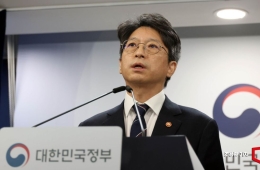
Kim Young-hoon, Minister of Employment and Labor, delivers opening remarks at a ruling party-government meeting on issues related to the Climate, Environment and Labor Committee at the National Assembly Members' Office Building on the 29th. 2026.10.29 Photo by Yoon Dongju
View original image© The Asia Business Daily. All rights reserved. Unauthorized AI training and use prohibited.