Ruling and Opposition Policy Chiefs Join Hands Amid Political Feuding... "We May Fight, but Must Negotiate on Policy"
Ruling and opposition policy committees hold forum on legislation to protect platform workers
Democratic Party of Korea and People Power Party showcase bipartisan cooperation
The policy committees of the Democratic Party of Korea and the People Power Party jointly held a forum on institutionalizing a platform safety net on October 29. Amid political confrontations between the ruling and opposition parties, it was a rare occasion for the two parties to seek common ground on issues affecting people's livelihoods.
The forum, titled “Institutionalizing a Platform Safety Net Co-Created by the Ruling and Opposition Parties,” was held that day at the National Assembly Members' Office Building. It provided a venue to discuss legislative measures to protect platform workers, who fall outside the protection of existing labor laws. Related forums have been held several times, but this was the first time the policy committees of both parties took the lead in jointly holding a forum and engaging in the discussion.
In congratulatory remarks that day, Kwon Chilseung, policy committee chair of the Democratic Party of Korea, said, “It has not been long since the parliamentary audit concluded, and seeing the policy committees of both parties come together so soon confirms that there are no differences between the ruling and opposition parties when it comes to people's livelihoods.” He added, “I believe today's discussion is an opportunity to listen to voices from the field, for both parties to share their respective positions, and to turn them into legislation and policy. It is a chance to demonstrate genuine cooperation and democracy.”

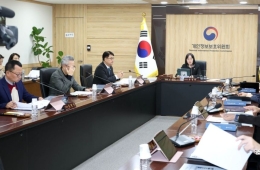
Kwon Chilseung, policy committee chair of the Democratic Party of Korea, and Lim Ija, policy committee chair of the People Power Party, talk at a forum on institutionalizing a platform safety net jointly organized by the ruling and opposition parties at the National Assembly Members' Office Building on the 29th. Yonhap News Agency.
View original imageLim Ija, policy committee chair of the People Power Party, said, “As the opposition's policy committee chair, I feel deeply regretful and troubled by the ruling party's unilateral actions, including its push for a parliamentary investigation into Chief Justice of the Supreme Court Cho Hee-dae and his impeachment, as well as its push to pass a special counsel bill to drop the charges against President Lee Jae-myung.” She continued, “I believe that even as political strife intensifies, we must not bring to a halt policies addressing people's livelihoods and the issues that affect how they make a living. I came here with a sense of urgency, believing that even as we fight, we must keep tending to people's livelihoods.” She added, “Those who lead the policy committees of the ruling and opposition parties and are responsible for policy have a duty to show a responsible attitude by dealing separately with political conflicts and issues affecting people's livelihoods. Policy committee chair Kwon and I are sitting down together with a shared sense of responsibility: despite our differences in political views, policy work for the people must continue without interruption.”
Earlier, on September 15, policy committee chairs Kwon and Lim pledged to hold candid discussions on various pending issues in order to consolidate bills jointly introduced by the two parties and achieve tangible results.
Kim Jeong-ho, chair of the National Assembly's Climate, Energy, Environment and Labor Committee and a member of the Democratic Party of Korea, said, “Bills from both the ruling and opposition parties to protect platform workers and other vulnerable workers are before the National Assembly. While there may be differences in approach and detail, I believe the ultimate legislative goal is the same: to protect working people left in gaps in the system.” He continued, “Politics must not stand in the way,” adding, “I hope today's forum will not end as a mere exchange of formalities, but will become a policy breakthrough that reflects the real voices of people in the field.”

Attendees, including Kwon Chilseung, policy committee chair of the Democratic Party of Korea, and Lim Ija, policy committee chair of the People Power Party, pose for a commemorative photo at a forum titled “Institutionalizing a Platform Safety Net Co-Created by the Ruling and Opposition Parties,” held at the National Assembly Members’ Office Building on the 29th. Yonhap News
View original imageKwon Hyuk, a professor at Korea University's Graduate School of Labor Studies, said at the forum, “The digitalization of the work environment accelerates the evasion of the concept of the employer and fragments labor, creating a gap between the need for labor-law protection arising from the ‘institutional failure’ of labor law and the realities workers face. When the way people work changes, the way they are protected must also change.” Professor Kwon proposed, “We should provide incentives, including government support, to foster solidarity and communication among service providers and improve their social and economic standing. We should also enable them to curb unchecked working hours and competition among service providers, thereby filling gaps in the social safety net and ensuring the sustainability of the labor market.”
Hot Picks Today
 "Two Spend 500,000 Won in a Flash, Yet Wait Two Hours?" ... 'Dreamland' Shunned by Kids and Foreign Tourists
- The Era of Getting 200 Million Won After 30 Years Is Over... A Japanese Bank's "Perpetual Department Head" Who Just Clocked In Cries Out
- Spain Hit by Its Worst Tragedy... Lee Kangin, Moreno and Real Madrid Join Soccer World in Mourning
- Missing $770,000 Diamond Earrings Were in the Thief's Stomach... Bizarre U.S. Heist
- "130 Rice Bowls Sold Out in a Day"... 'Unfiltered Face' Adds 8 Million Won to Night Market Sales: China's Bungeunwoo
Park Gwi-cheon, a professor at Ewha Womans University's School of Law, said, “If future legislation is to define the types and scope of rights guaranteed to working people, its fundamental legal basis must ultimately begin with the constitutional perspective of guaranteeing fundamental rights.” She added, “These rights can be classified as rights that ensure human dignity, personal rights and equality; the right to health; the right to subsistence; rights to social security; rights related to maternity protection, family life and privacy; and rights that guarantee freedom of contract while taking into account imbalances in bargaining power.” Professor Park added, “Enacting a basic law for working people can ultimately be seen as an effort to narrow the protection gap between employees, who provide services through their labor for others and receive protection under labor and social security laws, and those who do not. The new law must not be misused as a means of circumventing existing labor laws.”
© The Asia Business Daily. All rights reserved. Unauthorized AI training and use prohibited.