Seoul Left Out of 77,000-Home Supply Plan; Yongsan Park and Greenbelts Face an 'Uphill Battle'
New Housing Sites Announced in Gimpo, Guri and Elsewhere... None in Seoul
Talks Stall as Hong Jiseon and Oh Sehoon Delay Consultations
Focus on Additional Supply from Yongsan Park and Greenbelts
The government announced candidate sites for new housing developments totaling 76,700 homes in areas near Seoul on the 29th to expand housing supply, but excluded Seoul, which had drawn considerable attention. As the government and the Seoul Metropolitan Government have been unable to narrow their differences over development plans, including Yongsan Park, and lifting development restrictions in Seoul’s greenbelt areas has also proved difficult in practice, plans for additional housing supply in central Seoul appear to be repeatedly delayed.

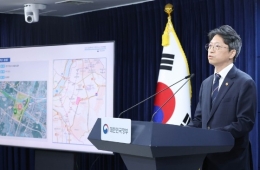
Hong Jiseon, Minister of Land, Infrastructure and Transport, announces housing supply plans for new public housing sites and follow-up measures to the August 13 measures at the Government Complex Seoul in Jongno-gu, Seoul, on October 29, 2026. Photo by Cho Yongjun
View original imageThe Ministry of Land, Infrastructure and Transport said on the 29th that it would lift greenbelt restrictions in six areas—Gimpo Ara, Guri Geonwon, Hanam Misa, Hanam Gamil 2, Uijeongbu Darakwon, and Goyang Daegok Knowledge Convergence—to supply new housing, but the plan does not include any sites in Seoul. Talks between Hong Jiseon, Minister of Land, Infrastructure and Transport, and Seoul Mayor Oh Se-hoon on resuming negotiations over housing supply in Seoul have been delayed, leaving discussions on developing key central-city sites at a standstill.
Earlier this year, the government announced plans to supply 32,000 new homes in Seoul, including 10,000 homes in the Yongsan International Business District in Yongsan-gu, 6,800 homes at Taereung Golf Course (Taereung CC) in Nowon-gu, 2,900 homes at the Air Force base in Doksan-dong, Geumcheon-gu, and 918 homes on military land in Gangseo-gu. However, development of key sites in Yongsan and Nowon has failed to gain momentum amid conflicts with the Seoul Metropolitan Government and local residents.
At the second regular briefing on housing supply on the 29th, Minister Hong addressed Seoul’s exclusion from the plan, saying, “We first announced the candidate sites where we had reached agreement with local governments.” She added, “The former U.S. military site in Yongsan is not under consideration because it requires legislation and public consultation. Working-level discussions are underway on areas where cooperation can be achieved in the short term, and we are waiting for a response from the Seoul Metropolitan Government soon.”
The Ministry of Land, Infrastructure and Transport has said it would use some degraded areas within Yongsan Park to supply housing, but Mayor Oh has opposed the plan, saying, “I can’t give up even one centimeter.” Instead, the Seoul Metropolitan Government has proposed an alternative: a mixed-use development around the Tancheon Water Reclamation Center in Gangnam-gu that could provide more than 10,000 homes. A Seoul Metropolitan Government official said, “We are continuing to discuss a meeting between Mayor Oh and Minister Hong, but nothing has been decided yet.”
Residents in the area around the Taereung CC site strongly oppose developing it for housing, citing concerns that traffic congestion will worsen. After the government announced in its August 13 measures that it would speed up housing development at Taereung CC, local groups, including Chorok Taereung-eul Jikineun Simindeul, also voiced opposition. Nowon-gu also maintains that regional transportation measures, including widening Hwarang-ro and extending Subway Line 6, must be implemented first.

Discussions on lifting greenbelt restrictions within Seoul are also making little progress. The government believes that some greenbelt areas need to be used to stabilize housing prices in Seoul, where there is a shortage of sites for new housing. Industry observers have identified the reserve forces training center in Naegok-dong, Seocho-gu; Segok-dong and Jagok-dong in Gangnam-gu; the Suseo train depot; and areas south of the Olympic Athletes’ Village in Bangi-dong, Songpa-gu, as potential sites. The Seoul Metropolitan Government and environmental groups oppose the idea, citing the need to preserve green spaces.
Construction has also not proceeded smoothly in areas where greenbelt restrictions have already been slated for removal. In November 2024, the Yoon Suk Yeol administration announced that it would lift greenbelt restrictions in the Seoripul area of Seocho-gu to provide a total of 20,000 homes, but disputes continue over land compensation, relocation and resettlement, and preservation of villages. Korea Land and Housing Corporation (LH) is accelerating follow-up procedures with the aim of starting housing construction in the second half of 2028. Even if the plan proceeds as scheduled, four years will pass between the announcement of the candidate site and the start of construction.
Hot Picks Today
 "Two Spend 500,000 Won in a Flash, Yet Wait Two Hours?" ... 'Dreamland' Shunned by Kids and Foreign Tourists
- The Era of Getting 200 Million Won After 30 Years Is Over... A Japanese Bank's "Perpetual Department Head" Who Just Clocked In Cries Out
- Spain Hit by Its Worst Tragedy... Lee Kangin, Moreno and Real Madrid Join Soccer World in Mourning
- They Said, “Make It Your Home for Life” - Then Suddenly Kicked 200 Passengers Off... What Happened to the Around-the-World Cruise?
- "130 Rice Bowls Sold Out in a Day"... 'Unfiltered Face' Adds 8 Million Won to Night Market Sales: China's Bungeunwoo
Lee Eun-hyung, a research fellow at the Korea Research Institute for Construction Policy, said, “Lifting some greenbelt restrictions in Seoul and developing Yongsan Park could help stabilize housing prices to some extent, but the matter requires further discussion in light of the need for green spaces.”
© The Asia Business Daily. All rights reserved. Unauthorized AI training and use prohibited.