Samsung Electronics' Q3 Operating Profit Hits Record 107.4 Trillion Won... DS Alone Earns 106.5 Trillion Won
First global tech company to post quarterly operating profit of 100 trillion won
Boost from HBM4 and server SSD sales
DX division posts 800 billion won loss as memory prices soar
Buoyed by a boom in AI semiconductors, Samsung Electronics became the first global tech company to enter the era of quarterly operating profit exceeding 100 trillion won. Its semiconductor division alone generated more than 106 trillion won in profit, driving the companywide results. The DX division, which includes finished products such as home appliances, continued to post losses in the 800 billion won range after taking a direct hit from a sharp rise in component prices.
Samsung Electronics disclosed on October 29 that it recorded consolidated revenue of 195.3 trillion won and operating profit of 107.4 trillion won in the third quarter of this year. The figures were up 126.88% and 783.11%, respectively, from the same period last year, marking a new quarterly record for the fourth consecutive quarter.
Falling exchange rates for major currencies, including the dollar and euro, had a negative impact of about 10 trillion won on operating profit, but strong memory prices offset the effect. Earnings per share (EPS) for common shares rose 6% from the previous quarter to 11,462 won.
The results showed how the memory boom boosted profits in the semiconductor business while increasing cost pressures on the finished-products business. The Device Solutions (DS) division recorded revenue of 147.1 trillion won and operating profit of 106.5 trillion won, accounting for 99.2% of the company's total operating profit. Expanded supplies of HBM4, the sixth-generation high-bandwidth memory, and rising prices for high-value-added products such as server solid-state drives (SSDs) for AI data centers and DDR5 drove the improvement in results.
Revenue also increased in the non-memory business, led by advanced products. The foundry business, which manufactures semiconductors on a contract basis, significantly improved its results on higher sales of HBM base dies and advanced-node products. System LSI expanded its business by supplying systems-on-chip (SoCs) and image sensors for new models in the second half of the year.
In contrast, the DX division posted an operating loss of 800 billion won despite revenue of 52.1 trillion won. The Mobile eXperience (MX) division faced profitability pressures from a sharp rise in memory prices for smartphones despite higher revenue, while Visual Display (VD) and home appliances were also affected by rising raw material and logistics costs.

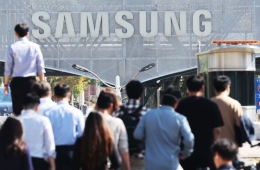
Samsung Electronics posted record-high earnings for the second quarter on the 7th. According to the company’s preliminary results for the second quarter of this year, consolidated revenue totaled 171 trillion won and operating profit came to 89.4 trillion won. These figures represent increases of 129.31% and 1,810.26%, respectively, from the same period last year. The photo shows Samsung Electronics’ Seocho headquarters in Seocho-dong, Seocho-gu, Seoul. July 7, 2026. Photo by Yoon Dongju.
View original imageSubsidiaries Harman, which makes automotive electronics and audio products, and Samsung Display contributed to profits. Harman recorded revenue of 4.3 trillion won and operating profit of 600 billion won, supported by U.S. tariff refunds and steady sales. Samsung Display posted revenue of 8 trillion won and operating profit of 1.1 trillion won, driven by panel supplies for new products from major customers and increased sales of large premium products.
Samsung Electronics plans to continue expanding its production base to meet growing demand for AI semiconductors. Of its 84.4 trillion won in facility investment planned for this year, it will allocate 76.8 trillion won to semiconductors to expand memory production infrastructure, including new plants. The foundry business will focus investment on its Taylor plant in the United States and prepare to meet demand for AI and high-performance computing (HPC) orders using its 2-nanometer process (1 nanometer is one-billionth of a meter).
The company invested 14.4 trillion won in research and development (R&D) in the third quarter and approved a total cash dividend of 30 trillion won, or 4,601 won per share.
Samsung Electronics expects memory demand to outstrip supply next year as AI investment expands, and plans to increase sales of high-value-added products such as HBM4 and high-performance DDR5.
Hot Picks Today
 The Era of Getting 200 Million Won After 30 Years Is Over... A Japanese Bank's "Perpetual Department Head" Who Just Clocked In Cries Out
- "Could That Really Be a Teacher at Our School?"... Japanese Teacher Caught Appearing in Adult Video Gives Bizarre Explanation
- [Breaking] Special Counsel Seeks Death Penalty for Yoon as 'Ringleader of Insurrection' in Appeal Trial
- "They Blocked China's Chips, and It Became a 'Value-for-Money Monster'..." China's Counterattack, Copying the U.S. and Selling It for Peanuts [China Shock, K-Industry on the Brink | AI] 1
- "Two Spend 500,000 Won in a Flash, Yet Wait Two Hours?" ... 'Dreamland' Shunned by Kids and Foreign Tourists
Samsung Electronics Chief Financial Officer (CFO) Park Soon-cheol said during the earnings call on October 29, "We expect the semiconductor division to deliver better results in 2027 than it does this year."
© The Asia Business Daily. All rights reserved. Unauthorized AI training and use prohibited.