Fund-Based Retirement Pensions Introduced; Trustees Must Prove 'No Fault' if Losses Occur
Mandatory External Funding at All Workplaces by 2030
New “Fund-Based Pension” Managed by Professional Trustee Corporations
Going forward, all workplaces will be required to externally fund retirement benefits by introducing retirement pension plans, and a new “fund-based retirement pension” system will allow professional trustee corporations to manage the funds. The government plans to phase in mandatory external funding, beginning with workplaces with 100 or more employees in 2028 and extending to small workplaces with fewer than 10 employees by 2030. Whether the National Pension Service will participate directly in managing the funds will be discussed further in the National Assembly, as the government, labor and management have differing views.
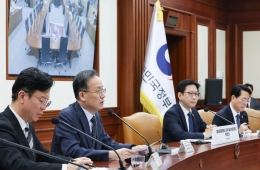
On October 29, the government announced the “Measures to Strengthen the Functions of Retirement Pensions,” jointly prepared by relevant ministries, following consultations between the government and ruling party at the Climate, Energy, Environment and Labor Committee.

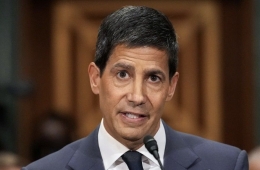
Minister of Employment and Labor Kim Younghoon briefs reporters on a proposal for social dialogue related to the Mega Special Zone Special Act at the Seoul Government Complex in Jongno-gu, Seoul, on September 15, 2026. Photo by Jo Yongjun
View original imageFirst, mandatory external funding to prevent unpaid retirement benefits will be introduced in three phases according to company size. Following revisions to the Guarantee of Workers’ Retirement Benefits Act within this year and a one-year preparation period, the requirement will apply sequentially to workplaces with 100 or more employees from January 2028, those with 10 to 99 employees from January 2029, and those with fewer than 10 employees from January 2030. The external funding requirement will apply to periods of continuous employment beginning on or after the start date for each phase. To ease the burden on small businesses, the government will provide KRW 6 billion in matching support for contributions to workplaces with fewer than 30 employees that adopt the system early, before it becomes mandatory. It will also provide KRW 6.2 billion in interest subsidies equivalent to 2 percentage points on business loans for workplaces with fewer than 50 employees. Nam Seonguk, director of the Retirement Pension and Welfare Division at the Labor Policy Office, explained, “Even after the requirement takes effect, workplaces that have not established a plan will be automatically enrolled in the Small and Medium-sized Enterprise Retirement Pension Fund (Pureun Seed).”
A “fund-based retirement pension,” under which professional trustee corporations manage the funds on behalf of participants, will also be introduced to improve returns. It will have three types: an open type operated by a financial institution (for-profit corporation), a consortium type operated by a labor-management consortium (nonprofit corporation), and a public institution open type (including the SME Retirement Pension Fund). The system will initially apply to defined contribution (DC) plans and individual retirement pension (IRP) plans. If losses arise from breaches of investment management, conflict-of-interest management or disclosure obligations, the burden of proof in damages claims will shift to the trustee corporation, which will have to prove that it acted without intent or negligence. This measure is intended to prevent information asymmetry and moral hazard (the principal-agent problem) that may arise because a third party manages the assets. In addition, the rules will require 0.25% of the funds to be set aside as an operational risk reserve, including to compensate participants for losses.
Hot Picks Today
 "Blockaded China's semiconductor access, and it became a 'value-for-money monster'..." China's Counterattack: Copying the U.S. and Offering It at Rock-Bottom Prices [China Shock, K-Industry on the Brink | AI] 1
- "Samsung Electronics Reaches Rerating Turning Point... Chinese Big Tech Firms Request '10-Year DRAM Supply'" [Click e-Stock]
- "Three times Lee Jaeyong's fortune?"... Meet China's richest man, who amassed 134 trillion won at 43.
- Yeoksam Serial Arsonist Transferred to Prosecutors in Custody... Claims "Patent Fraud" Despite Attempted Murder Charge
- "Two Spend 500,000 Won in a Flash, Yet Wait Two Hours?" ... 'Dreamland' Shunned by Kids and Foreign Tourists
The government will also consider introducing an “opt-out” system under which retirement benefits are automatically paid as a pension unless recipients separately apply for a lump-sum payment upon retirement, and will promote collateralized loans to reduce early withdrawals for reasons such as housing costs. To improve returns on existing contract-based retirement pension plans, it will gradually ease the current 70% limit on the share of IRP funds that can be invested in risk assets, and add integrated investment accounts (IMAs) and commercial paper to the investment options for DC and IRP plans. The advance notice for default options will also be moved up from four weeks after maturity to two weeks before maturity. Kim Younghoon, Minister of Employment and Labor, said, “We will do everything we can to ensure the bill is passed by the National Assembly within this year so that retirement pension funds, which have exceeded KRW 500 trillion, can develop into a reliable retirement income security system for workers.”
© The Asia Business Daily. All rights reserved. Unauthorized AI training and use prohibited.