[New York Stocks] Wall Street Edges Higher as Fed Holds Rates; Chipmakers Gain
Two Fed officials call for a rate hike
Oil prices rise as Middle East tensions escalate
All three major U.S. stock indexes closed higher on October 28 (local time). The Federal Reserve (Fed) kept its benchmark interest rate unchanged, as markets had expected, and investor sentiment appeared to strengthen amid gains in semiconductor stocks. U.S. Treasury yields rose immediately after the Fed’s decision to hold rates steady, but gave back some of those gains after the Fed said it would reduce the number of rate-setting meetings.
The Dow Jones Industrial Average closed up 97.53 points, or 0.19%, at 52,475.10. The S&P 500 gained 21.38 points, or 0.28%, to 7,743.98, while the tech-heavy Nasdaq Composite rose 72.04 points, or 0.27%, to 26,549.85.

Markets focused on the Fed’s October Federal Open Market Committee (FOMC) rate decision and a press conference by Fed Chair Kevin Warsh. The Fed held its benchmark interest rate steady at 3.75% to 4.00%. The decision was in line with market expectations, but the vote was split 10-2. Fed Governor Lisa Cook and Beth Hammack, president of the Federal Reserve Bank of Cleveland, dissented in favor of a 0.25-percentage-point rate increase.
At its September FOMC meeting, the Fed raised its benchmark interest rate by 0.25 percentage point for the first time in three years and two months. Although the Fed held rates steady this time, markets are leaning toward another increase in December. Interest rate futures are pricing in a 90% chance that the Fed will raise rates by 0.25 percentage point.
One notable aspect of this meeting was the Fed’s assessment of the economy. In its October statement, it said that “economic activity has been expanding at a strong pace.” This marked a step up from last month’s statement, which said activity was expanding at a “solid pace.”
The Fed’s assessment of inflation was unchanged from September, describing it as “still elevated.” It also maintained its assessment that uncertainty remained high, partly due to geopolitical developments.
As it did last month, the Fed maintained its assessment that U.S. productivity growth was strong and business capital investment was solid. Its view of the labor market was also unchanged. It said the unemployment rate had changed little, while the pace of job growth remained in line with labor force growth.

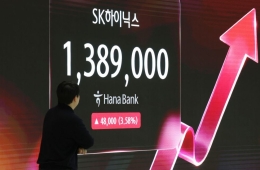
Semiconductor stocks also posted notable gains. After SK hynix reported record quarterly results the previous day, buying flowed into semiconductor-related stocks on U.S. markets as well. SK hynix ADR rose 13.30%, Micron Technology gained 5.86%, ARM advanced 4.10%, and AMD rose 3.24%.
Oracle led gains among technology stocks. The company set a fiscal 2030 revenue target of $225 billion and said it would limit additional funding for fiscal 2027-2030 to $20 billion. Oracle surged 10.58% from the previous trading day.
Oil prices ended higher amid escalating geopolitical tensions in the Middle East and the possibility of military action following the U.S. midterm elections. The previous day, the U.S. daily newspaper The Wall Street Journal (WSJ) reported that the United States had notified key Arab countries in the Gulf region to prepare for a brief, high-intensity military operation after the November 3 midterm elections.
On the New York Mercantile Exchange, West Texas Intermediate (WTI) crude for December delivery settled up 2.88% at $102.78 per barrel. On the ICE Futures Exchange, Brent crude for December delivery settled up 1.26% at $115.32 per barrel.
Spot gold continued to weaken even after the Fed held interest rates steady, falling 0.5% to $4,038.44 per ounce. Concerns about inflation grew as international oil prices rose more than 1% amid fears of supply disruptions caused by instability in the Middle East, while the possibility of an interest rate hike also weighed on gold prices.
The yield on the interest-rate-sensitive 2-year U.S. Treasury note rose to 4.777% immediately after the Fed’s rate decision, but fell after Fed Chair Kevin Warsh said the number of rate-setting meetings would be reduced. The 10-year U.S. Treasury yield stood at 5.036%, while the 30-year yield was 5.334%.
Steve Englander, global head of G10 FX research at Standard Chartered, said, “The market started to move when Chair Warsh mentioned changing the meeting schedule,” adding that “the market interpreted this as a dovish measure.”
Hot Picks Today
 "Blockaded China's semiconductor access, and it became a 'value-for-money monster'..." China's Counterattack: Copying the U.S. and Offering It at Rock-Bottom Prices [China Shock, K-Industry on the Brink | AI] 1
- "Two Spend 500,000 Won in a Flash, Yet Wait Two Hours?" ... 'Dreamland' Shunned by Kids and Foreign Tourists
- "Three times Lee Jaeyong's fortune?"... Meet China's richest man, who amassed 134 trillion won at 43.
- Why Samsung Electro-Mechanics Shareholders Are Watching a Japanese Rival's "Price Tag" [Click e Stock]
- "I Made an Extra 6 Million Won a Month"... "This Can Actually Make Money?" The Twist Behind a Few Pieces of Junk
Meanwhile, markets are expected to look to the U.S. personal consumption expenditures (PCE) price index, due out on October 29, for clues about the future direction of monetary policy.
© The Asia Business Daily. All rights reserved. Unauthorized AI training and use prohibited.