Easing the "Home Price and Rent Burden"... Seoul Allocates 55.7445 Trillion Won for Next Year's Budget
Supply 27,000 public rental homes and expand monthly rent support to 32,000 young people... Strengthening the housing safety net
Record-high budget, up 8.3% year over year... Narrowing the opportunity gap with the “Youth AI Growth Pass” for 500,000 people and other initiatives
The Seoul Metropolitan Government is allocating substantial funding to housing stability to ease the growing burden of housing costs on ordinary residents amid rising home sale prices and rents. Despite fiscal pressure, it has drawn up a record-high budget proposal totaling more than 55.7 trillion won while adhering to the principle of sound fiscal management and taking on no additional debt.
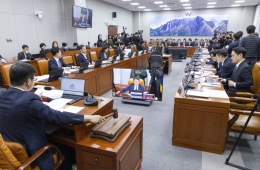
On Oct. 29, the Seoul Metropolitan Government announced that it had formulated a budget proposal for 2027 totaling 55.7445 trillion won, an increase of 4.2667 trillion won (8.3%) from the previous year. The net budget, excluding 5.554 trillion won in overlapping transfers between accounts, amounts to 50.1906 trillion won, up 8.9% from the previous year. Actual policy program spending, excluding administrative operating expenses and other costs, rose 9.0% to 31.5752 trillion won.
Although expanded government welfare programs, including changes to marriage and child-rearing support, increased the city’s matching contributions for national subsidies by 1.17 trillion won from the previous year, the city decided to reallocate resources to keep its outstanding debt at the end of 2027 at the 2026 level of 11.569 trillion won.

The budget proposal focuses on easing residents’ housing burdens and narrowing the opportunity gap for young people. To complete its core vision for the eighth and ninth terms of the city administration, “A City of Special Quality of Life,” the city will concentrate investment in five areas: a city of housing stability, a city of opportunity and vitality, a city of shared growth, a city of health and safety, and a city of spatial innovation.
In particular, the city has prioritized housing in next year’s budget to reduce residents’ housing costs amid recent increases in home prices. It plans to invest 1.1228 trillion won to provide 27,200 public rental homes tailored to demand. By type, these will include 20,736 homes acquired for rental, 3,100 leased homes, and 3,364 newly built homes.
The city is also stepping up efforts to encourage private-sector housing supply. It has allocated 10.8 billion won to Rapid Integrated Planning 2.0, an initiative designed to shorten the redevelopment period to a maximum of 12 years. It will also provide 12.3 billion won for the small-scale housing improvement programs Moa Town and Moa Housing, 5.6 billion won to draw up public maintenance plans for redevelopment candidate sites, and 3.2 billion won to support the establishment of redevelopment project committees and associations. Through these measures, the city aims to lay the groundwork for meeting its target of starting construction on 310,000 homes by 2031.
Support for young people’s housing costs will also be expanded. The Seoul Metropolitan Government has allocated 126.2 billion won to expand eligibility for its youth monthly rent subsidy, which provides up to 200,000 won a month to young people without homes, by 9,000 people to a total of 32,000. It will newly provide 500 Seoul-style Saessak One-Room units for university students in Seoul, with 1.8 billion won allocated for the program, and acquire 3,027 safe homes near transit stations for young people and newlyweds to provide as public rental housing, with 108.4 billion won allocated. The city will also expand its support for interest payments on rental deposit loans for newlywed couples and young people without homes, allocating 75.8 billion won to reduce their housing costs.
The Seoul Metropolitan Government also plans to strengthen support for housing-vulnerable groups. It will provide 1.0337 trillion won in housing benefits to households with incomes at or below 48% of the median income, and has allocated 72.5 billion won for interest-free loans of up to 70 million won to help residents secure long-term lease deposits. It will also provide tenants without homes with up to 500,000 won toward the cost of rental deposit return guarantee insurance.

The city is also moving ahead with efforts to build a “city of opportunity and vitality” to strengthen young people’s capabilities for the future. It will launch the Youth AI Growth Pass, with 26.6 billion won allocated to provide 500,000 young people in Seoul with generative AI vouchers and customized training tailored to different skill levels. The city will train 4,500 work-ready professionals through the Seoul Youth Employment Academy, with 46 billion won allocated, and move forward with the opening of the Yangjae AI Innovation District, the Hongneung Bio Cluster, and the Seoul Creative Industry Hub, with allocations of 16.4 billion won, 48.4 billion won, and 35.1 billion won, respectively.
In the “city of shared growth” sector, the city will expand livelihood, medical, and education benefits to 4.8054 trillion won in line with the increase in the median income threshold, and increase public employment opportunities for low-income residents and older adults, allocating 780.6 billion won to strengthen the income safety net. It will provide 3 trillion won in loans through a funding program for small businesses and small and medium-sized enterprises, with 42.6 billion won allocated, and issue 200 billion won in Seoul Metropolitan Love Gift Certificates, with 11.3 billion won allocated. It has also earmarked 143.4 billion won for a package of marriage, childbirth, and child-rearing support. The budget for the city’s core philosophy of “walking alongside the vulnerable” totals 17.6892 trillion won, an increase of 2.0533 trillion won (13.1%) from the previous year.
In the “city of health and safety” sector, the city will expand the functions of Sonmok Doctor 9988, allocating 58.9 billion won, to include management of metabolic syndrome, dementia, and smoking cessation. It will strengthen disaster-prevention infrastructure, including deep underground stormwater drainage tunnels near Gangnam Station, Gwanghwamun, and Dorimcheon; the construction of new stormwater pumping stations and expansion of existing ones at nine locations, with 236.2 billion won allocated; and upgrades to water and sewer pipelines that are more than 30 years old, with 410.9 billion won allocated.
In the “city of spatial innovation” sector, the city will continue work on five urban rail lines, including the Ui-Sinseol Line extension and the Dongbuk Line, with 138.3 billion won allocated, as well as the National Assembly-daero underpass and the development of the area above it into a park, with 132.1 billion won allocated. It will also continue the public transit fare refund program under the Climate Companion Pass, with 747.8 billion won allocated.
Hot Picks Today
 "Two Spend 500,000 Won in a Flash, Yet Wait Two Hours?" ... 'Dreamland' Shunned by Kids and Foreign Tourists
- The Era of Getting 200 Million Won After 30 Years Is Over... A Japanese Bank's "Perpetual Department Head" Who Just Clocked In Cries Out
- Spain Hit by Its Worst Tragedy... Lee Kangin, Moreno and Real Madrid Join Soccer World in Mourning
- They Said, “Make It Your Home for Life” - Then Suddenly Kicked 200 Passengers Off... What Happened to the Around-the-World Cruise?
- "130 Rice Bowls Sold Out in a Day"... 'Unfiltered Face' Adds 8 Million Won to Night Market Sales: China's Bungeunwoo
Seoul Mayor Oh Se-hoon said, “Despite rising inflexible spending, including mandatory expenditures, and an unfair disparity in fiscal support from the central government, we have expanded investment in areas essential to residents’ lives without increasing the city’s debt. We will make Seoul a ‘city of special quality of life’ where people can live well anywhere by providing housing stability to residents worried about finding a home and opportunities to take the next step to young people.”
© The Asia Business Daily. All rights reserved. Unauthorized AI training and use prohibited.