FSS: "Best Practices for Handling Complaints and Disputes" to Be Reflected in 2027 Consumer Protection Assessment (Comprehensive)
FSS Holds Briefing on “Best Practices for Handling Complaints and Disputes”
FSS “Aims to Establish Disclosure Framework in Q1 2027”
Lee Chanjin: “Report to Management and Reflect in Employees’ KPIs”
The Financial Supervisory Service (FSS) announced on October 28 that it had held a briefing for the entire financial sector on best practices for addressing current issues involving complaints and disputes, and that it would reflect those practices in its 2027 assessment of consumer protection practices. It said it aims to establish a related disclosure framework by the first quarter of 2027.

Presentation materials from a briefing on best practices for handling complaints and disputes, held by the Financial Supervisory Service at its headquarters in Yeouido, Seoul, on the 28th. The materials urged financial companies to “incorporate complaint- and dispute-related indicators into the KPIs of CEOs, executives and relevant departments.” Photo by Moon Chaeseok.
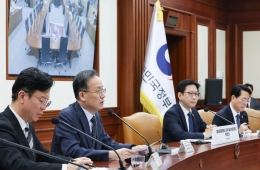
View original imageThe FSS delivered this message to the entire financial sector at a briefing on “Best Practices for Handling Complaints and Disputes” held that afternoon at its headquarters in Yeouido, Seoul. Attendees included FSS officials, including FSS Governor Lee Chanjin; approximately 300 consumer protection chief officers (CCOs) and executives responsible for human resources and organizational matters from 150 financial holding companies, banks, securities firms, insurers, specialized credit finance companies and savings banks; and executives and staff members from the Korea Federation of Banks, the Korea Financial Investment Association, the Korea Life Insurance Association, the General Insurance Association of Korea, the Credit Finance Association, the Korea Federation of Savings Banks and the central associations of mutual finance institutions.
The core of the best practices presented by the FSS to executives and staff responsible for consumer protection and human resources and organizational matters at financial companies was to grant CCOs decision-making authority and fully reflect performance related to complaints and disputes in product development and review, sales and business departments, and personnel evaluations.
The detailed tasks in the best practices include ▲ensuring the independence and impartiality of complaint and dispute handling ▲expanding organizational capacity and staffing and strengthening expertise ▲improving access to complaint and dispute filing ▲improving complaint and dispute handling processes ▲strengthening board reporting on complaints and disputes and follow-up measures ▲strengthening performance evaluations for complaint and dispute management.
Governor Lee stressed, “Report current issues involving complaints and disputes to senior management, including the chief executive officer (CEO), in a timely manner, and meaningfully incorporate complaint- and dispute-related indicators into employees’ key performance indicators (KPIs).”
The FSS said it plans to reflect the best practices in its 2027 assessment of consumer protection practices.
Kim Ukbae, Deputy Governor for Consumer Protection at the FSS, said, “These best practices are the result of work we began planning early this year, drawing on the consumer protection principles of the Organisation for Economic Co-operation and Development (OECD. We will incorporate them into the assessment of consumer protection practices to encourage financial companies to put them into practice in their work and implement them fully.”
Park Hyeonseop, senior director of consumer communications at the FSS, also said, “We will make every effort to check whether the best practices are being applied and provide consulting where necessary to encourage financial companies to comply. We will revise the relevant manuals over this year and next year, and are preparing to apply them, where possible, starting with next year’s assessment.”
Asked when the best practices would take effect, Park said, “They are not mandatory requirements, and it is difficult to specify a start date, but you can think of them as starting now. The best practices are a manual that sets out the direction to aim for, so we hope financial companies will incorporate short-, medium- and long-term plans into their operations.”
Asked when disclosure related to the best practices would be introduced, he said, “We plan to draft detailed disclosure criteria by the end of this year. After collecting feedback through the central associations and organizations for each financial sector, we intend to work toward establishing a disclosure framework around the first quarter of next year.”
Asked why the departments responsible for carrying out work should report to the board or an external committee when they fail to meet the consumer protection department’s requirements, Park said, “This is intended to strengthen the accountability of the departments responsible. Banks have sufficiently incorporated these requirements into their operations since strengthening their consumer protection departments, so other financial sectors can use them as a reference.”

Kyobo Life Insurance’s best practice, introduced at a briefing on “Best Practices for Handling Complaints and Disputes” at the Financial Supervisory Service’s headquarters in Yeouido, Seoul, on the 28th. The company holds regular expanded meetings of division and office heads, attended by everyone from the CEO to team leaders, where they receive complaints submitted through the customer call center directly. Photo by Moon Chaeseok
View original imageKB Kookmin Bank and Kyobo Life Insurance presented best-practice examples at the briefing. Gu Jeongseok, head of the Customer Contact Innovation Department at KB Kookmin Bank, presented examples including ▲upgrading the call connection system for KB Star Banking, which reduced the average wait time from 47 seconds to 31 seconds and lowered the share of customers waiting more than three minutes from 4.82% to 1.58%, a decrease of 3.24 percentage points ▲handling complaints about KB Kookmin Card, a subsidiary that receives a high volume of complaints, through “KB Link,” a phone connection system among KB Financial Group affiliates.
Park Jungsik, executive director of the Consumer Protection Office at Kyobo Life Insurance, presented six practical examples: ▲improving customer guidance messages at customer centers ▲providing detailed messages about insurance benefit payments ▲using standard response letters ▲setting up regional consultative bodies for important complaints ▲operating “Biz-On,” an online consultative body ▲operating a “regular expanded meeting of headquarters division heads,” attended by everyone from the CEO to team leaders.
Hot Picks Today
 "Better than stocks and real estate": Chinese investors rush in and snap up 430 metric tons of 'this' in a week
- "27,000 Won for an Hour of Walking?"... Robot Dog-Walking Jobs in the U.S. Now Pay by the Hour
- "Even with 9 Billion Won, I Can't Quit My Job"... The Unexpected Concerns of a Major-Company Employee in His 40s After an 'Investment Windfall'
- "I'm Married, but I Want to Meet Someone New"... Japan App for Married People Draws 500,000, Packed with Users in Their 30s and 40s
- "I Made an Extra 6 Million Won a Month"... "This Can Actually Make Money?" The Twist Behind a Few Pieces of Junk
According to Park, Kyobo Life Insurance ▲requires local consumer protection counseling center directors to attend its monthly regional sales strategy meetings ▲has a system for conducting surprise inspections when a local consumer protection center director receives an “early warning” identifying shortcomings at a sales center in a specific region ▲holds regular meetings twice a month, attended by everyone from the CEO to team leaders, where they listen to “the voice of the customer” by playing customer complaints and abusive language from call center recordings without editing them.
© The Asia Business Daily. All rights reserved. Unauthorized AI training and use prohibited.