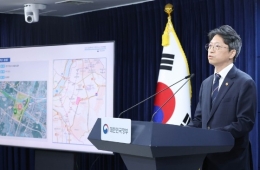
[2026 Parliamentary Audit] Choi Hyungdu: "Government-secured 260,000 GPUs: Carefully scrutinize 'actual use'"
Rep. Choi Hyungdu, Opposition Chief Parliamentary Secretary on the National Assembly Science, ICT, Broadcasting and Communications Committee
Cyberattack response, SMRs, physical AI and public broadcasting among issues
Holds government to account in
Rep. Choi Hyung-doo, the opposition secretary on the National Assembly’s Science, ICT, Broadcasting and Communications Committee, said on the 28th, as he wrapped up this year’s parliamentary audit, “I will follow through on the issues identified during the audit through next year’s budget review and follow-up legislation.”
Rep. Choi identified “the lack of follow-through in the government’s AI infrastructure policy” as a key issue in this year’s audit of the committee. He pointed out that 81% of the 260,000 graphics processing units (GPUs) touted by the government were part of private companies’ procurement plans with no agreements in place, and that even the amount the government said it had secured included only about 13,100 GPUs that researchers and businesses could actually use.

Rep. Choi said that of the GPUs purchased this year for KRW 2 trillion, budget execution stood at 80% as of early October, while the actual delivery rate was only 27%. “The GPUs are arriving, but the large-scale AI data centers needed to accommodate them are not scheduled to become operational until 2029–2030, and even the government’s estimates of annual electricity demand are unclear,” he said.
“AI G3 must be proven through execution, not slogans,” he said, adding, “Performance should be measured not by ‘how many GPUs have been purchased’ but by ‘how much they are being used.’”
Rep. Choi called for the government to disclose the status of GPU contracts, deliveries and operations at each stage, and to combine plans for additional purchases, GPUs, data centers, electricity and allocation into a single implementation plan. He also called for a system to recover and reallocate unused GPUs, as well as an ecosystem that connects talent, software as a service (SaaS) and industrial AI transformation (AX).
Rep. Choi also said that, amid recurring hacking incidents, the Korea Internet & Security Agency (KISA) needs a system for proactive on-site inspections rather than one that waits for incidents to be reported and responds afterward. In the small modular reactor (SMR) sector, he urged the introduction of a manufacturing permit system that would allow safety to be reviewed from the production stage, as well as the development of an industrial ecosystem centered on Changwon.
Hot Picks Today
 "Two Spend 500,000 Won in a Flash, Yet Wait Two Hours?" ... 'Dreamland' Shunned by Kids and Foreign Tourists
- The Era of Getting 200 Million Won After 30 Years Is Over... A Japanese Bank's "Perpetual Department Head" Who Just Clocked In Cries Out
- Spain Hit by Its Worst Tragedy... Lee Kangin, Moreno and Real Madrid Join Soccer World in Mourning
- They Said, “Make It Your Home for Life” - Then Suddenly Kicked 200 Passengers Off... What Happened to the Around-the-World Cruise?
- "130 Rice Bowls Sold Out in a Day"... 'Unfiltered Face' Adds 8 Million Won to Night Market Sales: China's Bungeunwoo
In physical AI, he proposed testing the Korea Institute of Science and Technology’s (KIST) humanoid robot “Kapex” at manufacturing sites in Changwon and South Gyeongsang Province, and combining manufacturing data with the robotics parts ecosystem. The audit also closely examined public broadcasters’ governance structures, personnel and administrative issues at the Broadcasting and Media Communications Review Commission, and the responsibility of overseas Big Tech platforms for the spread of disinformation and criminal proceeds.
© The Asia Business Daily. All rights reserved. Unauthorized AI training and use prohibited.