"AI for 'Choosing and Focusing' in Drug Development"... Strategies for Its Use Discussed at BIX 2026
Stem Cell Organoid Analysis and Toxicity Prediction
"Adjust Development Strategies Based on AI Analysis"
Boost Research Efficiency and Transform Experimental Methods
Artificial intelligence (AI) is expanding beyond the discovery of drug candidates to applications across the drug development process, including prioritizing development programs, predicting drug toxicity, and automating experiments. Experts said AI should be actively used not only to analyze the vast amounts of data generated by stem cell-derived organoids but also to identify research programs with a low likelihood of success.
Strategies for AI-driven drug development emerged as a key topic at BioPlus-Interphex Korea 2026 (BIX 2026), which opened on the 28th at COEX in Gangnam-gu, Seoul. Keynote speaker Sally Temple, Chief Scientific Officer (CSO) of Luxa Biotechnology, emphasized that combining stem cells and AI is creating new opportunities for disease research and drug development.

Sally Temple, chief scientific officer (CSO) of Luxa Biotechnology, speaks during the keynote address at Bio Plus-Interphex Korea 2026 (BIX 2026), which opened on the 28th at COEX in Gangnam-gu, Seoul. Photo by Lee Seongmin
View original imageDr. Temple and her research team use 3D organoids made from stem cells to study disease mechanisms and therapeutic targets and to screen drug candidates. Organoids are experimental models that mimic some of the structures and functions of actual organs. As the range of research subjects and the scale of experiments grow, so does the volume of data that must be analyzed.
"AI can be used to prioritize specific targets, predict the safety and toxicity of drugs, and analyze clinical data," she said. "The combination of various technologies is making this the most exciting time in drug development."
At a specialized session held afterward, titled "What to Develop and Where to Focus: How AI Is Changing Decision-Making in Biopharma," speakers said AI should be used not merely as a research aid but also to guide development strategy.
Christopher Lee, CEO of BioBox, said, "Even if AI predicts that a particular drug development program has a low likelihood of success, companies with only one or two programs in their pipelines are reluctant to accept that result. They need to be able to accept the analysis and adjust their development strategies."
He added, "Even large pharmaceutical companies find it difficult to change their existing decisions because discontinuing a program can affect the relevant teams and employees. They need to be able to accept AI's findings and improve their research, even when AI challenges past decisions or existing claims."

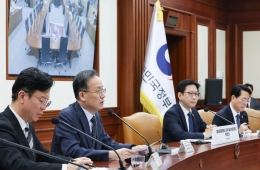
A panel discussion is underway at a special session of BioPlus-Interphex Korea 2026 (BIX 2026), which opened on the 28th at COEX in Gangnam-gu, Seoul. Photo by Lee Sungmin.
View original imageSpeakers also stressed that AI cannot replace researchers' expertise. "Rather than giving 100 scientists tools that boost productivity by 10%, it's important to use AI to greatly expand the capabilities of five to 10 outstanding scientists," Lee said, explaining that researchers should combine their experience and judgment with AI.
Kim Handol, CEO of Variational AI, cited speed and efficiency as reasons small and midsize biotech companies should use AI. "The only competitive advantages small and midsize companies can have over large companies are speed and efficiency," he said. "AI makes that possible."
Speakers also said that automating experiments should involve more than simply transferring existing tasks to machines. "Replacing with robots the experimental procedures that people have been carrying out is not the most efficient way to use automation and AI," said Vice President Paloma Prieto. "Successful examples show that technology providers go beyond simply selling products to become genuine partners to pharmaceutical companies, working with them to develop technologies suited to their research objectives."
Hot Picks Today
 "Better than stocks and real estate": Chinese investors rush in and snap up 430 metric tons of 'this' in a week
- "It's Never Too Late in Life": 50-Year-Old Grade 9 Civil Servant Shares His First-Day-at-Work Experience
- "I'll Pay 6 Million Won for an Internship at a Major Company"... Chinese College Students Pay "Placement Fees" to Get Full-Time Jobs
- Apartment Complex 'Abuzz' After Elementary Schoolgirl Goes Missing... Messages Flood Group Chat Late at Night
- "Even with 9 Billion Won, I Can't Quit My Job"... The Unexpected Concerns of a Major-Company Employee in His 40s After an 'Investment Windfall'
Kim Soyeon, director at Providence Healthcare Ventures, who chaired the session, said, "AI can do many things, but advancing development in practice requires evidence that meets regulatory requirements." She called for collaboration across disciplines, including AI experts, bioinformaticians, and biostatisticians.
© The Asia Business Daily. All rights reserved. Unauthorized AI training and use prohibited.