Gumi Set for 25 Trillion Won in Advanced Industry Investments... Government Also Accelerates Manufacturing AI Transformation
Trade, Industry and Energy Minister Kim Jeonggwan Meets with Seven Investor Companies, Including LG Innotek
Efforts Underway to Address Investment Challenges in Semiconductors, Robotics, Defense and AI Data Centers
AX Alliance Launched in Gumi, Cheongju and Pohang... To Expand to 25 Nationwide by 2030

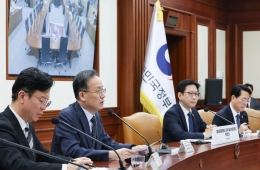
Minister Kim Jeong-kwan delivers opening remarks at a meeting with companies investing in the Gumi area, held in a conference room at the Gumi Convention Center in Gumi, North Gyeongsang Province, on the 28th. Ministry of Trade, Industry and Energy.
View original imageCompanies are pursuing investments totaling approximately 25 trillion won in advanced industries in Gumi, North Gyeongsang Province, including semiconductors, robotics, defense, rare earths and AI data centers. The government plans to address obstacles that arise during the investment process, such as securing power, infrastructure and talent, and expand the AI transformation (AX) of manufacturing, centered on industrial complexes, to develop Gumi into an advanced-industry hub for the Daegu-Gyeongbuk region.
On the 28th, Minister of Trade, Industry and Energy Kim Jeonggwan visited Gumi, North Gyeongsang Province, where he inspected LG Innotek's production site and attended the opening ceremony for the Battery Testing and Demonstration Center, a meeting with local investor companies, and the third M.AX Conference on Regional Expansion of AI Transformation in Manufacturing. This was his ninth field visit to a region under the "Five Mega-Regions and Three Special Provinces" initiative, following his visit to Gangwon on the 14th. It was his second visit to the Daegu-Gyeongbuk region, after a trip to Daegu on February 5.
Kim first visited LG Innotek's Gumi Plant 4 and toured the production line for flip-chip ball grid array (FC-BGA) semiconductor substrates, a key component used in high-performance semiconductors and processors for data centers.
FC-BGA is a high-value-added semiconductor packaging substrate that connects semiconductor chips to main boards and is used to transmit signals and supply power in high-performance semiconductors. LG Innotek announced its related investment plan at a briefing on the vision for developing advanced industries in the Yeongnam region on July 3.
"The Ministry of Trade, Industry and Energy will closely monitor and actively support investments by key companies, including LG Innotek, so that Gumi can continue to grow as a major production hub for semiconductor components," Kim said.
He then attended the opening ceremony for the Battery as a Service (BaaS) Testing and Demonstration Center, built within the Gumi National Industrial Complex. The event was attended by senior officials from relevant organizations, including North Gyeongsang Province, Gumi City and the Korea Testing & Research Institute.
Battery as a Service (BaaS) is a service model in which batteries are leased, exchanged or reused rather than directly owned. The newly completed center is a facility that comprehensively verifies the safety and performance of used batteries so they can be reused instead of simply discarded.

At the completion ceremony for the Battery Testing and Demonstration Center in Gumi, North Gyeongsang Province, on the 28th, industry, academia, research and government representatives, including Minister of Trade, Industry and Energy Kim Jung-kwan (10th from left), take part in a button-activated air-shot ceremony. Ministry of Trade, Industry and Energy.
View original imageThe center will establish systems for grading and sorting used batteries and verifying their safety and reliability, and will support the testing of new business models such as battery leasing, subscriptions and reuse.
"The center opened today signals the start of a shift in our battery industry toward new business models such as battery subscriptions and rentals," Kim said. "We will provide all necessary support to help the used-battery reuse industry take root as a new growth engine for the Gumi region."
In the afternoon, he held a luncheon meeting with seven local investor companies at the Gumi Convention Center to review investment progress and discuss challenges.
Those attending included LG Innotek, SK siltron and JAHWA Electronics from the semiconductor sector; Samsung Electronics from the robotics sector; LIG D&A from the defense sector; LS Cable from the rare-earth sector; and Samsung SDS from the AI data center sector. The seven companies are pursuing investment plans totaling 25 trillion won in the Gumi region.
The companies described difficulties they face in carrying out their investments, including securing power supplies, building infrastructure and recruiting specialized personnel, and called for policy support from the government. In particular, they discussed ways to improve the investment environment so that large-scale investments in advanced industries lead to the construction of production facilities and the revitalization of the local economy.
An event to promote the AI transformation of manufacturing was also held in Gumi that day. Kim attended M.AX Meetup Day, which brought together AI specialists and local manufacturers, and the third M.AX Conference on Regional Expansion. Around 250 people took part, including representatives from 10 AI specialist companies and 150 manufacturing companies.
At Meetup Day, specialist companies that have carried out manufacturing AX projects, including the establishment of AI factories, introduced potential applications of AI and ways to implement it to local manufacturers. Tailored consultations were also held to address the specific needs of sectors such as semiconductors, steel and automobiles.
An analysis by the Ministry of Trade, Industry and Energy of 38 successful AI factory cases found that productivity rose by an average of 30.1% after AI was introduced, while defect rates fell by 15.5%.
The regional expansion conference that followed discussed strategies and action plans for the AI transformation of manufacturing at individual industrial complexes. In particular, the MINI Alliance was newly launched to advance tailored AI transformation at the Gumi, Cheongju and Pohang industrial complexes, which were selected as AX demonstration complexes in July.
With this launch, the number of MINI Alliances operated by the industrial complex AX division has grown to 13. The Ministry of Trade, Industry and Energy plans to increase that cumulative total to 25 by 2030 and expand the AI transformation of manufacturing nationwide, centered on industrial complexes.
Hot Picks Today
 "Better than stocks and real estate": Chinese investors rush in and snap up 430 metric tons of 'this' in a week
- "It's Never Too Late in Life": 50-Year-Old Grade 9 Civil Servant Shares His First-Day-at-Work Experience
- "I'll Pay 6 Million Won for an Internship at a Major Company"... Chinese College Students Pay "Placement Fees" to Get Full-Time Jobs
- Apartment Complex 'Abuzz' After Elementary Schoolgirl Goes Missing... Messages Flood Group Chat Late at Night
- "Even with 9 Billion Won, I Can't Quit My Job"... The Unexpected Concerns of a Major-Company Employee in His 40s After an 'Investment Windfall'
"AX is no longer a choice but a matter of survival, and companies in industrial complexes are no exception," Kim said. "We will establish a cooperation platform connecting manufacturers in industrial complexes with AI companies and develop AI specialists with expertise in manufacturing so that industrial complexes can become hubs for expanding M.AX." He added, "Above all, the awareness of company chief executives (CEOs) is important, so I urge you to show a strong commitment to M.AX."
© The Asia Business Daily. All rights reserved. Unauthorized AI training and use prohibited.