Hadong County Reviews Key 2027 Administrative Plans, Discusses 170 New Initiatives
Major Business Plan briefing held; projects focused on residents' livelihoods and the local economy reviewed
Discussed plans to boost farm income, attract investment to industrial complexes, expand integrated care and improve transportation
Initiatives to be included in the initial 2027 budget after assessing effectiveness and fiscal conditions
Hadong County in South Gyeongsang Province reviewed 170 new policy initiatives and major pending projects as it drew up its 2027 county administration plan, and discussed how to advance projects needed for residents' daily lives and the local economy.
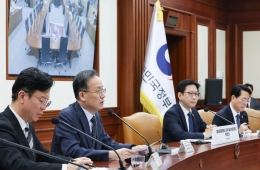
The county said on Oct. 28 that it had held a briefing on its “2027 Major Business Plan” on Oct. 22 and 27 in a small conference room at the county office, chaired by County Governor Kim Hyunsoo.

[Photo provided by Hadong County] Hadong County Governor Kim Hyun-soo chairs a briefing on the 2027 major business plan in a small conference room at the county office, discussing the direction for implementing new policy initiatives and key projects.
View original imageSenior officials, including heads of bureaus, offices, divisions and departments, attended the briefing to review 170 new policy initiatives and proposed improvements to existing key projects. They discussed the need for and feasibility of each project, as well as fiscal conditions.
The county focused on linking results in agriculture, industry and tourism to local income, while strengthening public services closely tied to residents' daily lives, including care, transportation and education.
In agriculture, officials discussed initiatives such as fostering prosperous farmers, jointly sorting agricultural products and providing logistics cost support to increase farm income. For efforts to develop local ventures using regional resources, they reviewed support at each stage of growth, including product development, improvements to processing facilities and finding sales channels.
In industry, they reviewed ways to improve conditions for companies moving into Daesong Industrial Complex and investment attraction strategies to normalize operations at Galsa Industrial Complex.
They also discussed ways to train talent needed by local industries and support youth employment and settlement in the area, in connection with plans to establish a Hadong campus of Changwon National University.
In welfare, they examined ways to improve the operation of “Hadong-style Integrated Care,” which involves dedicated staff in towns and townships identifying residents in need and connecting them with medical care, long-term care, meal and housekeeping services.
New initiatives also included “Care Taxi,” which provides transportation for people accompanying patients to medical appointments, and home-visit hair and beauty services for residents with limited mobility.
In transportation, officials presented a plan to pilot demand-responsive bus services in Hwagae-myeon. They also reviewed plans for “Hadong Pass,” which would link demand-responsive buses, whose routes operate according to user demand, with the existing 100-won Happy Taxi service.
In education, officials proposed the “Dream Up Career and College Admissions Project” to support students with career and college planning. The initiative includes one-on-one college admissions counseling, tailored admissions information, mock interviews and career exploration programs.
In tourism, they discussed developing tourism products that combine local food with rural experiences and improving the visitor and experiential facilities at Choi Champan House.
They also reviewed ways to increase tourists' length of stay and spending in the area, linking that spending to income for lodging, restaurants, experience-based businesses and farms.
Officials also presented a plan to assess the feasibility of establishing a Wellness Tourism and Culture Foundation to professionally manage festivals, tourism promotion and cultural and arts projects.
In administration, they discussed having the County Residents Support Office coordinate the handling of complex civil complaints involving multiple departments, as well as drawing up a master plan for “Hadong-style Basic Society” to comprehensively review livelihood support policies covering income, housing and care.
Hadong County plans to refine the plans for each project based on opinions raised at the briefing and set priorities after considering policy impact and fiscal conditions.
Existing projects will be improved to address inconveniences identified by residents using the services. For projects requiring cooperation among departments, the county plans to specify schedules and responsibilities and link them to the drafting of its initial 2027 budget.
“When implementing policies, we need to strike a balance between projects residents want and those they truly need,” County Governor Kim Hyunsoo said. “Please listen carefully to residents' opinions, assess each project's necessity and effectiveness, and set priorities accordingly.”
Hot Picks Today
 "Better than stocks and real estate": Chinese investors rush in and snap up 430 metric tons of 'this' in a week
- "It's Never Too Late in Life": 50-Year-Old Grade 9 Civil Servant Shares His First-Day-at-Work Experience
- "I'll Pay 6 Million Won for an Internship at a Major Company"... Chinese College Students Pay "Placement Fees" to Get Full-Time Jobs
- Apartment Complex 'Abuzz' After Elementary Schoolgirl Goes Missing... Messages Flood Group Chat Late at Night
- "Even with 9 Billion Won, I Can't Quit My Job"... The Unexpected Concerns of a Major-Company Employee in His 40s After an 'Investment Windfall'
To ensure the 170 new policy initiatives are effective, it is important to carefully assess the availability of funding and residents' needs, check for overlap with existing projects, and prioritize the budget accordingly.
© The Asia Business Daily. All rights reserved. Unauthorized AI training and use prohibited.