SK hynix says, "DRAM and HBM are sold out for the next three years"... "Share buybacks and cancellations to address undervaluation" (Comprehensive)
Kwak Nojeong: "The Business Environment Is Undergoing Fundamental Change"
Q3 Revenue of 104.6 Trillion Won, Operating Profit of 83.3 Trillion Won, Both Record Highs
HBM Demand More Than Double Supply Capacity
HBM4 to Become a "Flagship" in Q4; Yi
As SK hynix posted record-high results for the sixth consecutive quarter, its President and CEO, Kwak Nojung, expressed confidence in its medium- to long-term growth prospects on Oct. 28, saying, "The business environment underpinning our performance is itself changing." Building on this cash-generating capacity, the company plans to return approximately 100 trillion won to shareholders this year alone, including more than 60 trillion won for share buybacks and cancellations, in an effort to actively address the stock's undervaluation.

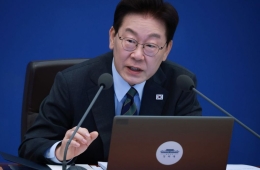
Kwak Nojung, president and CEO of SK hynix, speaks with reporters at Purdue University in Indiana on Aug. 27 (local time). Yonhap News.
View original imageDuring its conference call on its third-quarter results held today, SK hynix said its memory production capacity for the next three years was already fully booked. The company said, "Taking into account the long-term supply agreement (LTA) volumes we have already secured and the contracts currently under discussion with customers, virtually all of our DRAM and high-bandwidth memory (HBM) capacity for the next three years, through 2029, is effectively sold out."
The company has so far signed five-year LTAs with 14 major customers, including leading global cloud service providers (CSPs). These agreements cover more than 50% of its total production capacity for 2027-2028. "The trust we have built with customers through our technological competitiveness has translated into long-term contracts, establishing clear visibility into medium- to long-term demand and a stable earnings base," Kwak said. "Our challenge going forward is to make this transformation a sustainable competitive advantage and become the first partner customers turn to for next-generation products."
The company said, "Memory supply is not growing as fast as demand, making it difficult to fully meet customer requirements in the short term." It added, "Given the increasing complexity of advanced processes and the long lead times involved in building new production facilities, the supply shortage is expected to continue through 2030." The HBM shortage, in particular, is worsening as HBM is a key component of AI accelerators. "Current customer requests for HBM are more than twice the volume we can supply," the company said.
Regarding recent moves in some parts of the market to reduce the number of HBM stacked layers, the company said, "This is a strategy by customers seeking to increase the number of cubes so they can build more accelerators and computing systems with limited HBM supply, and is a clear example of demand far outstripping supply." It added, "Even if the number of stacked layers is reduced, greater capacity per die can compensate for the lower capacity per HBM unit." The company dismissed concerns, saying, "Even taking the possibility of such specification adjustments into account, our medium- to long-term HBM demand outlook remains unchanged."
The company also emphasized that its mass-production yields are among the industry's best. SK hynix said, "HBM3E has exceeded its target for mature yields, while HBM4 yields have improved steadily, allowing us to raise our target."
Chief Financial Officer (CFO) Kim Woo-hyun said, "We are rapidly ramping up production at Cheongju M15X and expect to reach full capacity by year-end." He added, "In the fourth quarter, HBM4 is expected to surpass HBM3E in its share of total shipments and revenue and establish itself as our flagship product." Meanwhile, sampling of next-generation HBM4E was completed in the second quarter, and evaluations are proceeding smoothly in line with customer schedules. The company is also working closely with big tech customers on "custom HBM" optimized for their systems and workloads.
Today, SK hynix also announced plans to return a total of 100 trillion won to shareholders this year, sharing its business success with them. The plan follows the principle of returning at least 50% of free cash flow (FCF) to shareholders. Specifically, the company will distribute more than 30 trillion won in cash dividends and spend at least 60 trillion won on share buybacks and cancellations. At a board meeting today, it approved a cash dividend of 24 trillion won (20,000 won per share, including a special dividend of 10,000 won per share from returns on its Kioxia investment) and 20 trillion won in share buybacks.
Explaining why it was increasing the share of its shareholder returns allocated to buybacks and cancellations, SK hynix said, "We believe the current share price is undervalued and does not adequately reflect the earnings and cash flow the company is generating." It added, "Buying back and canceling our own shares is the most effective way to increase per-share value." The company plans to continue buybacks each quarter, with the amount determined after considering factors including valuation and cash flow.
The initial public offering (IPO) of its sub-subsidiary Solidigm has been officially withdrawn. Kwak said, "Considering current financial market conditions and the semiconductor industry's business environment, we have concluded that it would be difficult to achieve the expected benefits of an IPO at this time." He added, "We will halt consideration of both a pre-IPO and an IPO and focus on strengthening our competitiveness and growth in the AI data center storage market. We will explore investment and financing options that align with enhancing corporate and shareholder value."
Meanwhile, buoyed by surging demand for AI memory, SK hynix posted third-quarter revenue of 104 trillion 600 billion won this year, surpassing 100 trillion won in quarterly revenue for the first time. Operating profit also reached 83 trillion 300 billion won, setting a new record. These figures were up 32% and 38%, respectively, from the previous quarter and surged 328% and 632%, respectively, from a year earlier. The operating margin reached 80%, up 4 percentage points from the previous quarter.
Hot Picks Today
 "Three times Lee Jaeyong's fortune?"... Meet China's richest man, who amassed 134 trillion won at 43.
- "What Happened to Mighty Tesla?"... "Cut Your Exposure," Analysts Warn [Click eStock]
- "I Made an Extra 6 Million Won a Month"... "This Can Actually Make Money?" The Twist Behind a Few Pieces of Junk
- "27,000 Won for an Hour of Walking?"... Robot Dog-Walking Jobs in the U.S. Now Pay by the Hour
- "If You See It, Avoid It"... 'Superfood' Fruit Kills 12-Day-Old Baby
Full-scale shipments of HBM4 and a sharp increase in server DDR5 sales drove earnings growth. The average selling price (ASP) of DRAM rose by a rate in the high 20% range, while NAND profitability was maximized by expanded sales of high-value-added products, including enterprise SSDs (eSSDs) based on 321-layer TLC.
© The Asia Business Daily. All rights reserved. Unauthorized AI training and use prohibited.