Ruling Party, Government Fail to Reach Decision on Virtual Asset Tax; Kim Minseok: "Many Favor Deferring Taxation"
Oh Kihyung: "Some say it's time to tax, while others call for improvements"
Land Committee talks: "Prioritize the Special Act on Administrative Capital and the Multifunctional Administrative City Act"
The ruling party and the government failed to reach a conclusion on taxing virtual assets. With opinions divided between those who say the relevant system should be improved first and those who argue that taxation should begin this time, they decided to continue their review.
On October 28, the Democratic Party of Korea and the government held a consultation at the National Assembly on taxing virtual assets. After the meeting, Assemblyman Oh Ki-hyung, the Democratic Party's secretary on the National Assembly's Finance and Economy Planning Committee, said, "Even within the party, some have argued that we should proceed now, since the tax has already been postponed three times in principle, while others have called for further improvements. We will keep various options open, review the issues, and make a final decision."

Kim Minseok, leader of the Democratic Party of Korea, talks with Policy Committee Chair Kwon Chilsung at a government-party consultation on virtual asset taxation at the National Assembly Members' Office Building on Oct. 28, 2026. Photo by Yoon Dongju
View original imageNo conclusion was reached on the urgent issue of issuing a public notice, either. Assemblyman Oh said, "If we can prepare the notice by the end of this month, we will; otherwise, we will do so later. I can't give you a definite answer."
This differed from expectations that the ruling party and the government would agree to postpone taxation, suggesting that disagreements emerged during their discussions. However, at a Supreme Council meeting after the consultation, Democratic Party leader Kim Minseok said, "Many people at the ruling party-government consultation expressed the view that it would be preferable to first update and improve the system related to virtual asset taxation, and then postpone taxation for a certain period. We will gather public opinion on this issue and hold final discussions between the party and the government to reach a reasonable outcome."
Democratic Party lawmakers on the National Assembly's Land, Infrastructure and Transport Committee and Minister of Land, Infrastructure and Transport Hong Ji-seon held a separate ruling party-government consultation to discuss key bills for the regular session. After the meeting, Assemblyman Bok Kiwang, the Democratic Party's secretary on the committee, said, "We discussed legislative priorities including balanced national development, housing stability, and the logistics and transport industries. In particular, the party and the government agreed to prioritize the Special Act on Administrative Capital and the Multifunctional Administrative City Act."
Hot Picks Today
 "Koreans Spend 1 Million Won Each and Come Back"... 'They Said They Were Going for Value for Money,' but Open Their Wallets Wide in Japan
- "I Drank It Every Day Instead of Water": The Surprising Drink That Could Cause Kidney 'Stones'
- [Exclusive] 15 Government Committees Have 'Zero' Appointed Female Members
- "I Have 9 Billion Won, but I Still Can't Quit"... The Unexpected Worry of a Major-Company Employee in His 40s Who Hit It Big with Investments
The Special Act on Administrative Capital defines Sejong City's status as an administrative capital, while amendments to the Multifunctional Administrative City Act set out plans to relocate five government ministries to Sejong starting next year. The committee will hold a subcommittee meeting today to review the Special Act on Administrative Capital and other bills. Assemblyman Bok said, "If this bill does not pass, we do not intend to take up the other bills. We will make sure to resolve this long-standing national task, which has remained unresolved for 20 years."

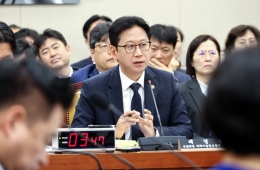
Bok Giwang, the ruling party’s secretary on the National Assembly’s Land, Infrastructure and Transport Committee, delivers opening remarks at a party-government meeting to discuss key livelihood and growth bills for the regular session, held at the National Assembly Members’ Office Building on Oct. 28, 2026. Photo by Yoon Dongju
View original imageThe ruling party and the government also agreed to speed up the Urban and Residential Environment Improvement Act, whose passage had been delayed in the name of securing agreement between the ruling and opposition parties. Assemblyman Bok said, "For the Urban and Residential Environment Improvement Act currently pending before the plenary session, we proposed to the People Power Party, as an amendment to the version currently on the agenda, an option allowing a 120% floor-area ratio for private-sector projects, but we have received no response. We have concluded that we cannot wait any longer. A key point of the ruling party-government consultation was to pass the Act as soon as possible when the time comes for its consideration, in order to address the supply bottleneck in Seoul and the greater metropolitan area." Assemblyman Bok expected the amended version to be passed instead of the version pending before the plenary session.
© The Asia Business Daily. All rights reserved. Unauthorized AI training and use prohibited.