Brokerages, Asset Managers, Crypto Exchanges Breached... Hacking Fears Rock Entire Financial Sector
Personal Information Leaked at Daishin Securities, Mirae Asset Global Investments and Bithumb
Brokerages, asset managers and cryptocurrency exchanges have all been breached. The personal information leak that began in the banking sector has spread across the financial investment industry. Critics say that while cyberattack methods, including AI-powered hacking, are becoming increasingly sophisticated, the financial sector is failing to keep pace in its response, despite handling customers' sensitive financial information. Lee Chan-jin, governor of the Financial Supervisory Service, said cyberattacks are spreading to non-core facilities at financial companies and called for stronger IT security.

According to the financial investment industry on October 28, Daishin Securities confirmed that the personal and credit information of 38,490 customers had been leaked. The company said it would notify affected customers individually and compensate those who suffered losses due to the leak in accordance with applicable laws and procedures.
On October 17, Daishin Securities detected signs of unusual access by a hacker to a server linked to the remote opening of securities accounts for discretionary investment services. It blocked the internet protocol (IP) address used in the attack and IP addresses used to circumvent access controls, and reported the incident to the regulatory authorities. The company confirmed the customer information leak on October 26.
The leaked information comprised eight items: customer names, email addresses, home addresses, telecommunications IDs, bank names, deposit and withdrawal account numbers, Daishin Securities account numbers, and mobile phone numbers. The company said the deposit and withdrawal account numbers, Daishin Securities account numbers, and mobile phone numbers were encrypted. So far, no signs of secondary damage or illegal access by hackers to core business systems have been found.
On the same day, cryptocurrency exchange Bithumb also announced that personal information had been leaked in a hack of its internal mobile system. The incident is believed to have occurred the previous day, October 27. On the day it became aware of the incident, Bithumb notified the Korea Internet & Security Agency (KISA) and the Personal Information Protection Commission. Bithumb is reportedly analyzing the precise scope of the leak, including the possibility that member information was exposed.
Mirae Asset Global Investments also confirmed a hacking incident and launched a detailed investigation into its cause and scope. However, the company added that the system was not a service for individual customers, so information about ordinary investors was not affected. A Mirae Asset Global Investments official said, "Based on what we have confirmed so far, the leaked information was limited to data in some business systems. No unique identifying information, such as resident registration numbers, passport numbers, driver's license numbers, or alien registration numbers, nor sensitive information or personal credit information, was leaked."
With the additional personal information breaches at Daishin Securities, Bithumb and Mirae Asset Global Investments on October 28, concerns are growing across the financial sector that virtually all areas, with the exception of card companies, have been exposed to hacking attacks. After the hacking incidents in the banking sector, financial investment firms, including brokerages, took active steps to strengthen security, such as sharing and blocking attack IP addresses and methods. Yet vulnerabilities have still been identified.
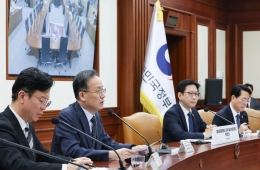
At a breakfast meeting with the chairpersons of bank holding company boards at the FSS's headquarters in Yeouido on October 28, Governor Lee mentioned the hacking incidents at financial investment firms and again called for stronger IT security. "As AI is used as a hacking tool, security vulnerabilities will be easier to detect, and simultaneous attacks will become commonplace," he said, pointing to the growing sophistication of cyberattack methods. He added, "Recognizing IT security as a core business function that protects customers' assets and information and underpins trust in the financial system, I urge boards to take the lead in strengthening their IT security capabilities." The FSS is currently gathering further information on the breaches at these financial companies, including by sending an on-site inspection team to Daishin Securities.
Experts are concerned about secondary damage following the personal information leaks. They warn that customers' sensitive financial information could be exploited in loan scams involving impersonation of financial company employees, as well as in phishing and smishing attacks. Many also say that the response by financial authorities and companies must go beyond strengthening individual companies' defenses and restoring systems.
Hot Picks Today
 "Wait 90 minutes or pay 37,000 won?" Japan's 'Fast Pass' lets patients skip hospital lines for a fee
- "It's Never Too Late in Life": 50-Year-Old Grade 9 Civil Servant Shares His First-Day-at-Work Experience
- "Koreans Spend 1 Million Won Each and Come Back"... 'They Said They Were Going for Value for Money,' but Open Their Wallets Wide in Japan
- Landlord in 'Mummified Body' Dumping Case Says "I Thought It Was a Doll"... Arrest Warrants to Be Sought Today
- "I Have 9 Billion Won, but I Still Can't Quit"... The Unexpected Worry of a Major-Company Employee in His 40s Who Hit It Big with Investments
Hwang Seok-jin, a professor at Dongguk University's Graduate School of International Information Security, said, "Hacking attacks disguised as legitimate access have become more common, making it take a long time for companies to determine whether they have been breached and assess the scale of the damage. Responses such as adding firewalls or security personnel have limits. The government should establish guidelines to help the private sector build its response capabilities through simulated hacking exercises."
© The Asia Business Daily. All rights reserved. Unauthorized AI training and use prohibited.