Deputy Prime Minister Lee Hyeongil: "Science is the driving force behind growth... economic and industrial policies must work hand in hand"
Deputy Prime Minister and Minister of Finance and Economy Lee Hyeongil said on October 28, "The driving force behind our economic growth is scientific and technological innovation." He stressed, "From research and development of fundamental technologies to demonstration and commercialization, and ultimately to fostering new industries, science and technology policy must now work hand in hand with economic and industrial policy."
At a joint meeting of the Economic Relations Ministers' Meeting and the Science and Technology Relations Ministers' Meeting held that day at Government Complex Seoul, Deputy Prime Minister Lee and Deputy Prime Minister and Minister of Science and ICT Bae Kyunghoon co-chaired the meeting. Lee said, "Going forward, I will work closely with the deputy prime minister for science and technology and other ministries to develop concrete plans for the Republic of Korea's future growth."
This was the first joint meeting with the Economic Relations Ministers' Meeting since the Science and Technology Relations Ministers' Meeting was launched in November last year. It was significant as the first government-wide forum for cooperation to discuss economic and industrial policy alongside science and technology policy.
"Solid growth continued in the third quarter... Focusing on easing polarization for 'Growth for All'"
Regarding the flash estimate of third-quarter GDP released the previous day, Deputy Prime Minister Lee said, "The economy continued its solid growth, rising 1.0% from the previous quarter, bringing us significantly closer to growth in the mid-3% range this year and per capita national income of $40,000." He also said, "The current account posted a surplus of $116.6 billion in the second quarter, the world's second-largest after China. For the first time ever, it even exceeded the combined surplus of Germany and Japan, both manufacturing powerhouses." He added, "We expect expanded exports and facility investment to improve productivity across the economy and strengthen its growth potential."
Deputy Prime Minister Lee also stressed, "The ultimate goal of growth is to improve people's lives. To bring about tangible changes in people's lives and achieve sustainable 'Growth for All,' it must be accompanied by 'easing polarization.'" He added, "We will focus the capabilities of the entire government on easing polarization among industries, regions, and generations as it emerges amid rapid growth, including the sweeping transformation driven by AI."

Vice Prime Minister and Minister of Finance and Economy Lee Hyung-il (right) and Vice Prime Minister and Minister of Science and ICT Bae Kyunghoon attend a joint meeting of the Economic Ministers’ Meeting and the Science and Technology Ministers’ Meeting at the Seoul Government Complex in Jongno-gu, Seoul, on the 28th. Yonhap News Agency
View original imageDeputy Prime Minister Bae: "Accelerating the AI transition... stepping up efforts to secure key future technologies"
Deputy Prime Minister Bae said, "The Republic of Korea's competitiveness in artificial intelligence and science and technology is receiving high international recognition. The country has joined the top-tier group of 'AI-leading nations' alongside the United States and China, and ranked first in Asia and fourth in the world in the Global Innovation Index for the second consecutive year."
He continued, "These valuable achievements were made possible by the government's strategic investments and the private sector's ceaseless innovation and bold efforts." He stressed, "To ensure these achievements improve people's quality of life, we must accelerate the nation's AI transition and step up efforts to secure key future technologies through the seven SEED projects."
Deputy Prime Minister Bae added, "Close cooperation among ministries is essential for the results of technology development to lead to the creation of new industries and markets. Building on today's first joint meeting, we will pool our capabilities in science and technology and economic policy to create new growth engines."
The meeting covered a wide range of key agenda items, including ▲plans to advance three key social policies ▲measures to strengthen the role of retirement pensions ▲the direction of the seven SEED projects and plans for cross-ministry cooperation ▲the maritime and fisheries AI transformation strategy ▲plans to build a next-generation shared local-government administration system ▲measures to swiftly advance the ninth Regional Revitalization Investment Fund project ▲a review of responses to the Middle East war ▲and the end of the ban on hoarding urea solution, urea, syringes, and hypodermic needles.

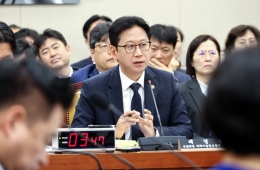
Deputy Prime Minister and Minister of Finance and Economy Lee Hyeongil speaks at a joint meeting of economic ministers and science and technology ministers at the Government Complex Seoul in Jongno-gu, Seoul, on the 28th. Yonhap News Agency
View original imageExternal funding of retirement benefits to be mandatory at workplaces with 100 or more employees from 2028... "fund-based" system to be introduced
The meeting first discussed the "Measures to Strengthen the Role of Retirement Pensions," developed jointly by labor, management, and the government based on a tripartite declaration issued in February. Following a preparation period next year, external funding of retirement benefits will be made mandatory in stages, starting in 2028 at workplaces with 100 or more employees, to prevent unpaid severance benefits. Specific plans were also drawn up to introduce and operate a fund-based retirement pension system. The system will seek to improve returns through professional asset management while setting strict fiduciary responsibilities to safeguard workers' benefit entitlements. The Ministry of Employment and Labor, the responsible ministry, and financial authorities will work together on authorization, administration, and oversight to ensure stable operation.
Other reforms are also planned, including revising evaluations of pension providers to focus on pension services and returns, and bringing forward the date when default options apply. The detailed plans will be announced after consultations between the government and ruling party at the Climate, Energy, Environment and Labor Committee on October 29. The government plans to coordinate with the National Assembly and swiftly pursue legislation and follow-up measures.
Seven SEED projects and maritime and fisheries AI transformation launched... 600 billion won AI data center to be built in Pohang
The government will also accelerate efforts to secure future growth engines through the "Direction for the Seven SEED Projects and Cross-Ministry Cooperation Plans." To achieve the key targets for each of the seven SEED projects for 2030 and 2035, ministries will strategically link their programs and investments around core missions, moving away from a focus on individual projects. As part of this effort, a public-private "Frontier Board" will be established to reflect private-sector demand and jointly address prerequisites such as regulations and permits, thereby building a technology and industrial ecosystem. Detailed implementation plans will be drawn up by the end of this year, with full-scale implementation beginning next year.
The government also announced a "Maritime and Fisheries AI Transformation Strategy." Based on assessments of AI capabilities in each subsector, it sets out key initiatives such as building ports powered by physical AI and establishing a leading innovation district for smart fisheries. The government plans to spread the results of priority initiatives and build an ecosystem for sustained AI transformation, accelerating structural change in the maritime and fisheries industries.
The government will also move forward with the "Construction of a Next-Generation Shared Local-Government Administration System," replacing outdated systems with AI- and cloud-based infrastructure. Systems currently dispersed across 243 local governments will be consolidated into cloud environments organized across 16 provincial and metropolitan governments, and documents and data will be standardized for use with AI. The project will introduce resident-centered civil services, including replacing paper documents at service counters with digital screens. It is scheduled to be put out to tender at the end of 2026, with the system to be rolled out in stages from 2028 through the end of 2029.
As the ninth Regional Revitalization Investment Fund project to build key local infrastructure, an AI data center with a budget of 600 billion won will be built in Pohang, North Gyeongsang Province. The government plans to expedite the relevant procedures, including exempting the project from the local government investment review, with completion targeted for November next year and operations scheduled to begin in January 2028.
Hot Picks Today
 "Koreans Spend 1 Million Won Each and Come Back"... 'They Said They Were Going for Value for Money,' but Open Their Wallets Wide in Japan
- "I Drank It Every Day Instead of Water": The Surprising Drink That Could Cause Kidney 'Stones'
- "I'd Rather Enlist Than Go into Debt"... U.S. Gen Z Turn to the Military as College Tuition Soars
- "Wow, Have Middle-Aged Men Had This All to Themselves?"... Women in Their 20s and 30s Find Comfort in a Standing Drink
- "I Have 9 Billion Won, but I Still Can't Quit"... The Unexpected Worry of a Major-Company Employee in His 40s Who Hit It Big with Investments
The ban on hoarding urea solution, urea, syringes, and hypodermic needles, introduced in response to the impact of the Middle East war, will end as scheduled on October 31, given that domestic supply and demand and market conditions are currently stable. The government will continue to monitor supply and demand after the ban expires and respond swiftly if there are concerns about disruptions.
© The Asia Business Daily. All rights reserved. Unauthorized AI training and use prohibited.