Ruling Party, Government Fail to Reach Decision on Virtual Asset Taxation: "Final Decision After Review"
Party-government consultation held, but no decision on the notice or other issues
"Let's impose taxes now" vs. "Let's make further improvements"
The government and ruling party have failed to reach a conclusion on taxation of virtual assets. With opinions divided between calls to improve the relevant system before imposing taxes and calls to tax virtual assets this time, they decided to continue their review.
On October 28, the Democratic Party of Korea and the government held a party-government consultation on virtual asset taxation at the National Assembly to discuss the issue. After the consultation, Assemblyman Oh Gihyeong, the Democratic Party's secretary on the National Assembly's Finance and Economy Committee, said, "Even within the party, some have said we should proceed now, since the tax has been postponed three times in principle, while others have called for further improvements. We will consider various options, review the issues, and make a final decision." In other words, they put off an immediate decision.

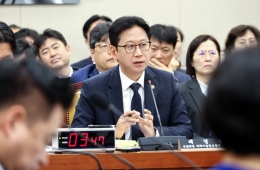
Kim Minseok, leader of the Democratic Party of Korea, delivers opening remarks at a government-party consultation on virtual asset taxation held at the National Assembly Members' Office Building on October 28, 2026. Photo by Yoon Dongju.
View original imageDemocratic Party leader Kim Minseok and others had said that, for now, priorities related to virtual asset taxation should include enacting the Digital Asset Basic Act. In his public remarks, Kim said, "(Virtual asset taxation) has long been a task that must be pursued, in light of the principle that income should be taxed appropriately." He added, "The Digital Asset Basic Act, which would provide an institutional foundation for the virtual asset market, has yet to be enacted. If taxation is implemented without fully reflecting the characteristics of the virtual asset market and its trading environment, could it lead to taxpayer distrust and disputes? We also need to discuss how to listen to and address the concerns of young people who have been seeking opportunities to build wealth, including issues such as inadequate tax infrastructure and fairness in comparison with overseas exchanges."
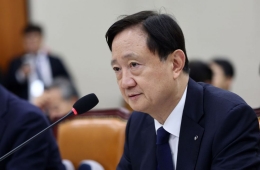
Cho Seungrae, chair of the National Assembly's Finance and Economy Committee and a member of the Democratic Party, also said, "We need to reach a conclusion after carefully considering how to strike a balance between the basic philosophy of taxation and practical conditions." He added, "Rather than debating the philosophy of taxation, taking a pragmatic approach based on the practical conditions and circumstances for taxation will be the most fundamental principle for resolving this issue."
Lee Hyeongil, Deputy Prime Minister and Minister of Finance and Economy, said, "At a field meeting on October 20, experts and industry representatives argued that the tax system should reflect changes in the market since the virtual asset system was legislated in late 2020. They also asked us to take into comprehensive account the global policy environment, including tax fairness between users of domestic and overseas exchanges." He added, "The government is carefully considering a reasonable approach that the public can accept and that can be implemented stably in the field."
Hot Picks Today
 Sold for 3.8 Billion Won, Now Down 700 Million... "I'll Sell" as Eunma Listings Surge 3.7-Fold
- "Koreans Spend 1 Million Won Each and Come Back"... 'They Said They Were Going for Value for Money,' but Open Their Wallets Wide in Japan
- Anthropic Tailwinds Lift Korean Stocks as Both Markets Surge Early
- "Wow, Have Middle-Aged Men Had This All to Themselves?"... Women in Their 20s and 30s Find Comfort in a Standing Drink
- "I Have 9 Billion Won, but I Still Can't Quit"... The Unexpected Worry of a Major-Company Employee in His 40s Who Hit It Big with Investments
However, after the party-government consultation, Assemblyman Oh described the discussion, saying, "We agreed in principle on virtual asset taxation, but there were discussions about tax fairness between domestic and overseas markets and the need to revise the tax system in response to market changes." Without reaching a conclusion on whether to impose taxes immediately, the meeting addressed specific issues related to virtual asset taxation, including information gathering, how to classify derivatives for tax purposes, loss carryforwards, and the limitations of simulations.

Kim Minseok, leader of the Democratic Party of Korea, and Lee Hyeongil, Deputy Prime Minister and Minister of Finance and Economy, pose for a photo with other attendees at a government-party consultation on virtual asset taxation at the National Assembly Members' Office Building on Oct. 28, 2026. Photo by Yoon Dongju
View original imageNo conclusion was reached on the urgent issue of issuing the notice, either. Assemblyman Oh said, "If we can prepare the notice by the end of this month, we will; otherwise, we will do it later. I can't give you a definite answer." In contrast, Committee Chair Cho said in his opening remarks, "If the notice is issued, it could be regarded as a declaration by the government that it will impose taxes, so I think we need to make our own assessment of the notice first." He added, "As we decide at an appropriate time whether to postpone taxation or proceed with it, if the notice currently before us becomes an obstacle to that decision, it would be appropriate to postpone it, even briefly, then reach a conclusion on taxation and decide what to do about the notice." He proposed deciding the taxation issue first and then assessing the notice.
© The Asia Business Daily. All rights reserved. Unauthorized AI training and use prohibited.