Government Mounts All-Out Response to EU Industrial Acceleration Act; Trade Chief Park Jeongseong to Visit Brussels Next Month
Calling for Equal Treatment of Korean-Made Components and Products Assembled in Korea
Strengthening the Public-Private Joint Response

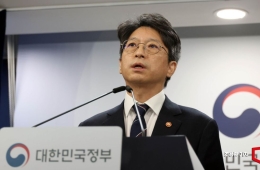
Park Jeongseong, chief trade negotiator at the Ministry of Trade, Industry and Energy (left), delivers opening remarks at the kickoff meeting of the public-private task force on responding to the EU Industrial Acceleration Act (IAA), held at the Korea Chamber of Commerce and Industry in Jung-gu, Seoul, on the 15th. Ministry of Trade, Industry and Energy.
View original imageThe government is stepping up efforts to persuade the European Union (EU) locally to prevent discrimination against Korean companies during the legislative process for the Industrial Acceleration Act (IAA). Next month, Park Jeongseong, chief trade negotiator at the Ministry of Trade, Industry and Energy, plans to visit Brussels, Belgium, in person to meet key European Parliament figures and call for equal treatment of Korean-made components and products finally assembled in Korea.
On October 28, the Ministry of Trade, Industry and Energy will hold the second meeting of the public-private task force on responding to the EU Industrial Acceleration Act at the Korea Chamber of Commerce and Industry. The meeting will be chaired by Chief Trade Negotiator Park and attended by major industry players in automobiles, batteries, steel, and nuclear power, as well as industry associations and relevant government ministries.
This follow-up meeting of the public-private task force, launched on October 15, was organized to share the results of outreach efforts in the EU to date and develop a detailed joint public-private strategy for responding to the upcoming legislative process.
The EU Industrial Acceleration Act is a proposed law designed to strengthen the competitiveness of manufacturing within the bloc and foster low-carbon industries. It includes provisions favoring products made in the EU in major industries such as automobiles, batteries, and steel, raising concerns that it could affect Korean companies' access to the European market. Key issues include the criteria for recognizing products as EU-made and whether trusted partner countries will receive equal treatment.
Since the first task force meeting, the government has expanded its outreach to major EU legislative bodies. On October 20 and 21, an official from the Ministry of Trade, Industry and Energy responsible for new trade strategy support visited the European Parliament in Strasbourg, France, and met in person with eight lawmakers from major political groups and relevant parliamentary committees. The official called for measures to prevent discrimination against Korean companies and for Korea to be recognized as a trusted partner country and granted equal treatment.
Then, at the 14th Korea-EU Free Trade Agreement (FTA) Trade in Goods Committee meeting on October 21, the government conveyed its concerns about the Industrial Acceleration Act to the European Commission. It also called for equal treatment of Korean-made components and products finally assembled in Korea, as well as reasonable requirements for recognizing products as EU-made.
At the meeting on October 28, participants will review EU legislative developments and key issues based on the results of outreach to the European Parliament. In particular, they will focus on the scope of countries to be recognized as trusted partners and the EU-made requirements for the automotive sector, as the EU's policy of favoring products made within the bloc gains momentum.
The government and industry will seek to strengthen their case by highlighting the investment and jobs Korean companies generate locally in the EU, along with their contributions to supply chains. The aim is to emphasize that Korean companies are not merely exporters from outside the bloc, but key partners contributing to Europe's industrial ecosystem.
The government will also strengthen its public-private coordination system. The Korea International Trade Association and the Korea Trade-Investment Promotion Agency (KOTRA) will take the lead in sharing information on EU legislative developments and local outreach. The government will also pursue joint efforts to convey its views by leveraging the local networks of Korean companies operating in the EU.
The government plans to step up high-level persuasion efforts on the occasion of Chief Trade Negotiator Park's visit to Brussels next month. Park is scheduled to meet key European Parliament figures, explain Korean companies' contributions to EU investment, employment, and supply chains, and ask that the concerns of Korean industries be reflected in the legislative process for the Industrial Acceleration Act.
Hot Picks Today
 "Two Spend 500,000 Won in a Flash, Yet Wait Two Hours?" ... 'Dreamland' Shunned by Kids and Foreign Tourists
- The Era of Getting 200 Million Won After 30 Years Is Over... A Japanese Bank's "Perpetual Department Head" Who Just Clocked In Cries Out
- "Teacher by Day, Adult Film Star by Night": Bizarre Excuse... Japanese School Rocked by Tip About Porn Video
- "'27 Trillion Won' Czech Nuclear Plant Construction Contract Talks Collapse; KHNP Parts Ways with Daewoo-Doosan Consortium (Roundup)"
- [Exclusive] "I Was Lured by Gangnam Unni's Coupons"... Behind Glamorous 'K-Beauty,' Complaints About Cosmetic Procedures Surge 38%
"We will pursue multifaceted outreach to major EU legislative bodies, including the European Commission, the Council of the EU, and the European Parliament, to ensure that our companies are not discriminated against during the legislative process for the EU Industrial Acceleration Act," Park said. "In particular, centered on the public-private task force, we will strengthen close cooperation among the government, industry, local diplomatic missions, and company offices, and make every effort to ensure that the views of our industries are meaningfully reflected in the EU legislative process."
© The Asia Business Daily. All rights reserved. Unauthorized AI training and use prohibited.