NSSC Approves 10-Year Life Extension for Kori 3 and 4, Giving Power Supply 'Breathing Room' (Roundup)
NSSC Reconsiders Application; Approves Continued Operation in Vote
Equipment Upgrades to Take 4-6 Months; Restart Expected Early Next Year
Approval Prospects Rise for Continued Operation of Hanbit 1 and 2, Which Use the Same Reactor Design

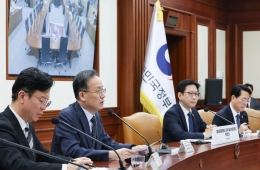
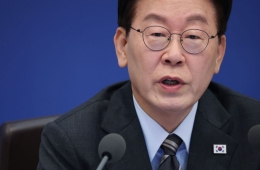
Choi Wonho, chair of the Nuclear Safety and Security Commission, discusses agenda items with committee members at the commission's 2026-17th meeting, held on Tuesday, the 27th, in the conference room of the commission in Jongno-gu, Seoul. Nuclear Safety and Security Commission
View original imageThe operating lives of Kori Nuclear Power Plant Units 3 and 4 in Gijang, Busan, which had been shut down after reaching the end of their design lives, have been extended by 10 years. This is the first time the Nuclear Safety and Security Commission has simultaneously approved continued operation for two nuclear reactors. The continued operation of Kori Units 3 and 4 is expected to ease pressure on the domestic electricity supply. The likelihood that Hanbit Units 1 and 2, which use the same reactor design, will also receive approval for continued operation has increased.
At its 17th meeting of 2026 on the 27th, the Nuclear Safety and Security Commission deliberated on Korea Hydro & Nuclear Power's application for approval to continue operating Kori Units 3 and 4 (pressurized water reactors, 1,025 MWe) and approved it in a vote of five in favor and two opposed.
The item was first placed on the agenda on the 15th, but was brought back for consideration that day following commissioners' requests for further explanations on how public hearings for local residents had been reflected, whether the latest technical standards had been incorporated, and whether the latest research findings on climate change had been taken into account.
Kori Units 3 and 4 received construction permits in 1979. Kori Unit 3 received an operating license in 1984, and Unit 4 in 1985. Their 40-year design lives expired on September 28, 2024, for Unit 3 and August 6, 2025, for Unit 4.
On September 26, 2022, Korea Hydro & Nuclear Power submitted periodic safety review reports for the continued operation of Kori Units 3 and 4. On November 16, 2023, it also submitted applications for operational changes covering the extended operating periods, along with radiological environmental impact assessment reports prepared after gathering public input.
The applications were then placed on the agenda following a safety review by the Korea Institute of Nuclear Safety (KINS) and a preliminary review lasting about six months by the Nuclear Safety Expert Commission.
The Nuclear Safety and Security Commission said that although Kori Units 3 and 4 are nuclear power plants of identical design built on the same site, their operating and maintenance histories differ. It therefore separately assessed and reviewed the actual condition, age-related degradation, and life assessments of the structures, systems, and components of each unit.
The commission said that, following its review of the life assessments of the structures, systems, and components, as well as plans for equipment replacement and upgrades, it confirmed that sufficient safety margins would be maintained throughout the continued-operation period in accordance with the Nuclear Safety Act and related standards.
It also said that the radiological environmental impact assessments confirmed that both the effects of continued operation and the effects of major accidents, including severe accidents, met safety standards, and that it had therefore approved continued operation of Kori Units 3 and 4.
As a result, Kori Unit 3 can operate until September 28, 2034, and Unit 4 until August 6, 2035.
An official from the commission said, "Under the terms of the approval, Korea Hydro & Nuclear Power plans to carry out follow-up measures, including equipment upgrades, over four to six months to ensure adequate safety margins." The official added, "The reactors will be restarted after on-site inspections confirm that the requirements have been met." Accordingly, Kori Units 3 and 4 are expected to restart in stages from the first quarter of next year.

A view of Kori Nuclear Power Plant Units 3 and 4 (Kori Second Power Plant). Korea Hydro & Nuclear Power (KHNP)
View original imageOn the same day, Korea Hydro & Nuclear Power said, "We aim to complete the ongoing equipment upgrades and maintenance, confirm safety through regular inspections by the regulatory authority, and restart the units in stages during the first half of 2027." It added, "Throughout the continued-operation period, we will continue to upgrade equipment and maintain rigorous safety management to enhance the safety and performance of the power plants."
As electricity demand surges with the growth of power-intensive industries such as semiconductors and data centers, the restart of Kori Units 3 and 4 is expected to help ease the domestic power shortage.
Of the 26 nuclear reactors currently operated by Korea Hydro & Nuclear Power, eight are shut down. Kori Units 3 and 4 each have a generating capacity of 950 MW, bringing their combined supply capacity to 1.9 GW.
Korea Hydro & Nuclear Power CEO Kim Hoecheon said, "Continued operation will help meet rising electricity demand from high-tech industries such as semiconductors and AI, support a stable power supply, contribute to the national economy, and play an important role in achieving carbon neutrality." He added, "We will carry out follow-up procedures, including equipment upgrades and regular inspections, without disruption and do our utmost to safely restart Kori Units 3 and 4, with safety as our top priority."
The approval for Kori Units 3 and 4 is also expected to affect deliberations on continued operation of Hanbit Units 1 and 2 in Yeonggwang, South Jeolla Province, which use the same reactor design. The commission plans to place the approval applications for continued operation of Hanbit Units 1 and 2 on the agenda in the first half of next year. Continued operation of the two Hanbit units is also needed to ensure a stable electricity supply to the semiconductor cluster the government is developing in the Honam region.
However, despite the approval granted that day, debate over the effectiveness of the continued-operation system is expected to continue. Although the operating lives of Kori Units 3 and 4 have been extended by 10 years, the actual operating period is expected to be only eight to nine years because the shutdown period is included in the extension. Some in the nuclear industry argue that the current 10-year approval period for continued operation of reactors whose design lives have expired should be extended to 20 years.
Hot Picks Today
 "Better than stocks and real estate": Chinese investors rush in and snap up 430 metric tons of 'this' in a week
- "27,000 Won for an Hour of Walking?"... Robot Dog-Walking Jobs in the U.S. Now Pay by the Hour
- Junior Female Officer Taken from Incheon to Sokcho While Asleep... Senior Officer Under Scrutiny: "Checking the Facts"
- "I'm Married, but I Want to Meet Someone New"... Japan App for Married People Draws 500,000, Packed with Users in Their 30s and 40s
- "I Made an Extra 6 Million Won a Month"... "This Can Actually Make Money?" The Twist Behind a Few Pieces of Junk
At that day's commission meeting, the secretariat reported on a proposal to extend the period between continued-operation approvals. The commission said it could discuss extending the continued-operation period for nuclear power plants if it receives a request from the Ministry of Climate, Energy and Environment, the government body responsible for nuclear power policy. However, commissioners Park Jeongun and Jin Jaeyong opposed discussing the proposal.
© The Asia Business Daily. All rights reserved. Unauthorized AI training and use prohibited.