[2026 National Assembly Audit] Minister Jeong Eunkyung: "Will Review Ways to Improve Standard Median Income Calculation"
Health and Welfare Minister Jeong Eungyeong said on Oct. 27 that the government would "review ways to address" the gap between the government-set standard median income and actual median income.
Responding to a related question from Park Jie-won, a Democratic Party of Korea lawmaker, during a comprehensive audit by the National Assembly Health and Welfare Committee, Jeong said, "This situation has arisen partly because of the time lag and partly because of fluctuations in the Household Finance and Welfare Survey, so those factors also need to be considered."

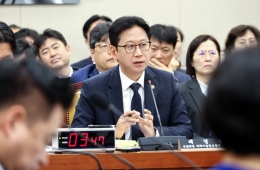
Health and Welfare Minister Jeong Eunkyung answers questions from lawmakers during a parliamentary audit of the Korea Disease Control and Prevention Agency held by the National Assembly Health and Welfare Committee on the 8th. Yonhap News Agency
View original imageThe standard median income is used to determine eligibility for and benefit levels under various welfare programs, including livelihood benefits under the National Basic Livelihood Security system. It is used across 80 welfare programs administered by 15 central government ministries. Next year's standard median income will be KRW 6,929,885 per month for a four-person household, up 6.70% from KRW 6,494,738 this year. For a one-person household, it will rise from KRW 2,564,238 this year to KRW 2,736,042 next year.
Park said, "Applying an increase rate to the previous year's standard median income could cause the gap with measured income to accumulate."
In response, Jeong explained, "Although the Household Finance and Welfare Survey is our primary source, recent statistics have been highly volatile, making it difficult to calculate the standard median income."
In July, the Ministry of Health and Welfare and the Central Living Security Committee approved a new calculation method to take effect next year. Under the method, the latest three-year average growth rate of median income from the Household Finance and Welfare Survey will be applied to this year's standard median income, with the growth rate subject to adjustment based on factors such as the consumer price index and real economic growth.
Hot Picks Today
 "You Mean Only Middle-Aged Men Got to Enjoy This?"... Where Japanese Women in Their 20s and 30s Are Flocking
- "They're Coming After My Pension Too?" Public Unease Mounts... Spain Sees Mass Protest Over Reform Push
- "Naked Again?" Controversial Actress Crosses a Line... Slammed for Sexualizing 'Child Characters'
- Another Former Employee Comes Forward With Workplace Allegations at Hey Jini's Company... "Exploited Within the Bounds of the Law"
- [Breaking] Smoke Billows From Fire in Gangnam's Guryong Village; Fire Authorities Issue Level 2 Response Alert
Jeong said, "This year, we established the criteria for calculating the standard median income that will apply over the next three years. We need to apply them for three years and then review the criteria again. We will review ways to improve them together with the committee."
© The Asia Business Daily. All rights reserved. Unauthorized AI training and use prohibited.