"K-Nuclear Power to Become a Global Production Hub"... Korea Hosts IAEA Ministerial Conference on Nuclear Power (Wrap-up)
Bae Kyunghoon: "Unite public and private sectors to accelerate SMR development and demonstration"
IAEA Director General Grossi: "Invest in workforce development and supply chains"

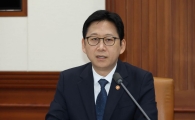
Bae Kyunghoon, Deputy Prime Minister and Minister of Science and ICT, delivers opening remarks at the International Atomic Energy Agency (IAEA) Ministerial Conference on Nuclear Energy, held at Songdo Convensia in Yeonsu-gu, Incheon, on the morning of the 27th. Provided by the Ministry of Science and ICT.
View original imageAs rising electricity demand from artificial intelligence (AI) and advanced industries makes nuclear power increasingly important, South Korea has outlined a vision to become a global production hub by leveraging its manufacturing and construction capabilities.
The Ministry of Science and ICT said the International Atomic Energy Agency (IAEA) International Ministerial Conference on Nuclear Power opened at 10 a.m. on October 27 at Songdo Convensia in Incheon. The conference, the first of its kind to be held in South Korea, runs through October 29. Bae Kyunghoon, Deputy Prime Minister and Minister of Science and ICT, is chairing the meeting and leading the discussions.
“Building on the Special Act on Small Modular Reactors (SMRs) and the ‘Seven Seed Projects,’ we will bring together the capabilities of the public and private sectors to advance the safe development and demonstration of SMRs and open a new future for K-nuclear,” Bae said. “We will connect South Korea’s manufacturing and construction capabilities with global demand for nuclear power to become a global production hub, and grow alongside the international community as a model country for nuclear power that upholds safety and trust.”
The IAEA ministerial conference is a major high-level policy meeting where participants discuss the peaceful uses of nuclear energy and the future direction of policy. It is typically held every four years. The conference began in Paris, France, in 2005, and after meetings in China, Russia, the United Arab Emirates and the United States, its sixth edition is being held in South Korea this year. More than 800 people are attending, including ministerial-level representatives from IAEA member states, government officials from 60 member states, representatives of eight international organizations, and around 85 domestic and international companies.
Since operating its first research reactor in 1962, South Korea has achieved technological self-reliance and exported nuclear power plants and research reactors, growing from a country that adopted nuclear power into one that shares its technology and expertise.
In his opening remarks, Bae stressed that countries should work together under the principles of safety, nuclear security and nuclear nonproliferation, pooling their technology and expertise to ensure that the benefits of nuclear power reach more countries and people. As host, South Korea is committed to making the conference an opportunity to expand practical cooperation among participating countries.
IAEA Director General Rafael Grossi, who announced on October 25 that he would not attend the conference, delivered a video message of congratulations, saying that he was unable to attend because a briefing to the United Nations Security Council had been scheduled. “In 2022, our conservative scenario assumed that nuclear power generation capacity would change very little by 2050. Our current conservative scenario projects that capacity will exceed 640 GW (gigawatts), while our optimistic scenario forecasts more than 1,000 GW,” Grossi said.
“To make effective progress, we need to identify the decisions required for nuclear programs and provide the relevant organizations with the resources to implement them,” he said, emphasizing the need to “maintain operating capacity through long-term operation.” Grossi also said, “We must work with financial and technology partners from the early stages and invest in workforce development and supply chains,” adding that “we need to engage with local communities while their views can still be reflected in decision-making.”

Bae Kyunghoon, Deputy Prime Minister and Minister of Science and ICT, delivers opening remarks at the International Atomic Energy Agency (IAEA) International Ministerial Conference on Nuclear Power at Songdo Convensia in Yeonsu-gu, Incheon, on the morning of the 27th. Provided by the Ministry of Science and ICT.
View original imageIn his keynote address, Bae identified three key policy priorities for South Korea: strengthening trust through safety and transparency, safely developing and demonstrating SMRs, and becoming a global production hub.
“Nuclear power can work in harmony with various energy sources, including renewables, and play an important role in providing a stable supply of low-carbon energy,” Bae said. “To achieve this, we must first ensure safety and earn the public’s trust.” He said it was important to raise safety standards through scientific reviews and inspections under an independent regulatory framework, guided by recommendations from IAEA international reviews, and to strengthen public and international trust by disclosing operational and safety information and communicating transparently.
South Korea plans to accelerate SMR development and demonstration by bringing together public- and private-sector capabilities based on trust. While respecting the independence of regulatory bodies, it will strengthen the foundations for regulatory research and verification, and advance technology development to meet specific needs and operating environments, including supplying electricity to AI data centers and providing industrial heat and ship propulsion. The government also plans to improve laws and regulations to support the commercialization of technologies whose safety has been sufficiently verified.
Bae also said South Korea would work with nuclear power design and development companies from around the world to become a global production hub. The country will draw on its accumulated manufacturing and construction capabilities to ensure stringent quality control and a stable supply, and use AI and robotics to strengthen on-site safety and quality management. It also plans to expand cooperation across the entire lifecycle, from operations, decommissioning and waste management to next-generation nuclear fuel.
The government also created a forum for exchanges to turn policy discussions into industrial cooperation. On October 26, the day before the conference opened, the Ministry of Science and ICT and the U.S. Embassy in South Korea held the Korea-U.S. Nuclear Industry Dialogue. A total of 150 representatives from the two governments and 50 companies and organizations took part, exploring opportunities to connect demand in the U.S. nuclear market with South Korea’s manufacturing, construction and supply chain capabilities.
Related Articles
 "K-Nuclear Power to Become a Global Production Hub"... Government Hosts IAEA Nuclear Power Ministerial Conference in South Korea for First Time
Major U.S. companies attending included TerraPower, NuScale Power, Oklo, Kairos Power and Centrus Energy. South Korean participants included Korea Hydro & Nuclear Power, Doosan Enerbility, Hyundai Engineering & Construction, Samsung C&T, SK Innovation and Samsung Heavy Industries. Drawing on demand and policy trends in the U.S. market and examples of existing cooperation, the two sides discussed business collaboration in design, construction, manufacturing, investment and nuclear fuel.
© The Asia Business Daily. All rights reserved. Unauthorized AI training and use prohibited.