[2026 Parliamentary Audit] Kim Younghoon: "Considering National Pension Service Participation in Retirement Pensions... Social Dialogue Essential on Labor Exemptions in Super-Regional Special Zones"
Minister of Employment and Labor Kim Young-hoon said the government is considering involving the National Pension Service in a fund-based retirement pension system. Regarding the introduction of labor-related exemptions under the Special Act on Super-Regional Special Zones to advance mega projects, he stressed that social dialogue among labor, management and government must be successfully concluded.
At a comprehensive parliamentary audit of the Ministry of Employment and Labor by the National Assembly’s Climate, Energy, Environment and Labor Committee on the 27th, Kim responded to a question from Rep. Ahn Ho-young of the Democratic Party of Korea about whether the National Pension Service would participate in the fund-based retirement pension system. “Because the National Pension has positive functions, we are considering its participation to an appropriate extent,” he said.

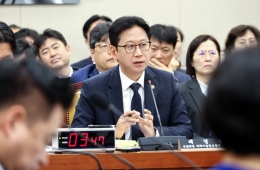
Minister of Employment and Labor Kim Younghoon receives a briefing from an official before the start of the parliamentary audit of the Ministry of Employment and Labor at the National Assembly on October 13, 2026. Photo by Yoon Dongju.
View original imageHowever, he said further discussion was needed on the specific scope of its participation. “There has been considerable debate at the working level about how extensively to involve the National Pension,” Kim said. “The appropriate extent requires further discussion, and I understand it will be discussed during the legislative process.”
The government is working to make external funding of retirement benefits mandatory and promote fund-based retirement pensions to protect workers’ entitlements to retirement benefits and strengthen the system’s role in providing retirement income. Under a fund-based system, contributions are pooled and professionally managed. The scope and role of public institutions such as the National Pension Service are key issues.
At the audit, lawmakers also called for improving the low long-term returns on retirement pensions and strengthening their role in providing security for subscribers in retirement. According to Rep. Ahn, retirement pension assets totaled about 553.9 trillion won at the end of the first half of this year. The annual return last year was 6.47%, the highest since the system was introduced, but the annualized returns over the past five and 10 years were only 3.29% and 2.64%, respectively.
Rep. Ahn argued that a dedicated management body with public accountability and independence was needed to manage the assets stably and increase returns. In response, Kim said, “Retirement pensions are expected to play an increasingly important role, alongside the National Pension, as part of a multi-tiered pension system that provides security in old age.” He added, “There have also been calls for public institutions to handle some of these responsibilities, and the matter could be discussed fully during the legislative process.”
On the introduction of labor-related exemptions under the Special Act on Super-Regional Special Zones to advance mega projects, Kim emphasized the need for social dialogue. When Rep. Lee Jong-bae of the People Power Party asked whether social dialogue among labor, management and government was at a standstill, Kim said, “It is true that there are such concerns,” but added, “We must ensure that social dialogue is successfully concluded.”
“Sustainable development is possible only if corporate productivity and workers’ right to health are balanced,” he said. “With that in mind, I will work to ensure that social dialogue proceeds smoothly.” He added, “As a member of the Cabinet, I have no doubt that the mega projects, on which the nation’s future depends, must succeed. These projects are uncharted territory, and we are in the process of finding solutions.”
Kim also discussed ways to secure the workforce needed to build semiconductor production facilities, or fabs, and data centers. “When people think of semiconductors, they may think only of operators, or production workers, and research and development (R&D), but the construction stage is also extremely important,” he said. “The government is estimating the workforce requirements across all ministries.”
Hot Picks Today
 "They're Coming After My Pension Too?" Public Unease Mounts... Spain Sees Mass Protest Over Reform Push
- "Where Do You Go Every Lunch Break?"... 'Time-Poor' Men in Their 40s: Where They Spend Their Money.
- Eating Habits, Testosterone Dragged Into U.S. Midterm "Alpha vs. Beta Male" Debate
- "Naked Again?" Controversial Actress Crosses a Line... Slammed for Sexualizing 'Child Characters'
- "A Really Beautiful Butt"... How Did Nicki Minaj React to Trump's Unexpected Remark?
He stressed that the country must train skilled domestic construction workers, as fabs and data centers are directly linked to national security. “We cannot simply bring in foreign workers; instead, we must train even more skilled construction workers ourselves,” Kim said. “We will promptly draw up a government-wide plan to train construction workers.” He added, “Construction sites have long been viewed as places with poor jobs and as offering young people work that is dangerous, dirty and difficult. But I believe construction work could once again gain prominence in the age of artificial intelligence (AI).”
© The Asia Business Daily. All rights reserved. Unauthorized AI training and use prohibited.