[2026 National Assembly Audit] Cho Hyun: "I told U.S. Ambassador Steel, 'When there's turbulence, buckle up and there's no problem'... She agreed"
"Claims that South Korea-U.S. relations have collapsed are utterly absurd... No problems with military cooperation"
"Meeting with Secretary Rubio the day after tomorrow... Will raise Chung Cheong-rae's visa issue"
Ruling party: "U.S. visa delay is r
Foreign Minister Cho Hyun dismissed concerns about “turbulence” in South Korea-U.S. relations, saying, “Differences are being well coordinated,” and stressed that there are no problems with the alliance. She also said she plans to meet with U.S. Secretary of State Marco Rubio later this week to discuss bilateral issues.

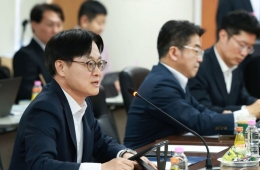
Minister of Unification Chung Dongyoung and Foreign Minister Cho Hyun listen intently to lawmakers' questions during a comprehensive audit of the Ministry of Foreign Affairs and other agencies at the National Assembly on the 27th. 2026.10.27 Photo by Yoon Dongju
View original imageAt a comprehensive audit of the National Assembly’s Foreign Affairs and Unification Committee on the 27th, ruling and opposition lawmakers continued to question the government about South Korea-U.S. relations and its diplomacy toward the United States. Jung Jeom-sik of the People Power Party said discord between the two countries was continuing, citing the detention of Korean workers in the U.S. state of Georgia in September last year, the implementation of investment commitments in the United States, controversy over restrictions on information sharing, and the transfer of wartime operational control.
In response, Cho said, “I believe there are basically no problems with military cooperation between South Korea and the United States,” adding, “There may be minor differences of opinion in South Korea-U.S. relations, but calling the relationship a breakdown, as some have claimed, is utterly absurd.”
When Jung asked for her position on U.S. Ambassador to South Korea Michelle Steel’s remark about “turbulence,” Cho said they had discussed the comment over breakfast the previous day. “I told her that when a plane passes through turbulence, there is no problem if you fasten your seat belt securely, and she agreed with me,” she said.
Steel had said on the 21st that “South Korea and the United States are going through a kind of turbulence” in their relationship.
Criticism of diplomacy toward the United States also came from the ruling party. Cha Ji-ho of the Democratic Party of Korea cited U.S. tariff pressure and the Georgia incident, asking, “Why can’t our foreign minister speak clearly to the United States?”
Cho replied, “Even on the issue of U.S. investment, South Korea was the last to reach an agreement and insisted on commercial rationality and domestic procedures to the very end,” adding, “I don’t think we simply accepted everything unilaterally.” She continued, “As for the Georgia incident, it’s not as though we only handled the aftermath at the time. We also protested, and the matter was resolved amicably as a result of an agreement with the U.S. side.”
Cho also said she plans to meet with Rubio during her visit to the United States. In response to a question from Hong Ki-won of the Democratic Party about delays in issuing a U.S. visa to fellow party member Chung Cheong-rae, Cho said, “I’m going to the United States the day after tomorrow and plan to meet with Secretary Rubio, so I will raise the issue then as well.” Cho will visit the United States from the 29th through the 2nd of next month to attend the G20 Foreign Ministers’ Meeting. She is expected to meet with foreign ministers from major countries on the sidelines of the multilateral meeting as she pursues separate bilateral talks.
Meanwhile, the ruling and opposition parties also clashed over delays in issuing a U.S. visa to Democratic Party lawmaker Chung Cheong-rae. In a personal statement that day, Chung said, “My U.S. visa has neither been denied nor approved; it is simply under review,” adding, “I am deeply disappointed with the U.S. administrative authorities.” Because the visa review had not been completed, Chung moved from the committee’s Americas subcommittee to its Europe subcommittee to take part in the audit.
Chung argued that the visa issue should not be interpreted as a crisis in the South Korea-U.S. alliance, saying, “This is something for the ruling and opposition parties to protest to the United States on a bipartisan basis, not an issue to use to attack our government.” Hong Ki-won of the Democratic Party also urged the committee to criticize the U.S. stance.
Hot Picks Today
 "Two Spend 500,000 Won in a Flash, Yet Wait Two Hours?" ... 'Dreamland' Shunned by Kids and Foreign Tourists
- The Era of Getting 200 Million Won After 30 Years Is Over... A Japanese Bank's "Perpetual Department Head" Who Just Clocked In Cries Out
- Spain Hit by Its Worst Tragedy... Lee Kangin, Moreno and Real Madrid Join Soccer World in Mourning
- They Said, “Make It Your Home for Life” - Then Suddenly Kicked 200 Passengers Off... What Happened to the Around-the-World Cruise?
- "130 Rice Bowls Sold Out in a Day"... 'Unfiltered Face' Adds 8 Million Won to Night Market Sales: China's Bungeunwoo
By contrast, Kim Dae-sik of the People Power Party said, “It is unacceptable for a member of the National Assembly of the Republic of Korea traveling to conduct a parliamentary audit to have their visa denied or put on hold,” adding, “The Ministry of Foreign Affairs also bears responsibility.”
© The Asia Business Daily. All rights reserved. Unauthorized AI training and use prohibited.