[2026 Parliamentary Audit] Chung Dongyoung: "North Korea's Visit to China Unusual Without Summit"... Cho Hyun: "U.S.-North Korea Dialogue Possible"
Unification Minister Chung Dongyoung and Foreign Minister Cho Hyun offered assessments of North Korean leader Kim Jong Un's visit to Dandong, China, describing it, respectively, as unusual summit diplomacy and raising the possibility of discussions on North Korea-U.S. dialogue.

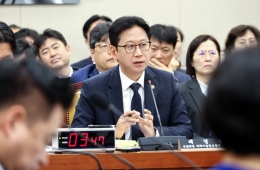
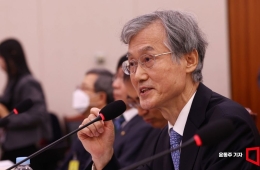
Unification Minister Chung Dongyoung and Foreign Minister Cho Hyun listen to lawmakers' questions with solemn expressions during a comprehensive audit of the Foreign Ministry and other agencies at the National Assembly on Oct. 27, 2026. Photo by Yoon Dongju
View original imageAt a comprehensive audit by the National Assembly's Foreign Affairs and Unification Committee on the morning of Oct. 27, Minister Chung responded to a question from Rep. Kwon Young-se of the People Power Party about the nature of Kim's recent visit to Dandong, saying, "We need to take a comprehensive and cautious look at it."
He said North Korea had "made a move in terms of its national interests and autonomy," while adding, "We need to examine the timing, format and substance in depth." He also said the visit had "the highly unusual feature of being summit diplomacy without a summit meeting," and that it should be examined carefully.
"It is difficult to view it as an economic event," Minister Chung said. "If he had visited the Museum of the War to Resist U.S. Aggression and Aid Korea, military officials should have accompanied him, but there were no military personnel among his entourage." He added that it was also difficult to view the visit as a military event, noting that "the key feature was the full deployment of the top foreign affairs officials and diplomatic corps."
Kim crossed the New Yalu River Bridge on Oct. 24 and visited Dandong, in China's Liaoning Province. He met Wang Huning, China's fourth-ranking official and chairman of the National Committee of the Chinese People's Political Consultative Conference, and toured the Museum of the War to Resist U.S. Aggression and Aid Korea and a bus factory before returning to North Korea the same day. It was his first visit to China in one year and one month, and his sixth since taking power, but the first time he had not met with Chinese President Xi Jinping.
Rep. Kwon noted that not only Wang Huning, chairman of the National Committee of the Chinese People's Political Consultative Conference, but also Executive Vice Minister Ma Zhaoxu, who is regarded as an expert on the United States, attended the event. He asked Foreign Minister Cho whether discussions related to North Korea-U.S. dialogue were possible. "I think that is possible," Minister Cho replied.
Asked about the fact that Kim had held a summit with Chinese President Xi Jinping ahead of past North Korea-U.S. talks but did not meet him this time, Minister Cho said, "It is still difficult to draw a conclusion," adding, "I think we need to consider various factors together."
Asked whether South Korea was communicating with the United States about the possibility of North Korea-U.S. dialogue, Minister Cho said, "We are consulting with the U.S. as well as China to encourage dialogue between North Korea and the U.S. so that the current situation on the Korean Peninsula can be resolved."
In a subsequent question, Rep. Maeng Seong-kyu of the Democratic Party of Korea asked about a strategy to bring North Korea to the negotiating table. Minister Cho replied, "I think a North Korea-U.S. summit could serve as a catalyst for resolving the current situation." He added that South Korea would coordinate in advance with relevant countries, including China and Russia, to bring North Korea to dialogue.
Minister Chung said, "The expansion and development of North Korea-China relations could also help North Korea take a more active approach to the outside world." He added, "Our goal is to somehow turn hostility between the two hostile states into dialogue, and dialogue into peace," and said, "Through peaceful coexistence, we can ultimately pursue our unification policy."
Meanwhile, before the questioning began that day, Rep. Park Chung-kwon of the People Power Party took issue with Minister Cho's response regarding the National Security Council (NSC), saying, "There was perjury here," and called for action. He alleged that the two ministers had made conflicting statements about independent cyber sanctions raised during discussions on how to respond to a North Korean landmine explosion.
Hot Picks Today
 "Koreans Spend 1 Million Won Each and Come Back"... 'They Said They Were Going for Value for Money,' but Open Their Wallets Wide in Japan
- "Wow, Have Middle-Aged Men Had This All to Themselves?"... Women in Their 20s and 30s Find Comfort in a Standing Drink
- "'430 Million Won a Year' and Still Gets Government Aid... '8.8 Million Won Monthly Rent' Emergency Declared in AI Hub"
- "Naked Again?" Controversial Actress Crosses a Line... Slammed for Sexualizing 'Child Characters'
- "They Get a Good Night's Sleep and Earn Twice My Salary... Honestly, I'm So Jealous I Could Die": Civil Servant's Post Targeting Firefighters Sparks Outrage
At the Unification Ministry's audit on Oct. 7, Rep. Park had also asked Minister Chung whether he opposed a proposal for independent cyber sanctions at the NSC, citing Minister Cho's response at the Foreign Ministry's audit the previous day. Minister Chung then retorted, "What does cyber sanctions have to do with the response to the landmine explosion?" Rep. Park alleged that Minister Cho had committed perjury and called for him to be referred for prosecution.
© The Asia Business Daily. All rights reserved. Unauthorized AI training and use prohibited.