Lee Administration Slow to Appoint Public Institution Heads? A Look at the Numbers
Appointed 7 More Institutional Heads Than the Yoon Administration in the Same Period
Without a Transition Committee, the Lee Administration Accelerated Appointments at 50 Institutions From March to May
Successor Selection Underway for 84% of Executi
Although concerns have repeatedly been raised that appointments to head public institutions under the Lee Jae-myung administration are progressing sluggishly, appointments have been concentrated since the first half of this year, and the number of heads of public enterprises and quasi-governmental institutions actually appointed has exceeded the figure for the same period after the Yoon Suk Yeol administration took office. However, as vacancies at some institutions continue to drag on, some say the specific causes of and responsibility for appointment delays should be examined, rather than focusing solely on the number of appointments or vacancies.
A review of findings from political circles and the Public Institution Management Information System (ALIO), among other sources, showed that a total of 37 heads of public enterprises and quasi-governmental institutions had been appointed under the Lee Jae-myung administration by September 30, 2026. The administration took office without a presidential transition committee. The total comprised 15 heads of public enterprises and 22 heads of quasi-governmental institutions, seven (23.3%) more than the 30 appointed during the same period after the Yoon Suk Yeol administration took office. In terms of public enterprise heads alone, six more had been appointed.
Appointments gained momentum this year. A survey by corporate research firm Leaders Index of all 342 public institutions, as of June 4, 2026, found that 74 had appointed new heads in the year since the current administration took office. Of these, 50 (67.6%) made appointments between March and May this year: 17 in March, 21 in April, and 12 in May.

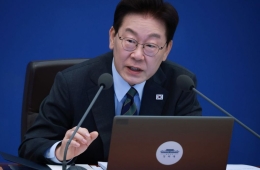
President Lee Jae-myung speaks during a briefing on the work of the Ministry of Trade, Industry and Energy, the Ministry of Climate, and the Nuclear Safety and Security Commission, among others, at the Cheong Wa Dae State Guest House on Aug. 4, 2026. Yonhap News.
View original imageData disclosed at recent parliamentary audits also offer a picture of the progress of public institution appointments. As of October 13, 2026, 44 executive positions subject to review and resolution by the Public Institution Management Committee had no successor appointed. Eight positions were actually vacant, while the previous executives continued in their roles at 36 institutions after their terms had expired. Successor selection procedures, including open recruitment, were underway for 37 of these positions (84.1%). Five labor director positions were undergoing internal consultation.
Of the seven positions for which the appointment process had not begun, four were related to Korea Plant Service & Engineering (KPS). Legal disputes over the selection of its president have disrupted the process of appointing a successor. The institutions concerned said they plan to begin open recruitment for the remaining three positions.
57 Institutions Had Yet to Appoint Successors 2 Years and 6 Months After Yoon Administration Took Office
Delays in public institution appointments have also recurred under previous administrations. In November 2024, two years and six months after the Yoon Suk Yeol administration took office, 57 of the country's 339 public institutions (16.8%) had yet to appoint successors to their heads. Thirty positions were actually vacant, while the heads of 27 institutions continued to serve after their terms had expired. At 24 institutions, successor appointments had been delayed for at least six months.
At the time, Kangwon Land had not selected a successor for 11 months after its previous president resigned, while the Korea Real Estate Board had still not completed the appointment process nearly nine months after its president's term ended. Leadership vacancies at the Honam National Institute of Biological Resources and the National Institute for Lifelong Education had lasted more than a year. All of these cases occurred before the Dec. 3 emergency martial law declaration, when the Yoon Suk Yeol administration was exercising its appointment authority normally.
Institutional factors also contribute to the controversy over public institution appointments whenever administrations change. Under the Act on the Management of Public Institutions, the terms of heads of public enterprises and quasi-governmental institutions are three years and do not coincide with the president's term. The law also stipulates that heads whose terms have expired continue to perform their duties until successors are appointed. As of the end of September 2026, heads appointed by the previous administration were still serving at 44 of the 87 public enterprises and quasi-governmental institutions. Twenty-three of them had at least one year remaining in their statutory terms.
From Early Resignations to Legal Disputes...Reasons for Appointment Delays Vary
The circumstances behind delayed appointments vary by institution. A vacancy may arise when a previous head resigns before the end of their term, or the process may be suspended after a legal dispute emerges during the selection of a successor.
Korea South-East Power's new president, Lee Hyunbin, took office on October 2, 2026, about seven months after former president Kang Giyoon resigned in February to run in local elections. The previous president of Korea Plant Service & Engineering (KPS) completed his term in June 2024, but the appointment process has dragged on because of legal disputes over the selection of a successor.
Incheon International Airport Corporation began the process of selecting a successor in February, when former president Lee Hakjae submitted his resignation with about four months remaining in his term. The corporation was run by an acting president after Lee's resignation took effect on March 20, but the open recruitment process was also delayed because appointments to replace non-executive directors needed to form the executive recommendation committee for selecting a new president were held up. After completing the replacement of its non-executive directors in early September, the corporation was finally able to begin recruiting for a new president on September 9.
Hot Picks Today
 "Three times Lee Jaeyong's fortune?"... Meet China's richest man, who amassed 134 trillion won at 43.
- "How expensive is it?" ... Even the world's largest AI company can't take it anymore, eyeing a rival
- "Even with 9 Billion Won, I Can't Quit My Job"... The Unexpected Concerns of a Major-Company Employee in His 40s After an 'Investment Windfall'
- Mother of Incheon Stabbing Victim Tells Daughter, Unconscious for Two Weeks: "I'll Wait, Don't Give Up"
- "I Made an Extra 6 Million Won a Month"... "This Can Actually Make Money?" The Twist Behind a Few Pieces of Junk
A ruling party official said, "The fact that an early resignation or legal dispute occurred does not, by itself, fully explain why a successor could not be appointed for an extended period." The official added, "If one claims that the government has neglected appointments simply by adding up the number of vacancies and expired terms, one should also examine the status of the appointment process and the reasons for delays at each institution."
© The Asia Business Daily. All rights reserved. Unauthorized AI training and use prohibited.