Former IAP President Hwang Cheolgyu: "Korean Law Firms Can't Rely on Their Name Alone... They Must Navigate Political Terrain and Guanxi to Have a Shot"
Former IAP President Hwang Cheolgyu
Government-private sector cooperation and recruitment of overseas veterans
Time to make medium- to long-term investments

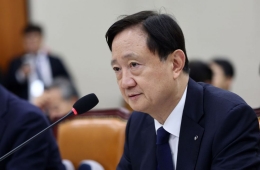
Hwang Cheol-gyu, former president of the International Association of Prosecutors and managing partner at Haegwang Law Firm
View original image"The role of Korean law firms in cases involving our companies overseas is currently very limited. Even when they work with local law firms, they often find themselves being led around without having any say. To overcome this limitation, they ultimately need to build a 'high-level network' that gives them a clear understanding of local conditions and enables them to communicate directly with key figures."
Hwang Cheolgyu (Class 19 of the Judicial Research and Training Institute), managing attorney at Haegwang Law Firm, formerly president of the International Association of Prosecutors (IAP) and currently vice president of the World Jurist Association (WJA), offered this assessment of the current state of Korean law firms' expansion into overseas markets. Hwang, who has extensive knowledge of global legal networks, said that although Korean law firms have expanded their physical presence overseas, they remain weak in building deep ties with local mainstream circles and developing political and geopolitical insights that can determine the outcome of a case.
Above all, Hwang stressed the importance of personal networks overseas - often referred to as "guanxi" - and direct channels of communication. "Personal networks play a far more decisive role not only in the United States and Europe, but also in countries where legal systems are not firmly established, such as those in the Middle East, Southeast Asia, Latin America and Africa," he said. "Even in places such as Southeast Asia, where Korean law firms have mainly established a presence, they have local offices but are not properly connected to key local figures or mainstream networks." He explained that even when working with local law firms, Korean firms need to maintain their own direct channels to key figures in the host country to minimize the risk of unexpected and unfair harm to Korean companies.
In practice, many companies find themselves helpless because they lack local channels of communication. Hwang said, "A Korean midsize company that had recently entered a country in the Middle East was defrauded, filed a complaint with the local prosecution service and entrusted the case to a local law firm. But unlike in Korea, where basic investigative details can be checked through mechanisms such as requests for disclosure of information, the company was unable to obtain any information at all through the local firm." He added, "In the end, we were able to find out the status of the investigation only by activating overseas networks rather than relying on a law firm, because even the local firm had no channel of communication with key figures."
Why have Korean law firms failed to build up such global networks? Hwang identified a "short-term, issue-driven work style" as the cause. "Korean law firms currently approach overseas experts from the Ministry of Foreign Affairs, the Ministry of Justice, the Ministry of Trade, Industry and Energy, intelligence agencies and international organizations only when a case suddenly arises and they need help, asking them to collaborate on a one-off basis," he said. "As a result, firms do not build up strong networks internally."
Hwang proposed two solutions: "ongoing public-private cooperation" and "medium- to long-term investment in proven overseas veterans." "First, law firms need to substantially expand ongoing networking and cooperation with government ministries, including the Ministry of Justice, the Ministry of Foreign Affairs and the Ministry of Trade, Industry and Energy," he said. "Moreover, since it is difficult to build overseas connections from scratch, they should be bold in recruiting people from the Ministry of Foreign Affairs, the Ministry of Trade, Industry and Energy, intelligence agencies and international organizations who have already worked overseas and built extensive networks around the world."
"A country's law firms are generally as competitive as its economy, so Korean law firms have plenty of potential to expand overseas proactively," he said. "Even if results do not materialize immediately, the time has come to move beyond short-term responses to immediate issues and make multifaceted, in-depth investments over the medium to long term."
Hot Picks Today
 "Koreans Spend 1 Million Won Each and Come Back"... 'They Said They Were Going for Value for Money,' but Open Their Wallets Wide in Japan
- "I Drank It Every Day Instead of Water": The Surprising Drink That Could Cause Kidney 'Stones'
- "Wow, Have Middle-Aged Men Had This All to Themselves?"... Women in Their 20s and 30s Find Comfort in a Standing Drink
- "I Have 9 Billion Won, but I Still Can't Quit"... The Unexpected Worry of a Major-Company Employee in His 40s Who Hit It Big with Investments
Hwang is a leading expert in international affairs and policy planning. He began working on international matters in 1997, when he was assigned to cases related to the Status of Forces Agreement (SOFA) between the United States and South Korea while serving at the Uijeongbu District Prosecutors' Office. In 2001, he served as a legal cooperation officer at the Permanent Mission of Korea to the United Nations, and in 2006, he became director of the International Criminal Affairs Division at the Ministry of Justice. He is a member of the New York State Bar. In 2010, he became head of the International Cooperation Department at the Supreme Prosecutors' Office and also served as head of the planning team preparing for the International Association of Prosecutors' conference of prosecutors general. He was elected to the IAP Executive Committee in 2011 and became an IAP vice president in 2014. In April 2019, he ran for IAP president and won, defeating a French chief prosecutor representing Europe. He took office that September and served on the international stage for three years. In 2023, he was elected vice president of the World Jurist Association (WJA), a position he currently holds.
© The Asia Business Daily. All rights reserved. Unauthorized AI training and use prohibited.