Trump Hints at Renewed Strike on Iran... U.S. Cuts Embassy Staff in Four Middle Eastern Countries
Iran Warns: "If Attacked, There Will Be No More Red Lines"
Military tensions between the United States and Iran are escalating again. After U.S. President Donald Trump raised the possibility of further military operations against Iran, Tehran warned of retaliatory attacks targeting undersea communication cables and other infrastructure. Concerns are also growing about the possibility of renewed conflict between the two countries as the United States reduces staffing at its embassies in four Middle Eastern countries.

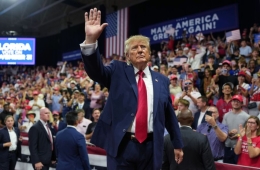
Speaking at a midterm election rally in Fort Myers, Florida, on October 23 (local time), President Trump said, "We may do another little 'Epic Fury' operation." He added, "If they are smart, they will now say, 'Let's negotiate in earnest.'"
"Epic Fury" is the name of the military operation launched on February 28, 2026, when the United States and Israel attacked Iran.
Trump's remarks came amid growing speculation that military operations against Iran could resume after the U.S. midterm elections on November 3.
The New York Times (NYT) reported on October 21 that the United States and Israel were considering a short, intensive attack on Iran after the midterm elections. The two countries' militaries are reportedly conducting attack drills involving fighter jets over Iraqi airspace.
Iran has also warned of a hard-line response. Two senior Iranian security officials said they had drawn up specific plans to target undersea communication cables in the Gulf if the United States and Israel attack Iran again.
One of the Iranian officials warned, "If Iran is attacked, there will be no more red lines," saying that all military facilities, including undersea communication cables and secret military bases, could be targeted.
They did not disclose specific methods or locations for the attacks. However, they said Iran was also considering ways to prolong disruptions to internet and communications services by not only destroying undersea communication cables but also hampering repair work.
Iran has continued to threaten oil tankers passing through the Strait of Hormuz. The Islamic Revolutionary Guard Corps (IRGC) claimed on October 23 that two supertankers had struck mines while sailing through the southern part of the Strait of Hormuz after straying from their designated route.
Yemen's Iran-backed Houthi rebels have also continued attacks targeting Saudi Arabia. The Saudi-led coalition said on October 23 that it had intercepted a ballistic missile launched by the Houthis toward the capital, Riyadh.
The United States has also begun reducing its diplomatic presence as security threats in the Middle East grow. According to foreign media reports, the U.S. State Department is reducing staffing at its embassies in four countries: Jordan, Lebanon, Qatar and the United Arab Emirates (UAE). The United States had previously ordered nonessential diplomatic personnel and their families at its embassy in Saudi Arabia to leave the country. However, the staffing reductions at the four embassies are not mandatory evacuations, and the embassies will remain operational.
Hot Picks Today
 "Let's Give Unemployment Benefits to Those Who Find Jobs Quickly and Stay Long-Term"... Petition Takes Aim at Compensation for 'Voluntary Resignations'
- "How Much Can You Buy for 20,000 Won?" Bustling... Millennials and Gen Z Flock to an 'Unexpected Shopping Hotspot' [China.zip]
- "Same facial mole and gait?" ... Kim Jong Un appears in a show of defiance, rendering death rumors moot
- 'YS's Closest Aide' Former Interior Minister Choi Hyungwoo Dies at 91
- "Shares Hit Daily Limit on 56 Billion Won News"... Marubeni Launches Tender Offer for K-Beauty Firm of 'Chae Sira's Husband' Kim Taewook
As the possibility of renewed conflict between the United States and Iran grows, major European and Middle Eastern countries have begun diplomatic efforts to prevent escalation. The foreign ministers of eight countries—Saudi Arabia, Egypt, Pakistan, Türkiye, France, Germany, the United Kingdom and Italy—met in Istanbul, Türkiye, on October 23 and called for a diplomatic solution. They warned that further military clashes could spread conflict across the Middle East and drive international oil prices up again.
© The Asia Business Daily. All rights reserved. Unauthorized AI training and use prohibited.