[Asia Business Daily-Realmeter Poll] President Lee's Approval Rating Falls 2.0 Percentage Points to 35.3%
Democratic Party 36.0%, People Power Party 42.2%
People Power Party leads by more than the margin of error for the first time in four months
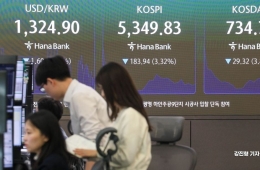
President Lee Jaemyung's job approval rating fell 2.0 percentage points in a week to 35.3%. The decline came as economic and real estate troubles, including a sharp stock market drop and a jeonse housing crisis, coincided with security concerns, such as North Korea's threat to resume loudspeaker broadcasts toward the South, and political disputes. Support fell particularly among progressives and residents of the Seoul metropolitan area. The Democratic Party of Korea's approval rating also edged down, keeping it in the mid-30% range for the third consecutive week. For the first time since June, it trailed the People Power Party by a margin outside the margin of error.
According to a regular poll conducted by pollster Realmeter at the request of The Asia Business Daily and released on the 26th, President Lee's job approval rating stood at 35.3%, down 2.0 percentage points from the weekly survey results for the previous week (the third week of October). Of respondents, 22.7% said he was doing a very good job and 12.6% said he was doing a fairly good job. The survey was conducted from the 19th to the 23rd of this month among 2,517 voters aged 18 or older nationwide using wireless telephone automated response interviews. The margin of error was plus or minus 2.0 percentage points at a 95% confidence level, and the response rate was 2.8%.

Negative evaluations stood at 62.3% (51.6% said he was doing a very poor job and 10.7% said he was doing a fairly poor job), up 1.9 percentage points from the previous week's survey. Negative evaluations thus exceeded positive evaluations by 27.0 percentage points, a difference outside the margin of error. A total of 2.4% of respondents said they were "unsure."
In the daily figures, the approval rating closed at 35.8% on October 16, rose to 36.3% on the 20th, and then fell to 35.1% on the 21st, 34.9% on the 22nd, and 34.5% on the 23rd. Negative evaluations rose from 61.4% on the 20th to 63.1% on the 23rd.
After rebounding by 2.1 percentage points last week, President Lee's positive rating fell by 2.0 percentage points this week, returning to a level similar to the 35.2% recorded in the second week of October.

By region, the rating fell by 4.6 percentage points in Seoul (from 34.7% to 30.1%), by 4.4 percentage points in Incheon and Gyeonggi (from 39.0% to 34.6%), and by 2.7 percentage points in South Jeolla-Gwangju and North Jeolla (from 54.7% to 52.0%). By age group, it fell by 7.0 percentage points among those aged 70 and older (from 39.8% to 32.8%), by 3.5 percentage points among those in their 20s (from 28.7% to 25.2%), and by 3.4 percentage points among those in their 60s (from 41.8% to 38.4%).
By gender, the rating fell by 3.4 percentage points among women (from 40.5% to 37.1%). By political orientation, support among progressives drew particular attention, falling by 5.6 percentage points (from 57.7% to 52.1%). Ratings among conservatives (from 12.6% to 12.7%) and centrists (from 39.3% to 39.2%) remained similar to last week. By occupation, the rating fell by 9.0 percentage points among the unemployed, retirees, and others (from 39.2% to 30.2%), and by 3.8 percentage points among those in agriculture, forestry, and fishing (from 33.1% to 29.3%).
A Realmeter official said, "The sharp stock market drop and controversy over deferring stock sales by the National Pension Service, along with economic and real estate instability, including the jeonse crisis, were compounded by North Korea's threat to resume loudspeaker broadcasts toward the South. Political disputes over the president's social media remarks and the controversy surrounding the chief of the Central Investigation Agency attending a Cabinet meeting also played a role. These factors appear to have caused support to fall again after a week, with defections concentrated among progressives and residents of the Seoul metropolitan area."
In a survey on political party support, the People Power Party stood at 42.6%, up 1.7 percentage points from the previous week's survey, while the Democratic Party of Korea stood at 36.0%, down 0.2 percentage points. The People Power Party led the Democratic Party of Korea by 6.6 percentage points. The survey was conducted from the 22nd to the 23rd of this month among 1,003 voters aged 18 or older nationwide using wireless telephone automated response interviews. The margin of error was plus or minus 3.1 percentage points at a 95% confidence level, and the response rate was 3.2%.
This is the first time in about four months that the People Power Party has led by a margin outside the margin of error, since the second week of June, immediately after the June 3 local elections, when the party stood at 44.3% and the Democratic Party of Korea at 38.0%. The Rebuilding Korea Party was at 6.7%, the Reform Party at 2.6%, the Progressive Party at 0.8%, and other parties at 2.4%. The share of undecided voters fell by 2.3 percentage points to 8.8%.

By region, the People Power Party's rating rose by 3.8 percentage points in Seoul (from 45.7% to 49.5%), by 3.4 percentage points in South Jeolla-Gwangju and North Jeolla (from 16.3% to 19.7%), and by 3.3 percentage points in Incheon and Gyeonggi (from 41.4% to 44.7%). The Democratic Party of Korea's rating fell by 4.1 percentage points in Incheon and Gyeonggi (from 39.5% to 35.4%) and by 3.9 percentage points in Busan, Ulsan, and South Gyeongsang (from 32.0% to 28.1%). In Daegu and North Gyeongsang, the share of undecided voters, which had risen sharply the previous week, fell by 9.8 percentage points (from 21.1% to 11.3%).
By age group, the People Power Party's rating rose by 18.1 percentage points among those aged 70 and older (from 42.2% to 60.3%) and by 3.5 percentage points among those in their 60s (from 40.1% to 43.6%). In contrast, its rating fell by 7.1 percentage points among those in their 30s (from 50.7% to 43.6%) and by 4.9 percentage points among those in their 20s (from 51.2% to 46.3%). The Democratic Party of Korea's rating fell by 13.8 percentage points among those aged 70 and older (from 38.2% to 24.4%), but rose by 4.8 percentage points among those in their 30s (from 27.5% to 32.3%) and by 4.6 percentage points among those in their 20s (from 26.1% to 30.7%).
By political orientation, the People Power Party's rating rose by 3.2 percentage points among centrists (from 38.8% to 42.0%), while falling by 2.1 percentage points among progressives (from 15.1% to 13.0%). The Democratic Party of Korea's rating fell by 1.2 percentage points among conservatives (from 12.3% to 11.1%) and by 1.0 percentage point among centrists (from 37.7% to 36.7%). As a result, the People Power Party led the Democratic Party of Korea among centrists by 5.3 percentage points, widening the gap from 1.1 percentage points the previous week.
By occupation, the People Power Party's rating rose by 10.2 percentage points among the unemployed, retirees, and others (from 41.4% to 51.6%), and by 6.8 percentage points among homemakers (from 34.3% to 41.1%). The Democratic Party of Korea's rating rose by 10.6 percentage points among the self-employed (from 29.9% to 40.5%), but fell by 6.3 percentage points among the unemployed, retirees, and others (from 34.7% to 28.4%).
A Realmeter official said, "The People Power Party appears to have gained support as its supporters consolidated, particularly among older voters and centrists. The party benefited from reduced legal risks following the acquittal of Seoul Mayor Oh Sehoon in his second trial on the 23rd, as well as from public calls for a tougher response to North Korea and a backlash against the president's difficulties in managing state affairs."
Regarding the Democratic Party of Korea, the official said, "After the fallout from remarks about 'firefighting finances' by Gyeonggi Governor Chu Miae and Rep. Boo Seungchan, internal factional conflict has intensified over efforts to impeach Chief Justice of the Supreme Court Cho Heedae and attacks over allegations involving the Shincheonji Church. The party's rating has edged down and remained in the mid-30% range for the third consecutive week."
Hot Picks Today
 "Everyone else is retiring"... People who say they'll work until 74: What's going on? [Pension Asset Polarization] 1
- "Maybe I'll just go to Japan," they'll say... Why are foreign visitors to Korea "flooding with complaints"? [2026 National Assembly Audit]
- He Left It in the Car and Forgot... "I Nearly Collapsed with Joy": Man Wins $1.48 Million Lottery
- North Korea Deploys Self-Propelled Artillery After Coastal Guns in Forward Areas
- "This Costs 66.3 Billion Won?"... The Story Behind the "Most Expensive Ever" Bra, Made Without a Single Piece of Fabric
For more details about the surveys, refer to the website of the National Election Survey Deliberation Commission.
© The Asia Business Daily. All rights reserved. Unauthorized AI training and use prohibited.