Park Honggeun: "Use Excess Tax Revenue to Develop Support Measures for Vulnerable Borrowers Amid High Interest Rates" [2026 Parliamentary Audit]

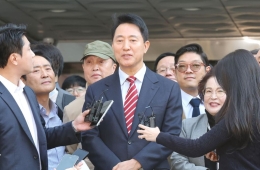
Minister of Planning and Budget Park Honggeun answers lawmakers' questions during a parliamentary audit of the Ministry of Planning and Budget at the National Assembly on Oct. 8, 2026. Photo by Yoon Dongju
View original imageThe government will draw on excess tax revenue from the semiconductor industry to develop additional support measures for vulnerable borrowers hit by prolonged high interest rates.
Minister of Planning and Budget Park Honggeun said on the 23rd at a comprehensive parliamentary audit of the National Assembly’s Finance and Economy Planning Committee, “The President recently asked us to develop more supplementary measures for the sectors and groups that are hardest hit by high interest rates, including vulnerable borrowers and low-income households seeking financial services, using excess tax revenue and other resources.”
“The relevant agencies are consulting with one another, and we will respond in stages,” Park said. He added, “Interest rates are rising, and that trend may continue. That is why we announced support measures for vulnerable borrowers at the end of August. Building on those measures, we have substantially increased the relevant allocations in next year’s budget proposal compared with this year’s.”
He continued, “Going forward, we need to develop measures with a broader, longer-term focus through close coordination between fiscal and monetary authorities.”
On support for youth employment, he said, “We are exploring various ways to provide more support than proposed in next year’s budget.” In response to a proposal to use inheritance and gift tax revenue to help young people build assets, he said, “We will consider the proposal from various angles, including whether it would be acceptable as policy and whether it could constrain fiscal flexibility, and will review any related proposals that come forward.”
He also noted that next year’s youth budget was set at approximately 43 trillion won, including about 5.1 trillion won for employment, adding, “I still think this is far from enough.”
During the audit, opposition lawmakers in particular criticized the allocation of 100 billion won for support for public-sector function reforms, 89.7 billion won to support the relocation of central government agencies to provincial areas, and 350 billion won for special welfare support for electricity bills in the Future Response Fund, arguing that these items did not align with the fund’s purpose of strengthening future growth engines.
Regarding the relocation projects for public institutions and central government agencies funded by the Future Response Fund, Park reiterated that they “fully align with our local fiscal projects.” He also stressed that existing projects could be included in the fund if they were consistent with its purpose and nature.
Hot Picks Today
 "The Transfer Failed, but 'Ding-Dong,' Money Came In"... KRW 32.5 Billion Financial Incident at Toss Bank
- Female YouTuber Who Disappeared During India Trip Makes Urgent "Proof of Life" Announcement: "I'm Not Being Threatened, Kidnapped or Held Captive"
- "Made 12 Billion Won Cleaning Up Other People's Dog Poop With Just a Rake"... 'Poop Scoop Millionaire' Is All the Rage in the U.S.
- Oh Se-hoon: "Justice has been served, the truth has finally prevailed... I'll repay your trust with results"
- 'Hangover Legend' Returns After 11 Years... Lee Sunmin Hyung's 'Captain Q' Sells Out
In response to criticism that initiatives such as the Local Future Growth Support Grant, the rural basic income pilot program, and child allowances lacked novelty and specificity, he said, “It is rare for any fund to consist entirely of completely new projects when it is first established. Naturally, existing projects whose nature and purpose align with the fund are included and carried out through it.”
© The Asia Business Daily. All rights reserved. Unauthorized AI training and use prohibited.