Oh Sehoon Acquitted on Appeal; Legal Cloud Lifts, Seoul Agenda and Presidential Bid Gain Momentum
Acquitted on appeal... Court finds Myung Tae-gyun’s testimony unreliable
“Difficult to find Myung Tae-gyun’s testimony credible,” court says
Uncertainty lifted... G3 Seoul Plan and night-time economy gain momentum
Oh Sehoon: “I am sorry to the pe
Seoul Mayor Oh Se-hoon was found not guilty on appeal of violating the Political Funds Act. In the first trial, he was sentenced to a penalty that would have cost him his mayoral office, putting his political career at risk. But with the appellate court overturning that ruling, he is expected to strengthen his position as a leading presidential contender from the opposition camp.
At 2 p.m. on the 23rd, the Seoul High Court’s Criminal Division 7, presided over by Judge Gu Hoe-geun, held a hearing to deliver its verdict in the case against Mayor Oh for allegedly violating the Political Funds Act and found him not guilty. Kang Cheolwon, a former Seoul deputy mayor for political affairs who was tried alongside him, and businessman Kim Han-jeong, one of Mayor Oh’s financial backers, were also found not guilty.

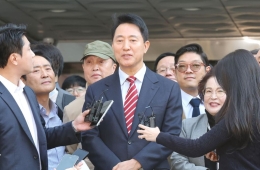
Seoul Mayor Oh Se-hoon comments on the not-guilty verdict after an appeals court hearing on the “alleged payment for opinion polls involving Myung Tae-kyun” case at the Seoul High Court in Seocho-gu, Seoul, on the 23rd. Yonhap News Agency.
View original imageThe court said it found the testimony of political broker Myung Tae-kyun difficult to trust. "There is no question that the fact that Mr. Kim, known as a supporter of Mayor Oh, paid money to Mr. Myung’s side on several occasions is clearly established by objective evidence, so there is some basis for suspicion of guilt," the court said. It particularly emphasized: "It is difficult to find Mr. Myung’s testimony, which is almost the only direct evidence, credible. The fragmentary facts established by the remaining evidence are insufficient to prove the charges in this case, and, in fact, many circumstances to the contrary have been established during the trial."
After the trial, Mayor Oh said, "I am sorry to the public, and I am also grateful. I will work hard so as not to disappoint your expectations." He also appeared to choke up while stating his position.
Mayor Oh was indicted in December 2025 on charges that, ahead of the April 7, 2021 Seoul mayoral by-election, he received opinion poll results from Myung on 10 occasions in total (three published and seven unpublished) and, through Kang, then his chief of staff, had his supporter Kim cover the costs, amounting to KRW 33 million.
In the first trial, the court found that, for five of the 10 opinion polls included in the charges, Mayor Oh’s side had commissioned the polls and Kim had covered KRW 21 million in costs. It ruled that the evidence did not establish that the remaining polls had been commissioned or that their costs had been covered. The court sentenced Mayor Oh to a fine of KRW 10 million and ordered him to forfeit KRW 21 million. Under Article 57 of the Political Funds Act, anyone sentenced to a fine of at least KRW 1 million for illegally receiving political funds cannot take up or be appointed to public office for five years after the sentence becomes final; anyone already in office must leave the position.
With today’s acquittal, Mayor Oh has been freed from the legal risks that had been holding him back. Uncertainty surrounding the Seoul municipal administration has also been significantly reduced. Above all, he can now focus on advancing key projects after fending off much of the criticism of the Seoul municipal administration during the recent parliamentary audit.
A key example is the "G3 Seoul Plan," the top-level municipal strategy for the ninth popularly elected administration. The plan is a four-year blueprint for the ninth administration, updating Mayor Oh’s "Seoul Vision 2030," unveiled in 2021, to reflect the AI transformation, the climate crisis and demographic changes. The city has set its goal as "Seoul, a global top city and a special city for quality of life."
The budget allocated to the "G3 Seoul Plan" alone amounts to KRW 86 trillion through 2030. Its detailed strategies include five visions for the future—Health and Safety City, Shared Growth City, Housing Stability City, Opportunity and Vitality City, and Spatial Innovation City—as well as 20 strategic goals and 100 key initiatives.
"Seoul-style Nighttime Economy," one of the city’s flagship economic growth initiatives, is expected to expand its scope to include areas such as business diversification. Mayor Oh believes the initiative, which aims to make it possible to safely enjoy tourism, culture, exercise and leisure activities at night, could generate an additional KRW 5 trillion in nighttime spending by 2030.
The city’s housing supply strategy, including its goal of reaching 30,000 housing units by the end of this year, is also expected to pick up pace. The city has already signed joint cooperation agreements with the cooperatives, construction companies and district offices involved in 11 redevelopment sites scheduled to begin construction by year-end. Of the 25 redevelopment sites it has been closely monitoring with the goal of starting construction this year, work has begun on 14, covering approximately 15,000 housing units. The city plans to closely manage the remaining procedures and factors causing delays so that construction can begin this year on the remaining 11 sites, covering 16,117 units.
Flagship projects, including the Han River Bus, the Namsan Gondola and AI support for young people, could also gain further momentum. The Han River Bus, which has faced questions about its effectiveness as public transportation and operating deficits, will seek to turn a profit by overhauling its services, including adjusting fares. The city plans to initially introduce more differentiated services through fare increases and gradually reduce the amount of subsidies it provides. The city had projected that the Han River Bus would become profitable starting in 2028, but estimated its operating losses through next year at approximately KRW 13.5 billion.
The city will also be able to continue its legal battle to get the Namsan Gondola project back on track after it was blocked by the courts. Earlier this month, the city decided to appeal to the Supreme Court after losing the appellate case against the cable car operator over the project. The city is also seeking ways to resolve the legal issues by easing height restrictions.
For the Youth AI Ladder program, the Seoul Metropolitan Council cut the project budget, but the Seoul Metropolitan Government had been preparing to design additional support programs. Based on the findings of its investigation, the city plans to include the relevant budget in its main budget for next year. A Seoul Metropolitan Government official said, "We will step up efforts to advance Mayor Oh’s key policies for his ninth term, including making Seoul a special city for quality of life that raises residents’ happiness and quality of life, a Seoul without loneliness, support for the socially vulnerable, and support for young people."
Hot Picks Today
 "The Transfer Failed, but 'Ding-Dong,' Money Came In"... KRW 32.5 Billion Financial Incident at Toss Bank
- "I waited all year for autumn just to eat this..." It may disappear from restaurants and supermarkets as catches plunge.
- Female YouTuber Who Disappeared During India Trip Makes Urgent "Proof of Life" Announcement: "I'm Not Being Threatened, Kidnapped or Held Captive"
- [Tomorrow's Weather] Rain to continue across Jeju and southern regions all weekend as Typhoon Champi approaches
- 'Hangover Legend' Returns After 11 Years... Lee Sunmin Hyung's 'Captain Q' Sells Out

Seoul Mayor Oh Sehun tours the facility ahead of an on-site meeting with Seoul’s integrated care officials at the Gwanak Health Care Link Center in Gwanak-gu, Seoul, on Oct. 21, 2026. Photo by Kim Hyunmin.
View original image© The Asia Business Daily. All rights reserved. Unauthorized AI training and use prohibited.