Delivery Robots, Automated Parking to Be Commercialized Sooner... Autonomous Taxis to Be Piloted in Gwangju in 2028
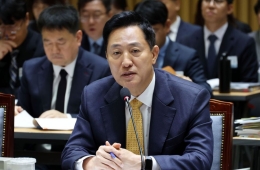
Lee chairs second plenary meeting of Regulatory Rationalization Committee
Land Ministry to update rules for autonomous vehicles and mobile robots
"Support commercialization beyond technology and service development"
Apply spatial and building regulations flexibly and streamline procedures
The government has decided to comprehensively revise regulations to enable the widespread everyday use of mobile robots. Advances in robotics have expanded their use in everyday settings, including delivery, automated parking and construction-site inspections. However, the government believes commercialization has been delayed by regulations that vary from one space to another and inconsistent operating standards. Robots have so far been used mainly in manufacturing, but the government plans to lay the groundwork for their wider use in daily life. It will also establish new criteria for businesses providing paid transportation services using autonomous driving technology.
On the 23rd, the Ministry of Land, Infrastructure and Transport presented a plan to promote the commercialization of mobile robots at the second plenary meeting of the Regulatory Rationalization Committee, chaired by President Lee Jae-myung. Manufacturing robots used in factories still account for about half of South Korea's robot market, but the government expects their use in the service sector to grow. It announced plans to update the relevant systems and infrastructure in preparation.
The government plans to enact the Special Act on the Safe Use and Promotion of Commercialization of Mobile Robots by the end of this year. The bill was recently sponsored by Han Byeong-do of the Democratic Party of Korea and will consolidate into a single special act robot-related regulations that are currently scattered across individual laws. In the construction sector, areas set aside indoors for robots to wait, as well as charging and maintenance facilities, will be excluded from calculations of a building's floor area. This is expected to make it easier to meet floor-area ratio requirements and encourage the inclusion of such facilities in apartment, office and commercial buildings.

Former Minister of Land, Infrastructure and Transport Kim Yoondeok listens to an explanation about mobile robots during a visit to Naver's headquarters last May. Photo provided by the Ministry of Land, Infrastructure and Transport.
View original imageFacilities for robot-based deliveries will also be allowed in residential areas and near other demand centers. Conditions for operating mobile robots in parks will be applied more flexibly, and residents' representative councils will be able to introduce robot services such as delivery, security, patrols and cleaning. A legal basis will also be established for using mobile robots to inspect and maintain aircraft exteriors at airports.
The government also plans to establish standardized design criteria that account for indoor routes for robots, charging areas and delivery facilities. Buildings that meet the criteria will be certified as robot-friendly. When building systems such as elevators are linked to robots, certification and inspections will not be required if the connection does not directly affect safety. Communications protocols, which currently vary by manufacturer, will also be standardized through measures such as Korean Industrial Standards (KS). The central government will provide the necessary funding to help local governments account for the operating conditions of mobile robots when upgrading outdoor spaces such as sidewalks, parks and plazas. Operating standards will be drawn up for sectors including apartment complexes, construction sites, parking lots and everyday logistics, taking into account the characteristics of each sector and setting out operating procedures and the scope of responsibility.
The government will build and manage spatial data needed for robot movement, including pedestrian areas and building entrances. It will make this data available to the private sector and establish a system for regularly updating it with operational data accumulated during testing and actual operation. An exception will also be introduced allowing video containing personal information to be used without anonymization. Regulatory sandboxes currently administered separately by different ministries will be consolidated under a single point of contact at the Ministry of Land, Infrastructure and Transport. The government also plans to designate zones to promote the use of mobile robots for service testing and other purposes.

An autonomous mobile robot (AMR) transports parts at Hyundai Motor Group Metaplant America (HMGMA). Photo courtesy of Hyundai Motor Group.
View original imageIn addition, operating and safety standards, as well as insurance requirements, will be set according to where robots are used and who operates them. Operators will be required to compensate for damages in the event of an accident in the first instance, while a legal basis will allow them to seek reimbursement from manufacturers depending on the cause, such as a manufacturing defect. The government plans to establish a separate mobile robot accident investigation committee and introduce a notification system to reduce the burden on operating companies.
"As robot technology advances and reaches the commercialization stage, where it is put into actual service, new policies are needed, including regulations, infrastructure, and operating and safety standards required for real-world deployment," a Ministry of Land, Infrastructure and Transport official said. "By maintaining existing support for technology development and manufacturing while supplementing it with system improvements and commercialization support across ministries and sectors, we can support the growth of the robotics industry and the expansion of the market."
Regulations related to autonomous driving will also be updated with a view to its everyday use, including driverless robotaxis and paid transportation services. To that end, the government plans to establish a formal framework for autonomous driving service providers. They will be required to monitor autonomous vehicles in operation and manage remote-control and cybersecurity systems. They must also have personnel available for on-site response in emergencies and appoint a safety manager. The government's goal is to pilot a driverless vehicle business model in 2028 in Gwangju, which has been designated an autonomous vehicle test city. The government has already formed a consultative body that includes existing transport operators, such as taxi companies, to discuss the timing of introduction and the scope and level of services.

A Waymo robotaxi on display at CES 2025 in the U.S. last year. It was built on the Hyundai Ioniq 5 platform. Yonhap News
View original imageThe rules will be revised to allow autonomous vehicles without a driver's seat to operate outside designated pilot zones when traveling to depots or charging stations. Until now, operators had to apply for an exception through the regulatory sandbox each time, but the government plans to make this a permanent arrangement. A fast-track system will be introduced for autonomous vehicles granted temporary operating permits, simplifying preliminary verification for vehicles and technologies whose safety has been confirmed. The government aims to have 3,000 vehicles available for testing next year, 2,800 more than this year, enabling them to be deployed in the field much sooner.
Hot Picks Today
 [Breaking] Oh Sehoon, Acquitted in Second Trial, Says, "Thank You to the People Who Believed in My Innocence... I Will Conduct Myself Even More Impeccably"
- "The Transfer Failed, but 'Ding-Dong,' Money Came In"... KRW 32.5 Billion Financial Incident at Toss Bank
- "The days of getting an instant discount at Don Quijote are over"... Heading to Japan to shop? Get ready for 'airport queues'!
- "People with money have already moved," they say... 1,700-ton underground vault full as the wealthy flock to this country
- 'Hangover Legend' Returns After 11 Years... Lee Sunmin Hyung's 'Captain Q' Sells Out
The scope for using raw data will also be expanded so autonomous driving companies can train their systems on a wider range of driving data. In Gwangju's test city, data can currently be shared only under separate agreements with three autonomous driving companies. The change will open the way for other companies to access the data as well. Safety standards for the commercial sale of autonomous vehicles will be introduced in South Korea based on standards recently established by the United Nations Economic Commission for Europe (UNECE). The government also plans to introduce a performance certification system to allow business-to-business (B2B) transactions between companies as early as the end of this year.
© The Asia Business Daily. All rights reserved. Unauthorized AI training and use prohibited.