[Interview] Kim Yonghyun: "If North Korea Activates Loudspeakers, Unexpected Incidents Are a Concern" [Current Affairs Show]
Interview with Kim Yonghyun, Professor of North Korean Studies at Dongguk University
"Kim Yo Jong's Move Is Unusual, Aimed at Demonstrating Resolve"
"We Must Manage the Situation to Prevent Further Deterioration; Diplomatic Response Also Important"
■ Broadcast: The Asia Business Daily's "Soh Jong-seop's Current Affairs Show" (Monday-Friday, 4 p.m.)
■ Host: Soh Jong-seop, Political Specialist ■ Producer: Lee Mi-ri, PD
■ Guest: Kim Yong-hyun, Professor of North Korean Studies at Dongguk University (October 22)
※ When quoting this article, please be sure to cite "Soh Jong-seop's Current Affairs Show."
Soh Jong-seop: Hello, everyone. Welcome to Soh Jong-seop's Current Affairs Show. North Korea's recent moves have been somewhat unusual. Kim Yo Jong, a department director of North Korea's Workers' Party, has stood out. She said, in a very strong message, that North Korea would resume broadcasts toward the South. There have been various analyses and proposed responses regarding North Korea's intentions and how we should respond. Let's connect with an expert to find out more.
We are joined by Kim Yong-hyun, professor of North Korean Studies and vice president for academic affairs at Dongguk University. Professor Kim, I believe this is the first time Kim Yo Jong has visited a border fortification site. How should we interpret this?

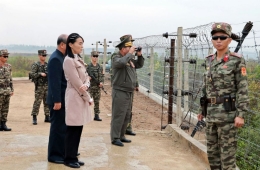
Kim Yo Jong, department director of the Workers' Party, inspected key sites of fortification work along the southern border with senior commanders of the Korean People's Army General Staff, the Korean Central News Agency reported on the 21st.
View original imageKim Yong-hyun: That's right. We should view it as a highly unusual move. Kim Yo Jong has played a libero-like role in inter-Korean relations. But I think this may be the first time, at least as far as I can remember, that she has come all the way to the Military Demarcation Line, where the two Koreas are in sharp confrontation, to inspect the site and provide on-site guidance. Overall, this can be seen as an action demonstrating North Korea's firm stance on the current state of inter-Korean relations.
Soh Jong-seop: Chairman Kim Jong Un is staying out of the spotlight, while Kim Yo Jong is at the forefront, delivering strong messages toward the South.
Kim Yong-hyun: When Chairman Kim Jong Un finds it difficult to step in directly, or when someone else needs to play a role on his behalf, Kim Yo Jong takes such action. In inter-Korean relations, Chairman Kim Jong Un's direct involvement could be seen as completely blocking any way out. North Korea is also considering the impact that his direct involvement could have. So, by putting Kim Yo Jong at the forefront, North Korea may be signaling Chairman Kim Jong Un's will and intentions.
Soh Jong-seop: Kim Yo Jong ordered new response measures to be placed on standby along the entire border and hinted at resuming loudspeaker broadcasts toward the South. Why do you think North Korea is taking these steps now?
Kim Yong-hyun: I think we need to look at two aspects. First, wasn't the recent landmine explosion a North Korean provocation? Paradoxically, North Korea seems to be taking a hard line toward the South to deflect its defensive position and the criticism directed at it. Another factor is a possible meeting between President Trump and Chairman Kim Jong Un. The chances of it happening have gradually declined, but it remains a possibility. In this situation, North Korea appears to be using its policy toward the South forcefully to consolidate support at home, meaning support for the Kim Jong Un regime. It also seems to be moving toward emphasizing its approach to the United States. We can see that North Korea is also seeking to consolidate support at home through its hard-line stance toward the South.

The “crater from a suspected landmine explosion” was released during a briefing by the Joint Chiefs of Staff on the “suspected landmine explosion in the Demilitarized Zone,” held at the Ministry of National Defense in Yongsan-gu, Seoul, on September 28. Provided by the Joint Chiefs of Staff via Yonhap News Agency.
View original imageSoh Jong-seop: North Korea said it would operate loudspeakers along the entire border sometime in October. Will it actually do so?
Kim Yong-hyun: It is possible. In the past, North Korea has often followed through on its threats. What is concerning is that this could put us in a position where we have no choice but to resume our loudspeaker broadcasts toward North Korea. If that happens, inter-Korean relations will revert to the past, with the two sides broadcasting to each other through loudspeakers. As tensions rise in inter-Korean relations, accidental or unexpected incidents could occur along the Military Demarcation Line or the NLL. That is a serious concern.
Soh Jong-seop: So if North Korea uses loudspeakers to broadcast toward the South, we will respond with our own broadcasts. But the loudspeakers facing North Korea have been removed, haven't they?
Kim Yong-hyun: They have been removed, but it would not take much time or technical effort to resume loudspeaker broadcasts. The concern is that things may not stop at loudspeakers. If North Korea deploys more powerful measures, and we respond in proportion, repeating this cycle, tensions between the two Koreas will inevitably rise.
※ Click the video to watch the full program.
Soh Jong-seop: What do you think are the chances of an accidental clash between the two Koreas?
Kim Yong-hyun: That is what concerns me most. The likelihood of incidents arising around the five West Sea islands or along the NLL, as well as inside the DMZ along the Military Demarcation Line, is increasing. To manage inter-Korean relations, it is extremely important for us to make a conciliatory gesture toward North Korea and develop the capacity to manage the situation so that it does not deteriorate further. The United Nations Command and our military authorities need to strengthen their coordination and work to prevent potential incidents before they occur. Diplomatic responses to prevent the situation from worsening are also very important. I believe it is also essential that we carry out these efforts effectively while continuing to send North Korea signals of our commitment to peace.
Soh Jong-seop: All right, we'll end it here. Thank you for your insightful comments, Professor Kim.
Hot Picks Today
 "The Transfer Failed, but 'Ding-Dong,' Money Came In"... KRW 32.5 Billion Financial Incident at Toss Bank
- Tearful Oh Sehoon Acquitted on Appeal: "Thanks to Those Who Believed in My Innocence" (Update)
- "Made 12 Billion Won Cleaning Up Other People's Dog Poop With Just a Rake"... 'Poop Scoop Millionaire' Is All the Rage in the U.S.
- "My Blood Vessels Got Cleaner Just by Drinking It"... Surprise: The "Tea" Even Doctors Make Sure to Drink
- 'Hangover Legend' Returns After 11 Years... Lee Sunmin Hyung's 'Captain Q' Sells Out
Kim Yong-hyun: Thank you.

© The Asia Business Daily. All rights reserved. Unauthorized AI training and use prohibited.