Constitutional Court: "Harsher Punishment for Killing Lineal Ascendants Is Constitutional" ... 8-1 Vote
"More deserving of condemnation than ordinary murder"
The Constitutional Court has ruled that a provision of the Criminal Act imposing a heavier punishment on someone who kills their lineal ascendant than for ordinary murder is not unconstitutional.

On the 22nd, the Constitutional Court ruled by an 8-to-1 vote that Article 250(2) of the Criminal Act is constitutional in a constitutional complaint filed by A, who had received a final four-year prison sentence for killing a lineal ascendant.
Article 250(2) of the Criminal Act provides that anyone who kills their own or their spouse's lineal ascendant shall be punished by death, life imprisonment, or imprisonment for at least seven years. The statutory minimum under Paragraph 1 of the same article, which defines ordinary murder, is five years' imprisonment. When the Criminal Act was enacted in 1953, the statutory penalties for killing a lineal ascendant were limited to death or life imprisonment. The phrase "imprisonment for at least seven years" was added in a 1995 revision. The Constitutional Court limited the scope of its review to the part concerning "a person who kills their own lineal ascendant."
After A's father, who had been hospitalized for treatment of symptoms of a cerebral hemorrhage, was discharged around April 23, 2021, due to the burden of treatment costs and other reasons, A did not give him any of his prescribed medication from the following day. A gave him only 10 servings of therapeutic food over seven days, although he needed three servings a day. From May 1 to May 8 of the same year, A stopped providing him with therapeutic food, water, and prescribed medication and did not enter his room. The father died after developing pneumonia and other conditions while suffering from severe malnutrition. At the time of his discharge, he was unable to stay alive without assistance from another person.
On August 13, 2021, the first trial sentenced A to four years in prison. On November 10 of the same year, the appeals court also dismissed A's appeal. While the case was pending before the Supreme Court, A petitioned for a referral to review the constitutionality of the law, but on March 31, 2022, the Supreme Court dismissed both the petition and the appeal. A filed a constitutional complaint in May of that year.
A argued that under this provision, a suspended sentence could not be imposed even if the sentence were mitigated based on extenuating circumstances, barring exceptional circumstances. A said this meant that even killings of lineal ascendants lacking any element of filial misconduct and therefore warranting less condemnation would be punished more harshly, violating the principle of proportionality between responsibility and punishment. A also argued that the provision violated the principle of equality by treating such cases differently from cases in which someone kills a person other than a lineal ascendant.
The Constitutional Court rejected these arguments. It said the provision "aims to protect the ethical relationship between lineal ascendants and lineal descendants" and that "the act of killing a lineal ascendant may be considered more unlawful and more deserving of condemnation than ordinary murder." The Court also noted that the statutory minimum of seven years' imprisonment was not substantially different from the five-year minimum for ordinary murder.
In response to the argument that the provision restricts suspended sentences, the Court ruled that "it is difficult to conclude that setting the statutory penalty so that a suspended sentence cannot be imposed solely through mitigation based on extenuating circumstances is excessively harsh in relation to the offender's responsibility and therefore falls outside the scope of legislative discretion." The Court reasoned that where circumstances warranting reduced responsibility exist, the sentence can be determined by applying statutory grounds for mitigation, such as diminished mental capacity, or by mitigating it based on extenuating circumstances. It also found that treating cases involving the killing of a lineal descendant or spouse differently was not arbitrary discrimination.
Hot Picks Today
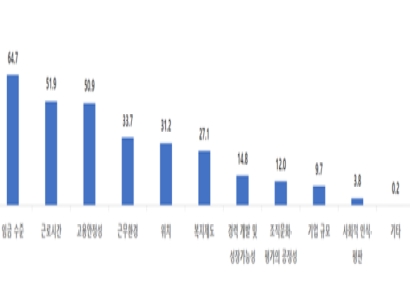 "Please Pay Me at Least 3 Million Won a Month": More Than Half of Young People Today Prioritize "Working Conditions" Over Company Size
- Selling Like Crazy Every Year... 30-Year-Old Hetbahn Takes on a New Challenge: Tastes Better Than "Mom's Home Cooking" [On-Site Report]
- Sleep Is Koreans' 'No. 1' Health Interest, but the 'Twist' Is They Averaged Less Than 7 Hours a Night This Year
- Ran 18 km With 9-Year-Old Tied to Him at the Waist... "Man Banned From Competing for 3 Years"
- Beachgoer Finds 'Plastic' That Turns Out to Be Perfume Ingredient Worth More Than Twice as Much as Gold
Justice Ma Eun-hyeok, however, issued a dissenting opinion. He said the provision "treats those whose actions involve filial misconduct and those whose actions do not as the same, increasing the statutory minimum to seven years' imprisonment," and added that "even when the degree of responsibility is low, unless another statutory ground for mitigation applies, a judge would have no choice but to impose an actual prison sentence of at least three years and six months, even after mitigation based on extenuating circumstances, leaving no possibility of imposing a suspended sentence."
© The Asia Business Daily. All rights reserved. Unauthorized AI training and use prohibited.