[Q&A] Shin Hyunsong: "Rate Hold Is 'Fruit of Using the Hoe'; Restrictive Stance Must Continue"
Bank of Korea's October Monetary Policy Press Conference
"Consecutive Rate Hikes in July and August Secured Policy Room"
"Next Year's Inflation Rate to Exceed the Target"
"Only in the Year After Next Will It Near the Target Level"
"Prolonged Oil Price Caps Could Cause Fiscal Problems")
Bank of Korea Governor Shin Hyun-song said the Bank of Korea’s Monetary Policy Board’s decision on the 22nd to hold the base rate steady at 3.00% per year was “the fruit of acting early,” but added that “there is a need to continue the restrictive policy stance.”
The Board raised the base rate by 0.25 percentage points twice in a row in July and August as a preemptive measure. This helped stabilize the financial market compared with those of other countries and bought time to reassess domestic economic conditions without raising rates further. However, he said a restrictive policy was still necessary because inflation remained high.
At a press conference held after the Monetary Policy Board’s policy meeting that day, Governor Shin said, “At the August meeting, I said we had ‘used a hoe to stop what would have required a shovel.’ This hold is the fruit of using the hoe.” He added, “Market conditions remained quite stable despite the U.S. Federal Reserve (Fed) raising interest rates,” and stressed that “the exchange rate also stabilized at a lower level, producing desirable effects.”
However, he left the door open to further base rate increases. “Growth and inflation are, if anything, stronger than they were in August,” Governor Shin said. “We will respond until we are confident that inflation is converging stably toward the target level.”
Regarding the Bank of Korea’s forecasts in August for economic growth of 3.3% this year and 2.9% next year, Governor Shin said, “Based on our current assessment, growth will be considerably higher than that.” He also forecast that core inflation next year would exceed the previous forecast of 2.5% and fall to around the Bank of Korea’s target of 2.0% in 2028.
The following is a Q&A.

Shin Hyun-song, Governor of the Bank of Korea, speaks at a press conference on the Monetary Policy Board's policy direction at the Bank of Korea in Jung-gu, Seoul, on Oct. 22, 2026. Photo by Kim Hyun-min.
View original image-Today’s decision by the Monetary Policy Board to hold rates steady was unanimous. The policy statement seems different from the restrictive message you have recently conveyed.
▲Governor Shin = We believe that by raising the base rate twice in a row in July and August, we secured policy room. I think we gained the flexibility to conduct policy in line with domestic economic conditions without being pushed around by market conditions. In particular, the Fed raised rates in September, and market conditions were somewhat volatile, but the Korean financial market remained quite stable. In terms of financial stability, we also assess that the pace of increases in housing prices and the financial vulnerability index has eased. At the August decision, I said we had “used a hoe to stop what would have required a shovel.” You can think of this hold as “the fruit of using the hoe.” That said, looking at the economic outlook, growth and inflation are somewhat stronger than they were at the August Monetary Policy Board meeting. In August, we said our forecast for economic growth was 3.3% this year and 2.9% next year. Our current assessment is that growth will be considerably higher than that. As for core inflation, this year it is generally in line with the August forecast of 2.5%, but next year it looks likely to be higher than the August forecast of 2.5%. The unanimous decision reflects a considerable consensus on our overall assessment of the economy. As growth and inflation are, if anything, stronger than they were in August, I believe we need to continue the current restrictive policy stance. We will continue to respond until we are confident that inflation is converging stably toward our target level.
-You also said you had bought time. And what do you mean by “the fruit of using the hoe”?
▲Governor Shin = One benefit is that market conditions remained quite stable despite the Fed’s rate hike, and the exchange rate stabilized at a lower level. We also gained several desirable benefits from the exchange rate’s stabilization at a lower level. For example, import prices remained under control, and their decline appears to have significantly improved the purchasing power of low-income households in particular. When the currency strengthens by around 10%, the purchasing power of households in the first income quintile, the most vulnerable group, improves by more than 0.5%. The effect is greater than for the fifth quintile. I believe the current direction of the exchange rate is also helping to reduce polarization. It takes time for financial stability and financial vulnerability indicators to ease, but preemptive action had the benefit of slowing the pace of deterioration. Overall, we gained the flexibility to conduct policy in line with domestic economic conditions, and exchange rate stability helped keep import prices under control and continue to boost household purchasing power. I would also say that it helped financial stability.
-The won-dollar exchange rate has fallen considerably from its peak. You said it had room to fall further. Do you still hold that view in light of fundamentals and market conditions? What important variables, besides the exchange rate level and volatility, should we look at?
▲Governor Shin = First, I would say predictability is extremely important when it comes to the exchange rate. The high exchange rate we saw in early summer was an exceptional case. Conditions at the time were highly abnormal. The exchange rate has fallen considerably and stabilized since then; the rapid decline can be seen as a process of reversing that abnormal situation. At the press conference in August, the won-dollar exchange rate was around 1,480 won. It is around 1,325 won now. I would say that volatility has eased considerably and gradually. As for the exchange rate level itself, the won is indeed somewhat weaker than in previous years, based on the real effective won exchange rate. The Bank for International Settlements (BIS) real effective exchange rate index is calculated as a weighted average based on the weights of trading partners. Its average is around 101, while it was around 89 at the end of August. The higher the real effective exchange rate, the stronger the currency. By the BIS measure, the won can still be considered weak. It is undervalued compared with previous years. If you ask whether it needs to return to its historical average, not necessarily. As I said earlier, the won had been very weak and then experienced a rebound, and a stronger exchange rate has both benefits and costs. It helps curb increases in import prices and boost household purchasing power. It clearly helps address polarization in Korea. The exchange rate is a price variable that facilitates trade, but it is also an important price that symbolizes confidence in the economy. As a central bank that seeks to stabilize the value of the currency, we will work to steady the market and serve as a focal point.
-Regarding the internationalization of the won, the offshore settlement system has been in operation since last month. What has the market response been, and what effects do you expect?
▲Governor Shin = The offshore settlement system is one of the two pillars of the won’s internationalization. One pillar is 24-hour trading, which began in July, and the second is the Bank of Korea’s offshore settlement system, which has been in pilot operation since September 1. It is currently proceeding smoothly, and actual operations will begin in January next year. I expect it to bring several benefits once it is up and running. Overall, trading volume has increased somewhat, including offshore-hours trading, but I will assess the situation and comment further after the system goes live.
-The domestic government bond market has been relatively stable. Given that the bond market is a channel through which monetary policy is transmitted, is there concern that the effects of monetary tightening are weakening?
▲Governor Shin = Long-term bond yields are rising around the world. No country can avoid this. Long-term yields have risen substantially even in countries with sound fiscal positions. There are several factors, but countries with sound public finances have seen smaller increases. There are clearly differences across countries. In addition to fiscal conditions, long-term factors such as global investment demand are also at work.
-What is your view on the possibility that increased investment in artificial intelligence (AI) could raise the real neutral interest rate and lead to a prolonged period of high interest rates in Korea?
▲Governor Shin = There is a lot of talk in the market about intense competition to secure funding for investment. In particular, hyperscalers investing in AI have entered the long-term corporate bond market to secure long-term funding, creating competition with government bond issuance. That is one reason long-term government bond yields have risen considerably. The yield on U.S. 30-year Treasuries has now exceeded around 5.4%. At that level, corporate bond yields are much higher once a spread is added. Even investment-grade corporate bonds have much higher yields for long maturities, at around 6-7%. Looking at the spreads, this is not due to worsening market conditions or risk aversion; rather, overall yields are rising while spreads remain stable. That reflects high demand for investment, with demand for investment translating into the need to secure long-term funding. Unless there is a major bubble, there is growing weight behind the possibility that expanding investment will eventually boost productivity and lift long-term growth. In discussions at the International Monetary Fund (IMF) meetings and in bilateral meetings with industry representatives, many people said that long-term investment demand, as well as fiscal issues, is important. Many therefore felt that growth would be higher in the future. In this context, as growth rises, the equilibrium interest rate is bound to follow. We cannot say for certain how much the neutral rate will rise; we will have to watch and see.
-Isn’t the government’s expansionary fiscal policy at odds with the Bank of Korea’s restrictive policy?
▲Governor Shin = Even when conducting fiscal policy, if funding is currently insufficient but investment can raise future growth, fiscal spending for investment may not be at odds with monetary policy. In the short term, however, it can add to aggregate demand and raise inflationary pressure to some extent. Of course, investment must be carefully designed, and market principles and profitability must be carefully assessed. The budget proposal for next year includes considerable spending not only on investment but also on transfers. Transfer payments generally have a limited effect on GDP. Taking various factors into account, we estimate that next year’s budget proposal will raise economic growth by around 0.5 percentage points and increase inflation by around 0.06 percentage points. The inflation impact is limited because many items have low fiscal multipliers. That does not mean there is no cause for concern. A low fiscal multiplier is no reason to be complacent. If spending continues and more such items are added, it will be very difficult to reverse them later. When designing spending to ensure fiscal sustainability, we must also consider how easily it can be reversed. Ultimately, the National Assembly must scrutinize it rigorously.
-The KOSPI has undergone a sharp correction recently. What economic impact do you think this will have?
▲Governor Shin = As I said at the July monetary policy meeting, I consider semiconductor prices more important than semiconductor stock prices. Semiconductor prices remain firm. We continue to monitor both long-term contract prices and spot prices. The spot price of DRAM DDR5 remained around $45 for some time and has recently either risen or stayed broadly stable. In this respect, our previous assessment of exports and investment remains valid. However, stock prices are affected by various factors beyond the real economy, and the recent correction has been substantial. It could have some impact on the real economy as well. Rising stock prices can create a wealth effect, and there are estimates based on historical data. Because more individual investors are participating in the market now than in the past, we are also considering the possibility that the wealth effect has grown. Consumer sentiment and retail spending suggest that we cannot rule out the wealth effect entirely. Consumption of financial services is also affected by trading volumes and financial institutions’ fees, so if trading volumes fall and the stock market loses momentum, measured consumption may decline to some extent. I believe the recent stock market correction has temporarily dampened consumption to some degree. However, overall, exports and investment are improving the conditions for consumption, so I expect consumption to remain solid.
-You said that imposing an oil price cap for an extended period could have adverse effects.
▲Governor Shin = Controlling fuel prices has a considerable effect in curbing the pass-through of rising costs to other items, including the process by which costs are passed through into prices. I believe the oil price cap has played a significant role in keeping consumer inflation at its current level, even amid considerable price instability. Of course, the longer it remains in place, the more it distorts the price structure. The IMF has also recommended that energy price subsidy policies not be maintained for too long. Cases in other countries show that prolonged policies can cause significant fiscal problems. I believe the government is well aware of this and is clearly considering an exit strategy.
-Regarding the internationalization of the won, is there evidence that offshore transactions are moving onshore?
▲Governor Shin = The internationalization of the won is still at an early stage. 24-hour trading began in July, and the Bank of Korea’s won international settlement network is still in pilot operation, so it is too early to fully assess its actual effects. Nevertheless, since 24-hour trading began, there have been signs of a slight increase in offshore non-deliverable forward (NDF) transactions and onshore deliverable forward (DF) transactions. In my view, once the won international settlement network is fully operational and overseas banks, particularly foreign banks, are designated as won trading banks and connected to the network, its effects will grow. Beyond exchange rate volatility, this is a necessary step for the won to gain international recognition and develop into an international currency. The won international settlement network is key infrastructure for strengthening confidence in the won in international financial markets.
-If growth and inflation are higher than expected even after two rate hikes and a further increase, would the terminal rate also need to be raised?
▲Governor Shin = We refer to interest rates that can be estimated from the bond market. However, I do not think the Bank of Korea needs to follow them. When new data come in, we will reassess our views and conduct monetary policy with an open mind.
-The United States may raise its base rate in December, following its move in September. How does the Fed’s monetary policy affect Korea’s monetary policy?
▲Governor Shin =We raised rates in July and August consecutively. I said that we had secured room to maneuver. Of course, the Fed’s decisions are very important. The dollar is the most important reserve currency, and the effects of its policies are significant because they are transmitted through global financial conditions and asset prices. We will continue to pay close attention to the direction of the Fed’s monetary policy. At BIS meetings, we are also in close communication with other central banks, including Fed Chair Kevin Warsh. Because we acted early, we are now in a position to reap the benefits.
Hot Picks Today
 Despite "Insufficient Balance" Notices, They Board Anyway... Reports of Foreign Fare Evasion Mounting
- "I Hide in the Classroom Alone to Eat Steamed Buns. Please Help Me"... Tearful Plea Draws 600 Million Views, But It Turns Out...
- [2026 National Assembly Audit] After Criticism Over "Delaying Virtual Asset Taxation"... Lee Eog-weon: "Various Circumstances Must Be Considered"
- A 'Premium Dessert' from Korea... 'Orion Custard' Hits Big in China and Vietnam as Production Lines Expand
- [Exclusive] "We Came for a KRW 140,000 Trip": Following Chinese Tourists in Korea Uncovers a 'Suspicious' Tour
-If next year’s core inflation forecast rises above 2.5%, could the restrictive cycle last longer?
▲Governor Shin = The core inflation forecast announced last August was 2.5%. Given the current situation, we think 2.5% is somewhat low. It looks likely to be a little higher next year. However, the monetary policy inflation target is 2%. We aim to achieve it within the time frame of monetary policy, taking growth and various other conditions into account. Core inflation is expected to remain above our 2% target next year, but we expect it to fall close to the target level the year after next. Government bond yields are affected by various factors, including monetary policy, fiscal soundness, global liquidity and market sentiment. Long-term yields have risen substantially around the world recently, but Korea has remained relatively stable thanks to its sound fiscal position. In particular, long-term yields of 10 years or more are more closely tied to market conditions, risk appetite and long-term liquidity than to monetary policy directly. The relationship between exchange rates and interest rates is also important. Therefore, the fact that next year’s core inflation is expected to exceed the August forecast does not, by itself, have major implications for government bond yields or the terminal rate.

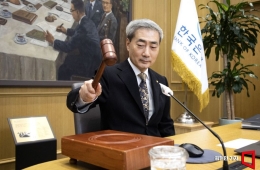
Bank of Korea Governor Shin Hyunsong strikes the gavel during a plenary session of the Monetary Policy Board at the Bank of Korea in Jung-gu, Seoul, on Oct. 22, 2026. Photo by Kim Hyunmin.
View original image© The Asia Business Daily. All rights reserved. Unauthorized AI training and use prohibited.