[Exclusive] "We Came for a KRW 140,000 Trip": Following Chinese Tourists in Korea Uncovers a 'Suspicious' Tour
[Korea Trips Sold at Rock-Bottom Prices] 1. Alcohol and Cigarettes Collected After Tourists Bring Them In, Tourists Stranded Over Low Shopping Spend... The Dark Side of "Tourism Korea"
Staff Collect Alcohol and Cigarettes from Chinese Tourists Afte

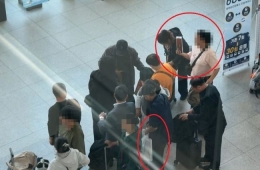
On the 13th, officials at the Pyeongtaek-Dangjin Port International Passenger Terminal collect alcohol and cigarettes brought in duty-free by Chinese tourists and transfer them into white bags and large duffel bags. Photo by Kim Heeyoon.
View original imageLiquor Collected Upon Arrival, Then Cigarettes at the Hotel... The Suspicious Side of a 140,000-Won Tour
On the morning of October 13, at the Pyeongtaek-Dangjin Port International Passenger Terminal in Gyeonggi Province, tourists who had arrived from China by car ferry were pulling their suitcases out of the arrivals hall. Among those moving carts piled high with agricultural products such as jujubes, some travelers also stood out carrying white duty-free shop bags.
A strange scene unfolded in one corner of the arrivals hall. Chinese tourists were handing over the liquor they had brought to a woman who appeared to be an attendant. She took the bottles one by one and placed them in a large bag. The liquor collected from several tourists was loaded into a vehicle. Just a few steps away stood a customs notice reading, "Bringing in goods on behalf of others is prohibited." The Asia Business Daily's reporting team captured the scene of liquor brought in as personal belongings being gathered in one place immediately after arrival.
The tourists had bought a Korean group tour package for 699 yuan (about 140,000 won). This ultra-low-cost package included round-trip car ferry fares, accommodation and meals in Korea, and sightseeing. The reporting team followed about 60 tourists who arrived that day to their accommodation in Incheon and then to Dongdaemun in Seoul the following day.
The collection of items continued at the accommodation. That evening, in the lobby of a lodging facility in Incheon, attendants laid out a list and called tourists' names one by one. Those called handed over liquor and cigarettes, which the attendants put into large bags. At Pyeongtaek Port, only liquor was collected, but at the accommodation, cigarettes were collected as well. The team also confirmed that attendants checked each name against the list as they gathered the items.
People in Korea's inbound travel industry say there have been cases in which Chinese outbound travel companies have tourists carry items and then collect them in Korea to generate separate revenue. However, it could not be confirmed where the liquor and cigarettes collected in this case went, or whether they were actually sold or traded.
There have also been cases in which tourists were caught being used to transport goods. The Animal and Plant Quarantine Agency announced in September that it had caught a group that had tourists bring in about 4.3 tons of agricultural products banned from import by dividing them among the travelers.

At a lodging facility in Incheon on the 13th, a representative of a Chinese outbound travel agency records items collected from Chinese group tourists. The representative was seen checking the alcohol and cigarettes brought by tourists against a list and collecting them. Photo by Kim Heeyoon
View original image"You Have to Spend 10 Million Won Just to Break Even"... Tourists Stranded at Night Amid a Shopping Dispute
On the night of October 14, around Doota in Dongdaemun, Seoul, about 60 tourists who had arrived at Pyeongtaek Port the previous day were waiting, unable to return to their accommodation. According to a domestic tour operator, they were stranded on the street for more than three hours. The conflict between the travel agencies erupted because the tourists had spent less than expected at shopping venues.
"They had to buy 10 million won's worth just to break even, but they spent only 1 million won." A representative of a domestic inbound travel agency told the reporting team this over the phone that day. The tourists had visited shopping venues, including ginseng stores, but their actual purchases fell far short of expectations, the representative said. The representative claimed that operating the group was expected to result in a loss of 8.5 million to 9 million won.
Signs of conflict emerged during the tour. According to a domestic travel agency representative, the package included shopping stops, but the Chinese recruiting representative told tourists they did not have to buy anything. In contrast, the guide leading the itinerary in Korea encouraged them to buy products and take optional tours.
The tourists took this as pressure to shop and strongly objected. They also demanded an apology and a change of guide, and eventually the male guide was replaced by a newly assigned female guide.

In front of Doota in Dongdaemun, Seoul, on the night of the 14th. Chinese group tourists who were unable to go to their accommodation due to a payment dispute between Korean and Chinese travel agencies are gathered on the sidewalk or waiting on benches. They were able to go to the hotel only after the Chinese travel operator transferred 27,500 yuan in unpaid operating expenses. Reporter Kim Heeyoon.
View original imageAs dissatisfaction over shopping grew, a financial dispute between the travel agencies also came to light. The Chinese outbound travel company had not settled the operating expenses it owed the domestic receiving travel agency. The domestic operator demanded payment of the outstanding costs, saying shopping commissions alone were not enough to cover the losses. When negotiations between the two sides broke down, the domestic operator stopped the buses.
The dispute also affected the tourists' accommodation. A representative of the domestic operator told the reporting team, "We canceled all the hotel rooms." The representative added that the hotel had been instructed not to hand over the room keys. Although the tourists had paid the full cost of their trip in China, they found themselves in Korea without guaranteed transportation or accommodation because of a financial dispute between the travel agencies.
The standoff continued late into the night. The Chinese side proposed sending 17,500 yuan first and paying the remaining 10,000 yuan the following day when the group traveled to Pyeongtaek Port. They also discussed abandoning the rest of the itinerary and heading straight to the port of departure.
The situation was resolved only after the Chinese outbound travel company transferred the full 27,500 yuan in outstanding operating expenses. The buses that had stopped began moving again, and the tourists were finally able to enter their hotel. On October 15, the scheduled sightseeing itinerary proceeded as planned.
The reporting team asked the Chinese outbound travel company to explain the shopping requirements and how the operating expenses had been settled, but received no response.

Flow of goods brought by Chinese budget group tourists after arriving at Pyeongtaek-Dangjin Port by ferry. At the port, tour-related personnel, including guides, collected liquor in an initial round, while agricultural products such as jujubes were loaded onto a separate vehicle. The tourists traveled by bus to accommodations in Incheon, where staff collected additional liquor and cigarettes. The final distribution routes and end uses of the collected goods remain unknown. Reporter Lee Youngwoo
View original imageEven Bringing in Tourists Means a Loss... "Negative Tour Fees" Leave Operators Dependent on Shopping Commissions
Why did this happen on a 140,000-won trip? The underlying issue is the structure of ultra-low-cost group tours, in which a travel agency's earnings depend on how much tourists spend in Korea.
Tourists paid for their trips in advance in China, but domestic travel agencies providing accommodation, meals, and transportation in Korea rely substantially on sales commissions from shopping venues. They can earn revenue if tourists buy a lot, but bear the losses if purchases are low.
According to Korea's inbound travel industry, there are business arrangements in which Chinese outbound travel companies do not pay Korean travel agencies sufficient land costs. There is also a practice known as "negative tour fees," in which Korean travel agencies pay the Chinese side in order to attract tourists.
Domestic travel agencies take on losses from the moment they bring in tourists, then use commissions from shopping venues, including ginseng stores, to cover accommodation, meal, and transportation costs. This allows them to offer lower-priced travel packages, but their profits inevitably fluctuate sharply depending on tourists' purchases.
The Dongdaemun incident also exposed this structural problem. The domestic travel agency claimed that tourists needed to spend 10 million won on shopping to avoid a loss, but actual purchases amounted to only 1 million won. The Chinese side's delay in paying operating expenses further led to the tourists' itinerary being suspended.
The number of Chinese tourists entering Korea is increasing. From January to August this year, 326,900 passengers used international car ferries at Incheon Port, up 22.46% from the same period a year earlier. However, an increase in tourists does not directly translate into higher profits for the domestic travel industry. In this case, the travel agency's profits and losses depended less on the number of tourists visiting Korea than on how much they spent at shopping venues.

Incheon Port's Korea-China international car ferry passenger numbers plunged from 1.023 million in 2019, before the COVID-19 pandemic, to 68,000 in 2023, before recovering to 357,000 in 2024 after services resumed. The number of passengers in 2024 rose approximately 429% from the previous year, but remains below pre-pandemic levels. Source: Incheon Port Authority.
View original imageThe government has also begun revising regulations to prevent the adverse effects of ultra-low-cost tourism. The Ministry of Culture, Sports and Tourism said it revoked the designation of the tour operator responsible at the end of August in connection with an incident in which Chinese tourists were left unattended, reported by The Asia Business Daily in July. It also plans to investigate the facts of the Dongdaemun incident once the tour operator involved is identified.
"Low-cost tourism must not lead to low-quality tourism," a ministry official said. "We need to look at how travel packages are structured and operated, rather than simply focusing on their low prices."
The government is set to implement an amendment to the Tourism Promotion Act on December 3, which regulates excessive shopping commissions and pressure to make purchases. It is currently drafting an enforcement rule that will set specific standards, including commission rates.
There are calls for a shift in policies that focus on increasing the number of tourists. In February this year, the government announced a strategy to accelerate the arrival of an era of 30 million foreign tourists at the 11th Expanded National Tourism Strategy Meeting. Its plan is to increase demand for visits to Korea while also promoting high-value-added tourism and regional tourism. However, more voices are stressing that improving the quality of travel packages and business practices is just as important as increasing tourist numbers.
Experts cite a lack of differentiation in tourism products and an imbalanced business relationship between Korean and Chinese travel companies as reasons ultra-low-cost group tours continue to recur. "If companies cannot compete by differentiating the travel experience, they have no choice but to focus on price competition," said Choi Kyungeun, a senior research fellow at the Korea Culture and Tourism Institute. "The structure allows Chinese travel agencies to pressure prices down and, if Korean travel agencies do not accept those terms, to send tourists to other companies."
Hot Picks Today
 Despite "Insufficient Balance" Notices, They Board Anyway... Reports of Foreign Fare Evasion Mounting
- "Even if I die, I have to die putting out a fire"... A serving firefighter's response to the post saying "Dying in the line of duty is like winning the lottery"
- "I Killed My Mother": Daughter in Her 40s Reports Herself to Police; Police Make Emergency Arrest
- "I Hide in the Classroom Alone to Eat Steamed Buns. Please Help Me"... Tearful Plea Draws 600 Million Views, But It Turns Out...
- [Exclusive] "We Came for a KRW 140,000 Trip": Following Chinese Tourists in Korea Uncovers a 'Suspicious' Tour
Some also caution against generalizing the problems of certain group tours to all Chinese tourism to Korea. "Chinese tourism to Korea is shifting toward independent travel," Choi said. "Since cases like this can increase tourists' dissatisfaction and damage Korea's image as a tourist destination, a policy response is needed."
© The Asia Business Daily. All rights reserved. Unauthorized AI training and use prohibited.