Foreign Investors Sold Off 38 Trillion Won, Yet the Exchange Rate Keeps Falling - How Low Could It Go? [Weekend Money]
Won-Dollar Exchange Rate Falls Despite External Headwinds
Exporters' Dollar Selling Gains Strength
Despite external headwinds, the won-U.S. dollar exchange rate could fall to 1,200 won amid an unprecedented current-account surplus, according to a new forecast.

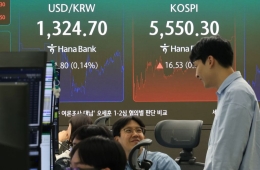
Eugene Investment & Securities said on October 24 that the won-U.S. dollar exchange rate has been setting new year-to-date lows for several consecutive days. On October 20, it fell below the 1,330-won level on a closing basis. Although the U.S. Dollar Index rose after the Federal Open Market Committee (FOMC) meeting of the U.S. Federal Reserve in September, the won appreciated 3.8% against the dollar, outperforming the currencies of other major economies.
The won's strength is the result of export companies selling dollars. Thanks to strong semiconductor exports, the current-account surplus is expected to reach $450 billion this year and $430 billion next year. These surpluses are equivalent to around 20% of gross domestic product (GDP), an unprecedented level given that the average has been 4.2% since 2010.
Given that the current-account surplus is driving the won's strength, whether that strength will persist over the long term depends on how long the semiconductor upcycle lasts. The possibility of a smaller trade surplus as China's ChangXin Memory Technologies (CXMT) expands its DRAM market share, as well as the possibility of a slowdown in domestic investment, are potential concerns. However, these factors are not enough to weaken sentiment in favor of the won in the face of visible earnings growth.
Amid recent external headwinds, foreign investors sold a net 11.2 trillion won worth of KOSPI shares last week alone. Their combined net sales of KOSPI and KOSDAQ shares over the past 30 trading days totaled around 38 trillion won. Under normal circumstances, the won-U.S. dollar exchange rate would be expected to rise above 1,400 won in such a situation. However, the won's continued strength amid foreign net selling suggests that the exchange rate could fall further if external conditions stabilize.
Hot Picks Today
 "Please Pay Me at Least 3 Million Won a Month": More Than Half of Young People Today Prioritize "Working Conditions" Over Company Size
- Selling Like Crazy Every Year... 30-Year-Old Hetbahn Takes on a New Challenge: Tastes Better Than "Mom's Home Cooking" [On-Site Report]
- "It's so popular you can't get it": 'Legendary liquor' returns after 11 years, causing a stir... 'Newtro' craze takes over convenience stores [How We Shop Today]
- "Hey, Lady, Teach Your Kids to Behave!" ... 300,000 Won in Cash and a Bodily Injury Claim Demanded Over Child's Door Ding
- Beachgoer Finds 'Plastic' That Turns Out to Be Perfume Ingredient Worth More Than Twice as Much as Gold
Cha Younghu, a researcher at Eugene Investment & Securities, said, "Considering shareholder returns in the semiconductor sector and investments related to mega-projects, the inflow of funds into Korea is likely to outweigh the pressure to send foreign currency back overseas for at least the next year." He added, "Downward pressure on the won-U.S. dollar exchange rate is dominant, and the lower end of the range could fall below 1,300 won. We maintain our forecast range for next year at 1,250 to 1,420 won."
© The Asia Business Daily. All rights reserved. Unauthorized AI training and use prohibited.