'The Community 2' Producer-Director Kwon Seongmin: "We're meeting and mixing less, and finding it harder to understand one another"
Interview with Kwon Seongmin, producer of "The Community 2"
A social experiment expands from politics to economics
Season 2: Group divisions deepen conflicts
Production team caught off guard by Gold Team's total isolation
"The war is ficti

Producer Kwon Seongmin, who directed "The Community 2: The Invisible Hand." Courtesy of Wavve.
View original image"I think we're increasingly spending less time meeting and mixing with one another. As we increasingly judge others based on only a part of who they are online, our ability to understand or tolerate other people is also weakening."
Kwon Seongmin, the producer who directed Wavve's variety show "The Community 2: The Invisible Hand," said this in an interview held in Yeouido, Seoul, on October 21. He said that watching people with different values live together in one place and groups with conflicting interests compete to survive made him realize how important dialogue is.
"The Community" is a social-experiment survival show in which contestants with different values form groups and compete for survival and prize money over eight nights and nine days. In Season 1, individuals with different political beliefs formed a single community. In Season 2, groups with different resources sought to survive through trade, negotiation and war.
"If Season 1 was about creating a shared political system to drive the economy, Season 2 is structured so that people must solve problems through negotiation and agreements alone, without a common system," Kwon said. "I thought it resembled the way economic exchanges take place in the international community."
The changing international landscape also influenced the decision to expand the show's focus from politics to the economy. Season 1 began with gender and political conflicts that had intensified online, while Season 2 focused on conflicts of interest and economic disputes between countries.
"Domestic issues can be addressed by looking for solutions within the framework of the law, but there is no common system that all countries follow in the international community," he said. "The way agreements and negotiations can be rendered ineffective when one side withdraws resembles the turmoil the international community is experiencing today."
The show translated these ideas into games using basic economic concepts such as trade based on comparative advantage, the issuance of currency and inflation, and the ultimatum game. War was also included, based on the view that many of humanity's wars have been tied to economic interests. The White Team was designed with the United States, which issues the world's reserve currency, in mind. The Blue Team was given the characteristics of a resource-rich country, while the Gold Team was modeled on a rising power seeking hegemony.

The division into groups also affected the contestants' relationships. In Season 1, people with different views saw one another every day and talked. In Season 2, boundaries between groups reduced opportunities for interaction from the outset. "I think the conflicts in Season 2 were more intense than in Season 1 because the contestants were divided into groups," Kwon said.
Kwon cited the change in Jini, a contestant from Season 1, as an example. In the Season 1 pre-show values test, Jini strongly opposed views that differed from her own. But when she took the test again during the production of Season 2, she acknowledged others' perspectives and gave much more open-minded answers. When Kwon asked why, Jini said that she had spent her life among people with backgrounds similar to hers, and that spending eight nights and nine days alongside people she would not normally have met had made a big difference. "I think we need experiences like that in real life, too," Kwon said.
In Season 2, the Gold Team became more isolated than the production team had expected. The team had built into the rules the possibility that the Gold Team could be completely excluded and that this could lead to an extreme outcome, but it did not expect the situation to actually happen. "Watching Gold remain isolated on set, I thought we were in serious trouble," Kwon admitted. Unlike with a typical board game, it was difficult to test every possible scenario in advance through simulations, given the contestants' interactions during the shared stay.
On the first day, Vector, who was in charge of running the supermarket, gave away food for free. Some members of the production team wondered whether they should stop him, but they did not intervene in order to preserve the contestants' freedom to choose. "We tried to make the dilemmas in the final game so finely calibrated that when things went off script, the outcomes also went in directions we couldn't control," Kwon said. "I learned that we shouldn't introduce too many variables."

Producer Kwon Sungmin, who directed "The Community 2: The Invisible Hand." Courtesy of Wavve.
View original imageWhile earlier mind-game survival shows focused on problem-solving skills and strategy, "The Community" placed human relationships, negotiation and groups' interests at the center. Revealing the rules one step at a time was also inspired by the incremental learning approach of video games. After learning how to trade on the first day, the contestants were introduced to new rules, such as those governing war. The idea was also to keep them focused on the situation at hand, much like in real life, where no one knows what will happen next.
One scene he particularly likes is from Episode 5, showing the contestants' movements ahead of a war. The camera captured the tension as they anticipated the conflict and began to act. "The events take place in a fictional world, but the emotions of the people in it are real. I think the variety-show format has a unique appeal: the camera lets you see that those emotions aren't acting, something that's hard to find in other content."
Kwon said he wants to continue turning the interesting ideas he finds in the social sciences into variety shows that audiences can enjoy. A third season has not been confirmed, but he said there are plenty of subjects to explore beyond politics and economics, including philosophy, religion and cultural anthropology.
Finally, he brought up the Voyager probes, launched during the Cold War.
Hot Picks Today
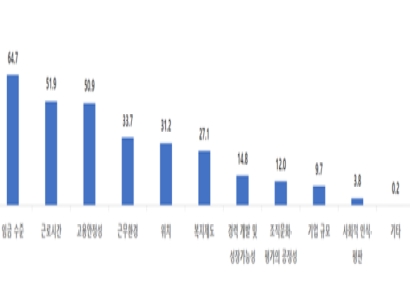 "Please Pay Me at Least 3 Million Won a Month": More Than Half of Young People Today Prioritize "Working Conditions" Over Company Size
- Selling Like Crazy Every Year... 30-Year-Old Hetbahn Takes on a New Challenge: Tastes Better Than "Mom's Home Cooking" [On-Site Report]
- Ran 18 km With 9-Year-Old Tied to Him at the Waist... "Man Banned From Competing for 3 Years"
- "Hey, Lady, Teach Your Kids to Behave!" ... 300,000 Won in Cash and a Bodily Injury Claim Demanded Over Child's Door Ding
- Beachgoer Finds 'Plastic' That Turns Out to Be Perfume Ingredient Worth More Than Twice as Much as Gold
"At the time, the United States and the Soviet Union were competing in space exploration, but I think people devoted themselves to sending messages to extraterrestrial life because they wanted to feel a sense of community on Earth. How romantic an idea it is to send a record into space containing greetings in many languages. But I worry that we're growing increasingly distant from that sense of community."
© The Asia Business Daily. All rights reserved. Unauthorized AI training and use prohibited.