"We Have the Technology, but Nowhere to Sell It"... Amid U.S.-China Rivalry, How Can South Korea Build Its Robotics Ecosystem?
Create an early market through public-sector robot procurement... Support needed for demonstrations and safety certification
Improve joint development between large companies and component makers, and make demand more predictable
Build an ecosystem that turns technology development into localization and mass production
As competition for leadership in the global robotics industry intensifies, led by the United States and China, calls are growing for government-led demonstrations, the creation of early demand, and the localization of key components to strengthen the competitiveness of South Korea's industrial ecosystem. Experts say that, because technology development alone is not enough to secure an early foothold in the market, the country needs to build an industrial foundation that takes robots from on-site deployment through validation to mass production.
At the "AI Robotics Industry Ecosystem Strategy National Assembly Forum," held at the National Assembly on October 21, participants discussed policy priorities for strengthening the competitiveness of South Korea's robotics industry and business strategies for individual companies. Reflecting strong interest in the industry, the forum was crowded with attendees. Panelists agreed that an ecosystem is needed to turn South Korean companies' technological capabilities into actual purchases and mass production.

Panelists discuss at the "AI Robot Industry Ecosystem Strategy National Assembly Forum" held at the National Assembly on the 21st. Photo by Park Junyi.
View original imageOne of the biggest challenges facing South Korean robotics component makers is turning their technological capabilities into actual sales. Ryu Jaewan, CEO of SBB, said the company had expected customers to buy its products if it improved their technology on its own, but that this was not what happened in the market.
"Even when we make a good product, customers do not use it right away," Ryu said. "It has to be ready for adoption in practice." In other words, improving product performance alone is not enough; companies need to work with prospective customers from the development stage so that those customers can actually adopt the products.
Ryu said the company had therefore changed its strategy to develop products together with customers. Rather than independently developing and selling robot components, the company tailors products to the needs of customer companies and combines its customers' quality standards and mass-production capabilities to secure the adoption of its products.

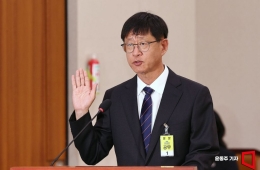
Hyundai Motor Group Executive Vice President Song Hodeuk speaks at the “AI Robot Industry Ecosystem Strategy National Assembly Forum” held at the National Assembly on the 21st. Photo by Park Juni.
View original imageHe particularly cited the cost of integration and validation required for domestic component makers to secure their first delivery record. Ryu said the integration and validation costs involved in obtaining a first reference are too high for companies to bear on their own, and called on the government to consider ways to reduce them. He argued that government programs should be expanded to promote joint development with prospective customers and reduce the time and costs involved in demonstrations.
Securing stable demand is also essential for component makers to enter the mass-production stage. If large companies share their future component needs and development schedules in advance, small and midsize companies can plan their technology development and equipment investments. The goal, he said, should be to secure product performance and reliability through joint development between large companies and component makers, and establish a structure that leads to repeat orders.
Song Hodeuk, an executive director at Hyundai Motor Group, said the United States and China were racing to build robotics industry value chains. The United States is focused on securing key technologies, including perception and decision-making algorithms and control and learning software, while China is rapidly boosting its competitiveness in commercialization, including hardware manufacturing, mass production, and on-site data collection, he said.
"A comprehensive strategy that allows the government to take a multidimensional view and serve as a control tower is clearly needed to quickly align South Korea's robotics industry ecosystem and prevent it from becoming fragmented," Song said. He argued that the ecosystem, which individual companies, universities, and research institutions would find difficult to build on their own, should be established at the national level.
He cited a lack of specialized manufacturing hubs, data-learning and training hubs, and demonstration infrastructure to create early demand as challenges for South Korea's robotics industry. He called for large-scale, government-led demonstration projects, the creation of public-sector demand, and regulatory reforms related to data collection and safety certification.
Kang Deokhyeon, CEO of RS Automation, proposed applying AI technology to robot components and the know-how of manufacturing sites. Existing robot AI models have limitations in adapting to changes in working environments, such as the position or shape of an object and lighting conditions. He argued that combining existing learning models with physical models and manufacturing experience would improve reliability and flexibility.
"We can combine and use our skills, manufacturing experience, know-how, and the functions of our components in a hybrid way, and agent learning can handle the entire process on its own," Kang said. His vision is that standardizing and connecting the functions of sensors, drives, and controllers held by component makers would make them usable across a variety of robot tasks.
Some participants also said the robotics market should expand into the service sector rather than remain limited to manufacturing. Lee Jeongho, CEO of Rainbow Robotics, said humanoid robots are not suitable for every industrial setting and emphasized the need to develop robots in a variety of forms to suit different working environments and tasks.
"To further develop the robotics market and industry, we need to put forward the idea that robots can be used extensively not only in traditional manufacturing but also in the service sector," Lee said. He said the market should expand into areas where existing robots have not been widely used, including specialized services such as healthcare and smart farming.
The safety and social acceptance of AI robots were also raised as challenges. Lee noted that greater AI autonomy can enable robots to perform complex tasks, but said social consensus is needed on accident liability and safety issues. He proposed conducting demonstrations in defined spaces, such as public institutions or campuses, to gauge public acceptance and potential resistance.
Participants emphasized that, to strengthen the competitiveness of the robotics industry, the government and industry need to work together to establish early markets and demonstration infrastructure, going beyond individual companies' technology development efforts. Establishing a structure that connects technological capabilities in key components to actual purchases and mass production has emerged as a major challenge for South Korea's robotics industry.

Participants wait for the presentations at the "AI Robot Industry Ecosystem Strategy National Assembly Forum" held at the National Assembly on the 21st. Photo by Park Juni.
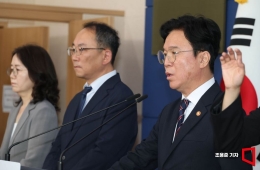
View original imageThe government also plans to create an early market by deploying robots in the public sector. Park Taehyeon, director of industrial AI policy at the Ministry of Trade, Industry and Energy, said public-sector robot adoption could help companies secure initial sales and build up data to improve performance.
"Companies expect this to create a stable early market," Park said. "By collecting and reprocessing on-site data, we can also build a data flywheel that further improves robot performance." The government plans to follow up on public-sector robot deployments by managing the robots and assessing their utilization and results.
Park Ilwoo, a program director for robotics at the Korea Evaluation Institute of Industrial Technology, outlined the progress made in building a collaborative ecosystem that connects AI, hardware, components, and companies that need the technology. He said work is underway to develop AI models specialized for humanoid robots, key components, and reliable robot platforms capable of operating for extended periods, while also conducting demonstrations at industrial sites.
Hot Picks Today
 "Why Is the Amount in My Account So Low?"... Why Pension Savings Subscribers Were Surprised
- As Kim Jong Un Death Rumors Spread... "It's Not Loading Again": North Korean State Media Sites Face Outages
- "3 Million Won for First Child, 10 Million for Third"... Taean County Raises Childbirth Incentives Fivefold
- "After Sleeping Well with Strangers"... Who Is the 24-Year-Old Woman Who Won 19 Million Won?
- "I wanted her to feel my passionate love"... Wife collapses after husband's overly tight hug, diagnosed with broken ribs
Park said the institute would support the development of domestic AI models, simulators, and key components through collaboration between companies, and expand the deployment of robots at work sites. It also plans to spread robot data factories tailored to different regions and industries, and support joint development between large companies and startups.
© The Asia Business Daily. All rights reserved. Unauthorized AI training and use prohibited.