When Authority Replaces Verification [The Second Take]
Yoo Hongjun's personal collection; calligraphy identified as work by pro-Japanese collaborator Park Jungyang
No verification or conflict-of-interest disclosure... Failures on three fronts
What remains after the resignation, as seen through "The Best Offer"
In Giuseppe Tornatore’s film "The Best Offer," Oldman (Geoffrey Rush) is the world’s most prestigious art auctioneer and appraiser. But he uses his discerning eye to serve his own greed. When he discovers an authentic work, he disparages it as a worthless fake and buys it for a pittance through an accomplice. The portraits of women he amasses this way fill a secret room. The film chillingly shows how fairness collapses when the authority of appraisal, which should be grounded in public trust, is privatized.

The story on screen played out at the nation’s largest museum. In July, the National Museum of Korea presented “Ilban Sigukeun” as calligraphy by independence activist Park Won-geun in its special exhibition “Our Table.” The work was purchased online at auction in 2019 for 50,000 won by Director Yoo Hong-jun. But cross-checks by experts determined that it was written by Park Jung-yang, a pro-Japanese collaborator. Director Yoo apologized several times for inadequate verification but did not disclose that the work belonged to his personal collection. The fact came to light only later during a parliamentary audit by the National Assembly’s Culture, Sports and Tourism Committee. On October 21, Director Yoo announced his resignation.
This incident reveals failures in all three areas of morality, scholarship, and professional ethics. The central moral failure was concealment. When an error occurs, the head of a public institution has a responsibility to transparently explain how it happened. Yet even as trust in the museum was shaken, Director Yoo put his personal reputation first, saying he had “hesitated to publicly acknowledge a major mistake as an art historian.”
The academic failure goes beyond an individual’s judgment. More troubling is that the verification system stopped working. The calligraphy was not included in the original plan for the special exhibition. It was added later at Director Yoo’s recommendation. Without verification by a calligraphy expert, it was attributed to Park Won-geun based only on Director Yoo’s account and other such evidence. The director’s certainty effectively replaced the verification process.

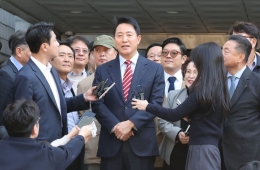
National Museum of Korea Director Yoo Hong-jun waits for the audit to begin with his eyes closed during a parliamentary audit of the National Museum of Korea and other institutions at the National Assembly on Oct. 19, 2026. Photo by Yoon Dong-ju
View original imageFrom the perspective of professional ethics, this was a textbook case of a conflict of interest. The International Council of Museums (ICOM) Code of Ethics cautions museum professionals to ensure that their personal collecting activities do not conflict with their institutions’ interests. The Association of Art Museum Directors (AAMD) likewise urges museum directors to exercise particular care to avoid conflicts of interest between their museums and their personal art collecting. When the head of a national museum puts a work from their personal collection in an exhibition, the exhibition history of a state institution adds value to a personal asset. The museum explained that the work had been purchased with the intention of donating it to the Buyeo Cultural Center. But an intention to donate does not eliminate the potential conflict of interest. No conflict was reported, and there were no documents recording the selection process.
The international art world takes such conflicts of interest seriously. In 2010, New York’s New Museum faced fierce criticism after holding an exhibition featuring works from the personal collection of board member Dakis Joannou. In 2017, Beatrix Ruf stepped down as director of the Stedelijk Museum Amsterdam amid allegations of a conflict of interest related to her personal advisory firm. A subsequent investigation cleared her, but she had already resigned. The episode shows how seriously museums abroad treat conflicts of interest. In 2022, former Louvre Museum director Jean-Luc Martinez was also placed under preliminary indictment over allegations that he turned a blind eye to forged provenance documents for Egyptian antiquities.
At the end of "The Best Offer," Oldman finds the secret room empty. As he waits in a cafe for someone who will never return, all that remains on his face is emptiness. Director Yoo’s departure from the museum is not so different. His resignation seems less like an honorable departure that fulfills his responsibility and more like a moment when he must confront the empty room left by the academic reputation he built over a lifetime and the public trust he has lost.
Hot Picks Today
 "The Transfer Failed, but 'Ding-Dong,' Money Came In"... KRW 32.5 Billion Financial Incident at Toss Bank
- Tearful Oh Sehoon Acquitted on Appeal: "Thanks to Those Who Believed in My Innocence" (Update)
- "Made 12 Billion Won Cleaning Up Other People's Dog Poop With Just a Rake"... 'Poop Scoop Millionaire' Is All the Rage in the U.S.
- After 10 Needle Sticks While Searching for a Vein, U.S. Death Row Inmate Survives Execution
- 'Hangover Legend' Returns After 11 Years... Lee Sunmin Hyung's 'Captain Q' Sells Out

This incident should not be read merely as the downfall of an elderly scholar. The resignation does not resolve the problem; it marks the start of a new challenge. No checks were in place at the museum as a work absent from the exhibition plan made its way onto the gallery floor on the strength of a single recommendation. An organization in which mutual verification has broken down is likely to repeat the same failures. Even Oldman, the world’s greatest appraiser, ultimately failed to recognize the fake that had deceived him. The moment one person’s judgment and authority take the place of verification, no one is left to correct the error.
© The Asia Business Daily. All rights reserved. Unauthorized AI training and use prohibited.