[2026 Parliamentary Audit] Next-Generation Launch Vehicle Needs Another 91.2 Billion Won to Complete Reusability
Core technologies to be validated by 2032... Actual recovery and relaunch to be addressed in a follow-up project
Additional development under consideration for 2033-2035... Project planning and funding schedule yet to be determined
The government will need an additional budget of about 91.2 billion won after the current project ends in 2032 to complete the reusable technology for the next-generation launch vehicle, which is being developed with an investment of about 2.3 trillion won. The current project aims to validate core reusable technologies, so separate follow-up development will be needed to enable the vehicle to be recovered, refurbished and launched again.

The Nuri rocket is launched from the Naro Space Center in Goheung County, Jeonnam-Gwangju, on the 7th. Courtesy of the Korea Aerospace Research Institute.
View original imageAccording to materials submitted by the Korea Aerospace Administration (KASA) to Assemblyman Han Junho of the Democratic Party of Korea, a member of the National Assembly’s Science, ICT, Broadcasting and Communications Committee, the government revised its development plan for the next-generation launch vehicle last year, changing it from an expendable design to a reusable one. The propellant was also changed from liquid oxygen and kerosene to liquid oxygen and methane.
As a result, the total project cost increased by 278.9 billion won, from 2.0132 trillion won to 2.2921 trillion won. The project period remains unchanged, ending in 2032.
The issue is that completion of the current project will not mean that the technology for actually operating reusable launch vehicles has been secured. By 2032, KASA plans to achieve Technology Readiness Level (TRL) 6 for core technologies, including engine thrust control, precision guidance and control, and landing accuracy, through tests such as “hop tests,” which involve vertical takeoff and landing.

Proposed flight profile for the reusable technology demonstrator. Courtesy of the Korea Aerospace Research Institute (KARI)
View original imageTRL 6 is the stage at which the performance of core technologies is validated in an environment similar to actual operating conditions. It does not mean that the technology has been developed to launch a commercial satellite, bring back and recover the first-stage rocket, refurbish it and launch it again.
KASA is considering a separate follow-up development project from 2033 to 2035. The goal is to reach TRL 8, a level closer to actual operation, by developing technologies for reentry control, first-stage recovery, refurbishment and relaunch.
The additional budget required is estimated at about 91.2 billion won. The estimate includes about 41.2 billion won for technology development related to first-stage rocket recovery and maintenance, and about 50 billion won to develop a drone ship, a platform for sea landings. However, the actual project cost may vary depending on the landing method and scope of development.

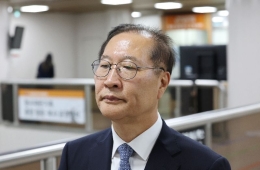
Rep. Han Junho of the Democratic Party of Korea asks a question. Photo provided by Rep. Han Junho's office.
View original imageThe follow-up project has not yet been finalized. In materials submitted to Assemblyman Han’s office on September 10, KASA said that follow-up development should be pursued as a separate project, but did not specify when project planning would be completed or when funding would be secured. Preliminary research into sea-landing and recovery technologies is underway.
This has prompted calls to prepare the follow-up project in advance to ensure that reusable technology development does not stall after the current project ends in 2032.
Hot Picks Today
 "Why Is the Amount in My Account So Low?"... Why Pension Savings Subscribers Were Surprised
- As Kim Jong Un Death Rumors Spread... "It's Not Loading Again": North Korean State Media Sites Face Outages
- [Breaking] Shark 'Bukangi' exits channel... operation to guide it ends
- "After Sleeping Well with Strangers"... Who Is the 24-Year-Old Woman Who Won 19 Million Won?
- "I wanted her to feel my passionate love"... Wife collapses after husband's overly tight hug, diagnosed with broken ribs
“Switching the next-generation launch vehicle to a reusable design was an important decision to strengthen our independent space transportation capabilities and secure competitiveness in the future launch services market,” Assemblyman Han said. “However, we must proactively prepare plans for the follow-up project and the budget approval process before the current project ends to ensure continuity in technology development.”
© The Asia Business Daily. All rights reserved. Unauthorized AI training and use prohibited.