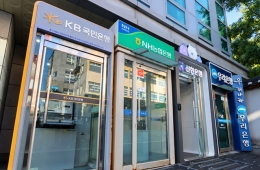
Five Major Commercial Banks Cut 4,000 Regular Employees as Non-Regular Workforce Grows by 1,000
Rep. Park Seonghun: "The impact of changes in employment structure on services should be assessed"
The number of regular employees at the five major commercial banks (KB Kookmin, Shinhan, Hana, Woori and NH NongHyup) fell by more than 4,000 over the past four years and seven months, while the number of non-regular employees rose by more than 1,000.
According to staffing data for the five banks submitted to the Financial Supervisory Service and obtained by Park Seonghun, a People Power Party lawmaker on the National Assembly’s Political Affairs Committee, the banks’ total workforce decreased by 3,032 from the end of 2022 through the end of July 2026. The number of regular employees fell by a total of 4,080, while the number of non-regular employees rose by 1,048 over the same period.
By bank, KB Kookmin Bank’s total workforce fell by 1,946, from 17,126 at the end of 2022 to 15,180 at the end of July 2026. Over the same period, its regular workforce declined by 2,376, from 14,990 to 12,614, while its non-regular workforce grew by 430, from 2,136 to 2,566.
At Woori Bank, the number of regular employees fell by 519, from 12,855 to 12,336, while the number of non-regular employees rose by 504, from 690 to 1,194.
At Hana Bank, the total workforce grew by 272 as the number of regular employees fell by 389 and the number of non-regular employees rose by 661. At NH NongHyup Bank, the number of regular employees remained unchanged, while the number of non-regular employees fell by 126. At Shinhan Bank, the numbers of regular and non-regular employees fell by 796 and 421, respectively.
The decline in regular employees in the banking sector may reflect a combination of factors, including efforts to improve workforce efficiency amid the expansion of artificial intelligence (AI), digital transformation and non-face-to-face financial services, as well as workforce restructuring through voluntary and honorary retirements.

Some analysts say, however, that the decline in regular employees cannot be immediately interpreted as job insecurity or their replacement by non-regular employees, given that banks have offered voluntary retirement packages that include one-time payments such as special retirement benefits.
However, with the number of regular employees falling by more than 4,000 while the number of non-regular employees rose by more than 1,000, Park said it is important to closely examine whether the workforce restructuring in the banking sector reflects simple attrition, structural changes driven by AI adoption and work automation, or a redistribution of duties among different employment types.
Hot Picks Today
 "Why Is the Amount in My Account So Low?"... Why Pension Savings Subscribers Were Surprised
- [Exclusive] Personal Data of 67,000 Leaked at Woongjin Compass, a Woongjin Thinkbig Affiliate
- "Hey, If You're Throwing That Away, Give It to Me"... China Grapples With Rise of 'Trash Hunters'
- "Even Lee Jae-yong may not be this big a fan"... Stunned to See Galaxy Phones in a Taxi
- "I wanted her to feel my passionate love"... Wife collapses after husband's overly tight hug, diagnosed with broken ribs
Park said, "As banks accelerate digital innovation and management efficiency, their employment structures have changed, with a significant decline in regular employees and a rising share of non-regular employees." He added, "Financial authorities should closely assess the impact of these changes on job security, internal controls and financial consumer services."
© The Asia Business Daily. All rights reserved. Unauthorized AI training and use prohibited.