Park Wonseok: "If Cho Heedae Is Impeached, the President Won't Be Able to Govern"
Lee Tae-kyu: "If he pushes too far, the Kim Min-seok leadership could be toppled"
Park Won-seok: "Kim Min-seok will likely consider it and then drop it"
Kim Min-seok, leader of the Democratic Party of Korea, has made discussions on impeaching Chief Justice Cho Hee-dae official. On Oct. 16, he appeared on the Democratic Party's YouTube program "Minty 07" and said, "There are already widespread calls for (the impeachment of Chief Justice Cho Hee-dae), so you can understand that we have begun discussing all possible methods and avenues." Some Democratic Party members, including Supreme Council members Lee Seong-yoon and Han Min-soo and lawmakers Jeong Cheong-rae, Park Kyun-taek and Kim Ki-pyo, support the idea, while others are concerned about the backlash. The People Power Party has strongly opposed it, saying, "They should be prepared for a second Bu-Ma Democratic Protests" (Rep. Joo Ho-young). The Rebuilding Korea Party has strongly called for "Cho Hee-dae's impeachment." We asked former Justice Party lawmaker Park Won-seok and former People Power Party lawmaker Lee Tae-kyu, both of whom work as political commentators, how they view the issue. The two appeared on The Asia Business Daily's YouTube channel "So Jong-seop's Current Affairs Show" on Oct. 19 for a discussion.
So Jong-seop: As the parliamentary audit passes the halfway point, Democratic Party leader Kim Min-seok has made discussions on impeaching Chief Justice Cho Hee-dae official.

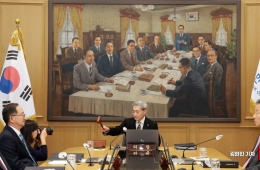
Kim Minseok, leader of the Democratic Party of Korea, delivers opening remarks at a Supreme Council meeting at the National Assembly on the 19th. Photo by Yoon Dongju.
View original imagePark Won-seok: During the recent parliamentary audit, Chief Justice Cho Hee-dae made remarks to the president or the National Assembly to the effect that there had been unconstitutional interference with the chief justice's authority to recommend candidates, didn't he? In a way, I think that touched a nerve among members of the ruling camp, who already had unfavorable feelings toward Chief Justice Cho Hee-dae. As a result, calls for impeachment are gaining momentum, and hardliners in the camp, including those in the Rebuilding Korea Party, are pressing strongly for it. I think the leadership may be responding to those calls to some extent. There seems to be a view that the prolonged vacancies on the Supreme Court were caused by the chief justice, who is responsible for judicial administration, neglecting his constitutional duties, and that this in itself constitutes a serious violation of the Constitution. I don't think bringing out the impeachment card against Cho Hee-dae now would serve any practical purpose, and I think the political backlash would be enormous. There is also considerable caution within the Democratic Party, so I suspect the idea will be considered and then dropped.
The reason is this: if the case goes to the Constitutional Court, is there a chance it would uphold the impeachment on the grounds of a serious violation of the Constitution or laws? That possibility looks very slim. A serious violation of the Constitution or laws requires an extremely high threshold. The impeachment and suspension of the chief justice alone would create a huge gap in the constitutional system, and all final appeals would then be suspended. The procedures for recommending and appointing Supreme Court justices would also be halted. Chief Justice Cho is due to step down in June 2027, but there is no guarantee that a ruling would be reached by then. The ruling party would also not be free from criticism that it had itself created a vacuum in the constitutional order. I understand that the leadership may be making a gesture to rally its support base and mend divisions within the camp because the party's hardliners are making such forceful demands. But it must not actually carry this out. That would worsen the dysfunction in state affairs, and how would the president govern? I don't think the president's approval rating will recover, or that the administration will regain any control over the political agenda.
Lee Tae-kyu: Impeachment is possible when there is a serious violation of the Constitution or laws, isn't it? It is difficult to identify such a violation. The Democratic Party has a majority, so it can initiate impeachment proceedings in the National Assembly. But if the Constitutional Court reviews the case indefinitely, Chief Justice Cho Hee-dae could complete his term in the meantime. Any disruption to the constitutional order or political conflict that arises in the process could end up being blamed entirely on President Lee Jae-myung and the Democratic Party if they mishandle it. If the Democratic Party is going to raise the possibility of impeaching the chief justice or take similar steps, it needs to be extremely cautious and have a firm plan or strategy. It seems to be raising the idea too impulsively.

Chief Justice Cho Hee-dae answers lawmakers' questions during a parliamentary audit of the Supreme Court at the National Assembly on the 6th. Photo by Yoon Dongju
View original imageSo Jong-seop: Kim Min-seok said he would work in step with the president. How should we view his push to impeach the chief justice? If he raises the idea and then drops it, won't it make him look ridiculous?
Park Won-seok: Has the Democratic Party changed much under Kim Min-seok compared with when Jeong Cheong-rae was its leader? It is true that Kim took a relatively moderate stance on prosecution reform. He also said there might be a need for supplementary investigative authority, but in the end, it was abolished. When hardliners within the party raised their voices in opposition to Kim Ji-yong as head of the Serious Crimes Investigation Agency, the party failed to rein them in. In fact, when the president's power to appoint officials is challenged to that extent, the party should step in and resolve the matter. But all it did was say that people should not cross the line, and nothing has really changed. Kim Min-seok has also given the impression that he is wary of the party's hardline supporters. And when it comes to Chief Justice Cho Hee-dae, starting with Cho Hee-dae himself, there is little difference from the time when Jeong Cheong-rae was party leader.
The only change has been the Democratic Party's increased activity on its television channel. Apart from that, there has been little of note. Bringing out the impeachment card again now seems to show a lack of leadership. This is not the time to do that; the party should be putting forward a new agenda. Without a new agenda, returning to a familiar hardline position and merely toying with the impeachment card may satisfy hardline supporters to some extent, but then what is the difference from former leader Jeong?
Hot Picks Today
 Despite "Insufficient Balance" Notices, They Board Anyway... Reports of Foreign Fare Evasion Mounting
- A "Rich Family's Daughter" Is "Effortlessly Polished" Today, "Glamorous" Tomorrow... Department Store-Core Has 20- and 30-Somethings Going Wild [Why&Next]
- "Even Underwear Has to Be Cut Up with Scissors"... China Hit by Rise of "Trash Hunters" in an "If You're Slow, You're Out" Scramble
- "Chinese Tourists Won't Go Anymore"... Arrivals Halved, but Koreans Say "Now's Our Chance" and Open Their Wallets in Japan
- "Photos of Kim Jong Un Released by North Korea Are a Deception"... Debate Over Death Rumors Continues
And they won't be able to impeach him. In the end, they will just toy with the idea and drop it. If they want to address the issue of the chief justice head-on, they should abolish the National Court Administration, not pursue impeachment. I don't understand why they won't do that and are instead choosing an irrelevant, highly emotional and one-dimensional response like impeachment. If they impeach Chief Justice Cho, the president won't be able to govern. He will be dragged into the controversy, and people will end up asking whether this is what the president wants. Can they handle that?

Kim Min-seok, leader of the Democratic Party of Korea, talks with lawmaker Jung Cheong-rae during a plenary session at the National Assembly on Aug. 26. Photo by Kim Hyun-min
View original imageLee Tae-kyu: If things get worse, the Kim Min-seok leadership could be toppled. If public opinion on the administration or the ruling party deteriorates sharply, there will be by-elections next year, and calls could arise ahead of them saying the Kim Min-seok leadership cannot continue and should step down. He is taking a very risky step. At the last party convention, one of the points Kim Min-seok emphasized was unity between the party and the government. That does not mean blindly following and obeying the president. True party-government unity means supporting the president when he is in difficulty. But how much has the ruling party actually done to ease the president's political burden on personnel matters, various policy issues, or political issues such as the Chief Justice Cho Hee-dae matter? The ruling party is failing to fulfill its role.
© The Asia Business Daily. All rights reserved. Unauthorized AI training and use prohibited.