Potential Growth Rebound: President Lee Calls It “A Dramatic Turnaround in Economic Fundamentals, the First in 40 Years”
IMF analysis: Potential growth rate to rise from 1.94% last year to 2.14% this year and 2.20% next year
"Sharing the fruits of growth with everyone"
Accelerating three mega-projects and key livelihood policies
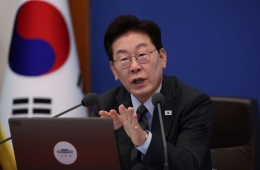
President Lee Jae-myung described the International Monetary Fund’s (IMF) forecast that South Korea’s potential growth rate will rebound for a second consecutive year for the first time in about 40 years as “a dramatic turnaround in the fundamentals of the Korean economy.” He emphasized that the Korean economy’s growth potential is recovering despite structural constraints on growth, including low birth rates and an aging population. President Lee said he would accelerate efforts to foster advanced industries such as semiconductors and artificial intelligence (AI), while also ensuring that the benefits of growth reach people in their daily lives through housing supply, job security and inclusive finance.

On October 20, President Lee posted a message on his X account (formerly Twitter) titled “A Dramatic Turnaround in the Fundamentals of the Korean Economy, for the First Time in More Than 40 Years,” calling it “welcome news.”
“According to major media outlets, the IMF forecast that South Korea’s potential growth rate will rebound for a second consecutive year, this year and next,” President Lee said. “A rise in the potential growth rate for two consecutive years has not happened in about 40 years, since the ‘three lows boom’ of 1986–87, when oil prices, interest rates and the U.S. dollar were all low.”
He added, “The potential growth rate is the maximum rate of growth a country can achieve without fueling inflation by using its available resources, such as labor, capital and productivity, to the fullest. Put simply, it is an indicator of a country’s economic fundamentals.” He emphasized, “The rebound in the potential growth rate is a very positive sign that the fundamentals of the Korean economy are coming back to life.”
Based on real gross domestic product (GDP) growth rates and the GDP gap ratio in the October World Economic Outlook (WEO), released by the IMF on October 13, South Korea’s potential growth rate is estimated to rise from 1.94% last year to 2.14% this year and 2.20% next year. After falling from 1.96% in 2024 to 1.94% last year, the potential growth rate is set to rebound by 0.20 percentage points this year and rise by a further 0.06 percentage points next year.
This is the first time the potential growth rate has risen for two consecutive years since 1986–87. At the time, South Korea’s potential growth rate climbed from 9.67% in 1985 to 9.77% in 1986 and 9.91% in 1987. Although there have been temporary rebounds since then, including through the global financial crisis and the COVID-19 pandemic, the rate has not risen for two consecutive years.
The IMF also forecast South Korea’s real economic growth at 3.33% this year and 2.83% next year. It projected that GDP per capita would reach $43,512 this year, surpassing $40,000 for the first time. Strong semiconductor exports and increased investment in AI-related facilities were cited as major factors driving up the growth outlook.
President Lee emphasized that it is important not only to boost the economy’s growth potential but also to distribute the fruits of growth fairly among the public. “It is time to build on our improved economic fundamentals to give our economy greater vitality and keep it growing, while ensuring that the benefits of growth are shared fairly with everyone,” he said.
He outlined specific policy directions: the “Three Mega-Projects,” the “Seven SEED Projects” and “Three Key Social Policies.” The Three Mega-Projects are a national growth strategy involving large-scale investment focused on semiconductors, physical AI and AI data centers. The Seven SEED Projects aim to secure a foundation for growth in future industries, including nuclear fusion, small modular reactors (SMRs), renewable energy, quantum technology, space and aviation, advanced biotechnology, and advanced supply chains.
“Alongside the successful implementation of the Three Mega-Projects and Seven SEED Projects to make South Korea a global leader in industries with an overwhelming technological edge, the government will focus its efforts on ensuring that people feel the benefits of growth through the Three Key Social Policies: housing supply, job security and inclusive finance,” President Lee said. “We will do our utmost to improve people’s lives,” he added.
Hot Picks Today
 [Exclusive] "My paycheck fell short, and I couldn't get a card loan either" More people in their 40s and 50s turn to 'cash advances'; "debt-investing woes" put long-term delinquency among those in their 20s and 30s on red alert
- Surpassed Even Perennial No. 1 Adani and Lee Jae-yong... 'This Man' Becomes Asia's Richest as His Fortune Soars Eightfold
- [Solving AI Power Shortages with DC] ③ How Data Centers Are Changing the Path of Power... Why "DC Power Distribution"?
- “I Thought It Was Just Inflammation”: 70 Men Have Died of Breast Cancer in This Country in 5 Years
- "Korean Beef for Dinner Tonight" - Drawn in by Half-Price Deals, but... "What Else Is There to Buy?" at 'Empty' Homeplus
The message is also in line with President Lee’s remarks on October 15, ahead of the 500th day of his presidency, when he identified housing, jobs and finance as the top priorities of his administration. At the time, he said that despite improvements in key economic indicators, the recovery in people’s livelihoods was progressing slowly, and called for expanded housing supply tailored to each stage of life, a national employment project, increased policy financing and customized debt restructuring.
© The Asia Business Daily. All rights reserved. Unauthorized AI training and use prohibited.