President Lee to Tackle Regulations on Semiconductors, AI and Robotics at Oct. 23 Pan-Government Meeting
Removing Regulatory Barriers for Advanced Industries and Regional Growth Engines
More Than 100 Attendees, Including Businesses and Experts
Supporting the "5 Mega-Regions and 3 Special Self-Governing Provinces" Growth Strategy
Also Dis
President Lee Jaemyung is launching a government-wide effort to overhaul regulations, aiming to lower regulatory barriers in advanced industries such as semiconductors, artificial intelligence (AI) and robotics, and promote balanced regional growth. The plan is to develop the regulatory reform direction presented at the first meeting of the Regulatory Rationalization Committee in April into concrete, industry-specific implementation measures. Attention is focused on whether removing regulations that impede investment in advanced industries, the development of regional growth hubs and startup activity can create a breakthrough for economic growth.

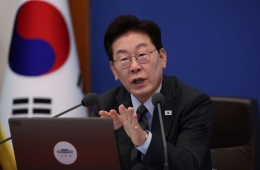
President Lee Jaemyung speaks with reporters in the lobby of Chunchugwan, the press center for journalists at Cheongwadae, on Oct. 19, 2026. Yonhap News
View original imageThe Blue House said on Oct. 20 that President Lee will chair the second plenary meeting of the Regulatory Rationalization Committee at the Blue House on Oct. 23. Held under the slogan “Give growth wings, revitalize livelihoods, and create a future for regions,” the meeting will focus on regulatory rationalization measures to foster advanced industries with a significant technological edge, promote region-led growth and usher in a new era of startups nationwide.
The meeting comes about six months after the first plenary meeting on April 15. At the time, the government overhauled its regulatory reform framework for the first time in 28 years, elevating the committee chair from the prime minister to the president and expanding private-sector participation. The aim was to link regulatory reform with the national growth strategy, rather than limit it to resolving complaints at individual ministries.
At the first meeting, the government proposed introducing mega-special zones to support its “Five Mega-Regions and Three Special Provinces” strategy for balanced national growth. The plan is to concentrate regulatory exemptions and policy support, including financial, fiscal and tax measures, in key industrial hubs at the metropolitan and supra-metropolitan levels to develop regional economies and strategic national industries at the same time. The upcoming meeting is expected to discuss specific regulatory improvements to put this vision into practice in key industries.
Semiconductors, robotics and AI data centers... Focus on removing regulations hampering industry
The first agenda item is “Regulatory rationalization to foster advanced industries with a significant technological edge and promote region-led growth.” The Office for Government Policy Coordination will present “Regulatory rationalization measures to support mega-projects and growth engines in the Five Mega-Regions and Three Special Provinces,” while relevant ministries will announce plans to address regulatory hurdles in their respective industries.
The five key sectors are robotics, semiconductors, AI data centers, autonomous vehicles and biotechnology. The Office for Government Policy Coordination and the Ministry of Trade, Industry and Energy, the Ministry of Science and ICT, the Ministry of Land, Infrastructure and Transport, the Ministry of Health and Welfare, and the Ministry of Food and Drug Safety will present regulatory improvement tasks for each sector.
These industries are central to the government’s strategy to foster advanced industries and establish regional growth engines. In August, the government also announced plans to develop growth engines in each region in connection with three mega-projects. Regulatory improvements by industry are expected to be a key topic at the upcoming meeting, with discussions focused on supporting large-scale investment and regional industry development.
A key question is how to address the problem of existing regulatory frameworks failing to keep pace with rapid technological advances and obstructing the testing and commercialization of new industries. In April, the government outlined the basic direction for regulatory rationalization: proactively overhauling regulations on new industries, redesigning regulations to align with global standards, and improving the regulatory sandbox system.
The second agenda item is “Regulatory rationalization to usher in a new era of startups nationwide.” The Ministry of SMEs and Startups will present measures to rationalize regulations affecting startups, while the Office for Government Policy Coordination, the Ministry of Land, Infrastructure and Transport, and the Ministry of Climate, Energy and Environment will introduce plans and key examples for redesigning administrative paperwork required of startups.
The focus is expected to be on reducing unnecessary administrative procedures and document-submission requirements that burden companies from the earliest stages of starting up. In April, when the government announced its plan to reform the regulatory framework, it set a target of cutting by more than 50% the unnecessary administrative documents required of early-stage companies.
About 100 people from the private sector, the government and the Blue House will attend the meeting, up from about 60 at the first meeting in April. In addition to three vice chairs and 25 private-sector committee members, about 40 businesspeople and experts from relevant fields have been invited separately. The aim is to give companies affected by regulations an opportunity to explain the challenges they face on the ground and discuss solutions with the relevant ministries.
Seventeen government officials will attend, including the prime minister, vice ministers and ministers from relevant ministries such as the Ministry of Finance and Economy, the Ministry of Trade, Industry and Energy, the Ministry of Land, Infrastructure and Transport, and the Ministry of SMEs and Startups, as well as the head of the Office for Government Policy Coordination, the chair of the Financial Services Commission and the chair of the Korea Fair Trade Commission. Blue House attendees will include Chief of Staff Lim Kwang-hyun, Policy Chief Ha Jun-kyung, the Senior Secretary for Economic Growth and the Senior Secretary for AI and Future Planning.
Hot Picks Today
 "Korean Beef for Dinner Tonight" - Drawn in by Half-Price Deals, but... "What Else Is There to Buy?" at 'Empty' Homeplus
- [Exclusive] "My paycheck fell short, and I couldn't get a card loan either" More people in their 40s and 50s turn to 'cash advances'; "debt-investing woes" put long-term delinquency among those in their 20s and 30s on red alert
- “I Thought It Was Just Inflammation”: 70 Men Have Died of Breast Cancer in This Country in 5 Years
- "Three Free Meals, Botox with a 1.69 Million Won Allowance"... Benefits Race Heats Up in Japan Amid Talent Shortage
- "Come Live With Me on My Farm": Man Sells Everything and Travels 1,930 km, Trusting a Beautiful Woman
The meeting will begin with opening remarks by President Lee, followed by presentations on agenda items by relevant ministries, suggestions from businesses and experts based on their experience on the ground, and an open discussion. The proceedings will be broadcast live on KTV.
© The Asia Business Daily. All rights reserved. Unauthorized AI training and use prohibited.