[2026 Parliamentary Audit] "KOK Coin fraud ring behind KRW 2.5 trillion scam openly working at blockchain firm," lawmakers say... Lee Chanjin: "I'll check" (Updated)
2026 FSS Parliamentary Audit by the National Assembly's Political Affairs Committee
KOK Coin Fraud Group Faces Allegations of Revolving-Door Ties
FSS Admits Limits in Its Capacity to Respond to Virtual Asset Fraud
A group behind the KOK Coin pyramid scheme, which caused losses totaling KRW 2.5 trillion to 570,000 people, has stirred controversy by openly working at a blockchain company. Financial Supervisory Service Governor Lee Chanjin said he would "look into it" in an effort to quell the backlash. It has also emerged that a law firm adviser who previously worked at the FSS tried to arrange a memorandum of understanding (MOU) between the company and financial institutions, fueling allegations of revolving-door ties.

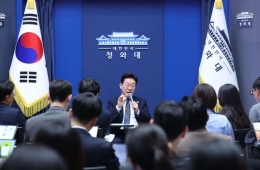
Financial Supervisory Service Governor Lee Chanjin answers lawmakers' questions during a parliamentary audit of the Financial Supervisory Service and other agencies at the National Assembly on the 19th. 2026.10.19 Photo by Yoon Dongju.
View original imageMin Byung-deok of the Democratic Party of Korea said at the FSS parliamentary audit held by the National Assembly's Political Affairs Committee on the 19th, "I heard that people involved in the KOK Coin case had been hired by a blockchain company. When I checked, it turned out to be a company called Bitoz." He added, "The victims have received no compensation, and there has not yet been a court ruling, but those involved have openly taken jobs there and are signing MOUs with financial institutions."
Min said, "Bitoz is promoting that it has even completed proof-of-technology work with Hana Financial TI, iM Bank, Hecto Innovation, Danal, Eugene Investment & Securities, and Jeonbuk Bank." He added, "I wonder whether Hana Bank President Lee Ho-sung checked what kind of executive the other party had when Hana Financial TI entered into an agreement with Bitoz."
The KOK Coin case was a pyramid scheme involving cryptocurrency that caused losses of KRW 2.5759 trillion to 570,000 people in South Korea and abroad. The group is suspected of issuing KOK Coin from 2019, attracting investors through deposit rewards and a pyramid scheme, then shutting down the service and absconding with the investment funds. Those responsible for managing the funds are reportedly on the run overseas. After calls were made that day to verify the links between Bitoz and financial institutions, Lee replied, "I will check and get back to you."
Allegations of revolving-door ties involving members of the KOK Coin fraud group who work at Bitoz also came under scrutiny. Lee Kang-il of the Democratic Party of Korea said, "According to several company officials who have experience with MOUs with Bitoz, when they asked, 'How can we join Hana Bank's stablecoin consortium?' they were told that the Hana Bank president had suggested they meet with a particular law firm adviser." He added, "They said that whenever they went to see the adviser, the adviser recommended an MOU with Bitoz. The adviser is with Kim & Chang and previously worked at the FSS."

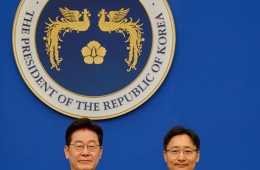
Lee Chanjin, governor of the Financial Supervisory Service, hands his statement to Yoo Dongsoo, chair of the National Assembly’s Political Affairs Committee, after taking the witness oath during a parliamentary audit of the Financial Supervisory Service and other agencies at the National Assembly on Oct. 19, 2026. Photo by Yoon Dongju
View original imageLee replied, "I have received a brief report regarding Bitoz." Hana Bank President Lee Ho-sung explained, "I don't know the details. Bitoz is a company I am not familiar with."
During the audit, lawmakers also raised concerns about the FSS's capacity to respond to cryptocurrency fraud. When Min asked, "Recently, KRW 2.8 billion was transferred in half a day through a fake chain impersonating Giwa Chain, developed by Dunamu. Speed is critical in financial fraud involving virtual assets. How capable is the FSS of responding?" Lee acknowledged the limitations, saying, "At present, it is difficult for us to keep up with that speed."
There were also calls to unify oversight of virtual assets. Asked by Lee whether the second-stage legislation, the Digital Asset Basic Act, reflected a unified approach to virtual asset supervision, which is currently divided among the Financial Services Commission, the FSS, the Financial Intelligence Unit (FIU), and the Bank of Korea, Lee replied, "It is reflected in the government's proposal, although it has not yet been announced."
Hot Picks Today
 "Tried leveraged semiconductor stocks, watched 3.5 billion won shrink to 200 million won": Salaried investor in tears
- "Please Let Me Go Home"... Customers Trapped in Department Store Parking Lot for 5 Hours Vent Their Anger
- "I Should Enjoy It After Retirement": Prices Quadruple... Memberships Over 100 Million Won Popular, but Closures Mount
- “The Strong Drink This” Goes Viral on Social Media... What China's Millennials and Gen Z Are Hooked on After Ditching Coffee and Milk Tea
- "Come Live With Me on My Farm": Man Sells Everything and Travels 1,930 km, Trusting a Beautiful Woman
Lee also asked the FSS to "work with the FIU to promptly use, within the bounds of the law, information on suspicious wallets identified by investigative agencies, and to review advance risk assessments and post-partnership monitoring between financial companies and digital asset businesses." Lee replied, "We are strengthening our coordination with the FIU compared with before. We are also discussing the establishment of a related system, and preparations are nearly complete. I will provide an update once everything has been finalized."
© The Asia Business Daily. All rights reserved. Unauthorized AI training and use prohibited.