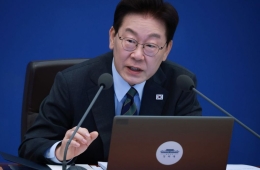
President Lee: "Persuade Farmers and Fishers First on CPTPP... Will Meet Farmers' Groups Soon"
President Lee holds surprise tea time with reporters
Reaffirms decision to defer CPTPP application this year
Pledges to fulfill 1 trillion won fund commitment
Stresses compensation for losses from market opening
U.S.-South Kore
On Oct. 19, President Lee Jae Myung maintained the existing policy of deferring an application to join the Comprehensive and Progressive Agreement for Trans-Pacific Partnership (CPTPP) until next year, while identifying the restoration of trust with the agriculture, livestock and fisheries sectors and the development of compensation measures for potential losses as prerequisites.

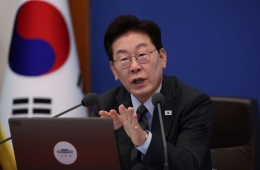
President Lee Jae Myung speaks with reporters in the lobby of Chunchugwan, the press center for journalists at Cheong Wa Dae, on the 19th. October 19, 2026. Yonhap News Agency.
View original imageAt a tea meeting with reporters held at Chunchugwan in Cheong Wa Dae to mark his 500th day in office, Lee said of efforts to join the CPTPP, "We must continue to expand Korea's economic territory," adding, "Opening up markets and expanding our economic territory is a national task that we must not and cannot avoid."
However, he made clear that addressing the harm to the agriculture, livestock and fisheries sectors and their distrust of the government must come first. "Joining the CPTPP is not something that happens as soon as we apply," Lee said. "We need the approval of every member country, and there are complex interests involved, including the issue of Japanese seafood imports, so it cannot be done in a short time."
"There is no need to rush, but we do need to do it," he said. "We must talk and communicate sufficiently, and develop measures that they can accept."
On Oct. 8, Lee instructed the government not to apply to join the CPTPP this year. The government had been considering an application ahead of the CPTPP ministerial meeting in November, but put the timeline on hold after deciding that building consensus with farmers and fishers should come first.
"I will meet with representatives of farmers' groups in a few days," Lee said. "I will hear what they have to say, present alternatives the government can accept, clarify the issues and then develop sufficient measures that can be implemented."
In particular, he noted that promises to compensate farmers and fishers during past free trade agreement (FTA) negotiations had not been properly honored. "We can take some of the gains from sectors that benefit and use them to compensate those that incur losses," Lee said, pledging to fulfill the promise to establish a 1 trillion won fund for cooperation between urban and rural communities.
The government plans to make up the approximately 700 billion won still missing from the 1 trillion won fund promised when the Korea-China FTA was ratified in 2015 using government funds. The government's economic impact analysis estimates that joining the CPTPP would increase manufacturing output by up to 6.7 trillion won a year on average, while reducing output in agriculture, forestry and fisheries by approximately 850 billion won. How to balance the benefits of expanded trade against the impact on individual sectors is expected to be a key issue in future efforts to join.
On US-Korea intelligence agency tensions: "Minor differences...must be managed in the national interest"

President Lee Jaemyung speaks with reporters in the lobby of Chunchugwan, the press corps' workspace at Cheong Wa Dae, on Oct. 19, 2026. Yonhap News Agency
On discord between South Korean and U.S. intelligence agencies, Lee said that differences of opinion should not in themselves be treated as a problem. "I don't think we can say there are absolutely no problems between the National Intelligence Service and U.S. intelligence agencies," he said. "I see them as minor differences that arise as each side works to protect its own national interests." He added, "They are manageable, and we must be able to manage them."
"The only way to eliminate differences is to do everything the other side asks," he said, also expressing displeasure with political disputes at home over diplomatic and security issues.
Recent incidents have included delays in issuing a U.S. visa to an NIS employee and controversy over the NIS being excluded from a meeting on responding to North Korean cyber threats involving South Korea, the United States and Japan. The NIS, however, says some of the issues have been resolved and that intelligence cooperation between South Korea and the United States is proceeding normally. "South Korea is not the same country it was yesterday," Lee said, stressing that "its standing in industry, the economy, culture, diplomacy and security must also change."
Hot Picks Today
 "Once Worth 4 Million Won a Day, Now Going for Chicken Money"... Chinese Robots' Humiliating Fall to 'Bargain-Bin' Prices in Just One Year
- "I Won't Take It Even If You Leave It to Me"... 9 Million Parents' Homes Sit Empty as 320,000 Japanese Renounce Inheritances
- One Facial Photo, and You're Told '90 Days to Live'... A Modern-Day Grim Reaper?
- Defense Minister Kang Shinchul Meets Chinese Ambassador: "Rising Tensions on Korean Peninsula Are Not in China's Interests Either"
- Serial Arson at Two Buildings in Yeoksam-dong; Police Arrest Suspect (3rd Update)
On relations with Russia in connection with opening Arctic shipping routes, Lee said there were issues to resolve, as Russian cooperation would be necessary in an emergency. Asked about the possibility of a North Korea-U.S. summit, he declined to elaborate, saying, "I have no special information."
© The Asia Business Daily. All rights reserved. Unauthorized AI training and use prohibited.